<?xml version="1.0" encoding="UTF-8"?>
<!--Generated by Squarespace Site Server v5.11.81 (http://www.squarespace.com/) on Sat, 11 Feb 2012 03:11:58 GMT--><rdf:RDF xmlns:rdf="http://www.w3.org/1999/02/22-rdf-syntax-ns#" xmlns:rss="http://purl.org/rss/1.0/" xmlns:dc="http://purl.org/dc/elements/1.1/" xmlns:sy="http://purl.org/rss/1.0/modules/syndication/" xmlns:admin="http://webns.net/mvcb/" xmlns:content="http://purl.org/rss/1.0/modules/content/" xmlns:cc="http://web.resource.org/cc/"><rss:channel rdf:about="http://www.lrcphysics.com/trouble-with-physics/"><rss:title>Trouble With Physics</rss:title><rss:link>http://www.lrcphysics.com/trouble-with-physics/</rss:link><rss:description></rss:description><dc:language>en-US</dc:language><dc:date>2012-02-11T03:11:58Z</dc:date><admin:generatorAgent rdf:resource="http://www.squarespace.com/">Squarespace Site Server v5.11.81 (http://www.squarespace.com/)</admin:generatorAgent><rss:items><rdf:Seq><rdf:li rdf:resource="http://www.lrcphysics.com/trouble-with-physics/2011/11/10/the-illusion-of-time.html"/><rdf:li rdf:resource="http://www.lrcphysics.com/trouble-with-physics/2011/11/3/the-fabric-of-nothing.html"/><rdf:li rdf:resource="http://www.lrcphysics.com/trouble-with-physics/2011/10/14/the-score-larsons-rst-3-newtons-lst-0.html"/><rdf:li rdf:resource="http://www.lrcphysics.com/trouble-with-physics/2011/7/27/by-small-means-great-things-are-brought-to-pass.html"/><rdf:li rdf:resource="http://www.lrcphysics.com/trouble-with-physics/2011/5/6/the-fundamental-confusion-of-the-lst-community.html"/><rdf:li rdf:resource="http://www.lrcphysics.com/trouble-with-physics/2011/5/2/4d-spacetime-or-3d-spacetime.html"/><rdf:li rdf:resource="http://www.lrcphysics.com/trouble-with-physics/2011/4/7/and-the-winner-is.html"/><rdf:li rdf:resource="http://www.lrcphysics.com/trouble-with-physics/2011/3/9/implications-of-redefined-point.html"/><rdf:li rdf:resource="http://www.lrcphysics.com/trouble-with-physics/2011/2/22/expanded-version-of-essay.html"/><rdf:li rdf:resource="http://www.lrcphysics.com/trouble-with-physics/2011/2/15/what-is-the-point-of-reality.html"/></rdf:Seq></rss:items></rss:channel><rss:item rdf:about="http://www.lrcphysics.com/trouble-with-physics/2011/11/10/the-illusion-of-time.html"><rss:title>The "Illusion" of Time</rss:title><rss:link>http://www.lrcphysics.com/trouble-with-physics/2011/11/10/the-illusion-of-time.html</rss:link><dc:creator>Doug</dc:creator><dc:date>2011-11-11T00:13:11Z</dc:date><dc:subject></dc:subject><content:encoded><![CDATA[<p>Last night,&nbsp;the second installment of Nova&#8217;s program, &#8220;The Fabric of the Cosmos&#8221; aired. As expected, this episode, &#8220;The Illusion of Time,&#8221; was just as grating as the last one, &#8220;The Fabric of Space.&#8221;</p>
<p>The reason is that they treated space and time as &#8220;spacetime,&#8221; focusing on Einstein&#8217;s discovery of how vector motion affects time. It doesn&#8217;t occur to any of them, as far as I can tell (and I&nbsp;am familiar with the ideas of most of the physicists on the program), that the <em>reason</em> motion affects time is that time is an aspect of motion. Instead, they view time as something mysteriously apart from motion.</p>
<p>They make a big deal out of the arrow of time, and the fact that the forward direction of time is not incorporated into the laws of physics (i.e. the equations can be reversed as far as time is concerned without changing the result.) However, they don&#8217;t seem to notice that, if all <em>motion</em> stops, then so does time, since time can only be measured by motion.</p>
<p>Sitting there, I thought, what if all motion in the universe really did stop, so that it became frozen at absolute zero? Then, what if all the frozen objects were removed from the universe? Would anything be left? According to the big bang theory, the amount of space in the universe, as well as the amount of matter, is finite. Therefore, the amount of space in the emptied universe would be some measurable quantity.</p>
<p>Now, if this quantity of space in the emptied universe were to be subsequently&nbsp;increased somehow, it would have to be increased over time,&nbsp;or if the amount of space were decreased, it would have to be decreased over time. Clearly, there is no other way, and <a href="http://en.wikipedia.org/wiki/Metric_expansion_of_space">we know that space is indeed increasing</a>&nbsp;in the universe.</p>
<p>Similarly, if time were increased&#8230; - but wait a minute - what does it mean to increase the amount of time in the universe? When all objects are removed from a frozen universe, does a finite amount of time exist in it at that point? I guess their answer would be that a certain amount of spacetime exists (imagine a loaf of bread containing slices of time), but what does this mean? Does it mean that for every cubic light-year of space there is a cubic light-year of time?</p>
<p>Certainly not. We can&#8217;t say this, because time is zero dimensional; that is, it is a scalar magnitude, with no direction in space. So, then, how much time is in the hypothetically frozen universe? The only way to express it is as a scalar quantity, a number that tells us how many moments passed since the beginning (i.e. since the big bang in their cosmology). But what does the number representing the elapsed time of the universal expansion mean, if not that a certain quantity of motion, or a certain increase of space over time, occurred since the big bang?</p>
<p>The trouble is, of course, this scenario requires a point of view that is outside the universe, since no observer can exist in the frozen universe by definition. However, if we&nbsp;admit this God-view, then it is clear that time would have to continue for the observer, but if we don&#8217;t admit it, then the observer&#8217;s observation stops at the moment the universe is frozen, and we must conclude that time stops as well.</p>
<p>But&nbsp;what do we mean, then, when we&nbsp;say space and time are&nbsp;frozen?&nbsp;Obviously we mean that the continuous increase of space and time has hypothetically ceased. Now, what should be just as obvious, is that the subsequent increase of either one cannot begin without the increase of the&nbsp;other; that is, an observable&nbsp;change in the magnitude of space requires some change in the magnitude of time, while an observable increase in the magnitude time requires some change in the magnitude of space.</p>
<p>One might argue that, while space can&#8217;t increase without a corresponding change in time, time could conceivably&nbsp;increase without a concomitant increase in space. The trouble with that argument however, is that one could never know. Time can only be measured over space, just as space can only be measured over time. Without a change in space, it&#8217;s not possible to detect a change in time. The bottom line here is that a change in space <em>requires</em> a change in time as well, and vice versa.</p>
<p>Yet, an <a href="http://www.lrcphysics.com/legacy-physics/">LST</a> physicists might want to still argue that motion is defined as a change of position, not a change in size, and&nbsp;in a universe&nbsp;without objects, motion itself is not detectable.&nbsp;How can one determine that the size of&nbsp;an empty&nbsp;universe is changing? There aren&#8217;t any grid lines to indicate a change of scale. He would be right, of course, but, by the same token, he would also have to believe that&nbsp;the space of a&nbsp;universe that was expanding with matter,&nbsp;could reasonably be expected not to expand without matter. This is a pretty difficult argument to make.</p>
<p>It&#8217;s easy to see that the discussion would quickly lead to consideration of the so-called dark energy and dark matter, but we will have to wait for a future episode of the program to get into that.&nbsp;</p>
]]></content:encoded></rss:item><rss:item rdf:about="http://www.lrcphysics.com/trouble-with-physics/2011/11/3/the-fabric-of-nothing.html"><rss:title>The "Fabric" of Nothing</rss:title><rss:link>http://www.lrcphysics.com/trouble-with-physics/2011/11/3/the-fabric-of-nothing.html</rss:link><dc:creator>Doug</dc:creator><dc:date>2011-11-03T13:29:55Z</dc:date><dc:subject></dc:subject><content:encoded><![CDATA[<p>Last night I watched the Nova program <a href="http://www.pbs.org/wgbh/nova/physics/fabric-of-cosmos.html#fabric-space">&#8220;What is Space?&#8221;</a>, the first hour of the series by Brian Green, based on his book, <em>The Fabric of of the Cosmos</em>. In the text on the program&#8217;s page at the NOVA website they talk about <em>clues</em> which <em>indicate&nbsp;</em>that space is something, not nothing, but in the film the scientists don&#8217;t describe these clues as indications of anything. They speak as if the clues were facts of something.</p>
<p>However, these &#8220;facts&#8221; are unraveling. They are proving to be quite elusive for researchers at the Large Hadron Collider (LHC) experiments. So far, they have found no evidence that the strings of finite length, which are supposed to be composed of vibrating nothingness, exist in the extra dimensions that the theorists have imagined to contain them.</p>
<p>Without strings, or more precisely, without the extra dimensions in which to imagine length of strings in various modes of vibration, the concept of the fabric of space that somehow can be twisted and warped enough to move objects, exposes the contradiction between the &#8220;facts&#8221; of general relativity that lead to small distances in extremely warped space and the &#8220;facts&#8221; of quantum field theory that posits virtual charges popping in and out of warped space at the same time.</p>
<p>This situation must embarrass <a href="http://www.lrcphysics.com/legacy-physics/">LST</a> theorists to no end, but they don&#8217;t act or talk like it does. Instead, they make movies for the masses, playing with computer graphics, like children in a high tech science museum, who don&#8217;t understand the science, but are fascinated by the displays and models that can be played with anyway.</p>
<p>Here&#8217;s the point: There is no point. There is no point that can be consistently defined as having no spatial extent, but yet can carry a charge on its non-existent surface, like an electron or positron. If nothing is perfect, something must be imperfect, by definition, but then how can something come from nothing?</p>
<p>Thus, the very definition of particle, let alone that of space, is jeopardized by their convoluted theories. Regardless, they press on, looking for a Higgs &#8220;particle&#8221; to get them out of the impasse, by providing a field to generate a force of gravity, which presumably would do away with the concept of warpable space, generating gravity without force.</p>
<p>We have to give them credit, though, because, even though they are looking through a glass darkly, they get many things right. They have the speed of light right and the relations that govern the electromagnetic fields right. These form the <a href="http://www.science20.com/hammock_physicist/einstein_steroids_dirac_higgs_and_speeding_neutrinos-83856">corner piece of the puzzle</a> they are seeking to solve, and there&#8217;s probably no going back from those first principles, but to replace the dark glass with something more transparent, they are going to have to recognize the fudges that they have accepted in several of their fundamental concepts, most notably in the concepts of motion and force, but also in the concept of points.&nbsp;</p>
<p>However, to get the concept of point right, they have to get the concept of motion right first. A start would be to consider that the simplification of Dirac&#8217;s equation for the electron, through the application of Feynman&#8217;s model, invoking quantum field theory, described by Penrose&#8217;s &#8220;zigs&#8221; and &#8220;zags,&#8221; the &#8220;zitterbewegung&#8221; of Dirac&#8217;s theory and the crux of <a href="http://www.montgomerycollege.edu/Departments/planet/planet/Numerical_Relativity/Geometric_Algebra/caiqm.pdf">Hestenes&#8217; work on the electron</a>, could really be a three-dimensional, space/time oscillation.</p>
<p>A three-dimensional space/time oscillation has to be scalar motion, by definition, since it involves a change of size, a simultaneous 1D, 2D and 3D change of size. However, by the failure to recognize such an oscillation as an example of scalar motion, and, therefore, the <a href="http://www.lrcphysics.com/storage/documents/What%20Is%20Reality%20Point.pdf">redefinition of a point</a> that this requires, the mathematicians keep getting all tangled up in their universe of imaginary numbers. Clearly, as John Baez now admits, this experience is like &#8220;wading through molasses&#8221; (see <a href="http://golem.ph.utexas.edu/category/2011/01/the_threefold_way_part_4_1.html">here</a>.)</p>
<p>Redefining space and time as simply the reciprocal aspects of motion changes the rules of the game entirely, but without throwing out what we already know that is true, just what we know that is not true.</p>
<p>The next episode of Brian&#8217;s NOVA program is entitled, &#8220;What is time?&#8221; A concept even more enigmatic than the concept of space, to be sure.</p>
]]></content:encoded></rss:item><rss:item rdf:about="http://www.lrcphysics.com/trouble-with-physics/2011/10/14/the-score-larsons-rst-3-newtons-lst-0.html"><rss:title>The Score: Larson's RST 3, Newton's LST 0</rss:title><rss:link>http://www.lrcphysics.com/trouble-with-physics/2011/10/14/the-score-larsons-rst-3-newtons-lst-0.html</rss:link><dc:creator>Doug</dc:creator><dc:date>2011-10-14T11:11:24Z</dc:date><dc:subject></dc:subject><content:encoded><![CDATA[<p><span style="color: #181818;">Several years ago, as President of ISUS, I led the fight to document Larson&#8217;s RST in Wikipedia. It was arguably one of the most protracted Wikipedia struggles ever waged at the time (everything has been deleted since then). We eventually lost the battle and everything about Larson was deleted, ostensibly on the grounds that Larson&#8217;s work constitutes original research. A while later, another member of ISUS managed to write a short biographical article, which was deleted just last week, after being in existence for several years. This time the reason given for deleting the article was that Larson is too obscure a figure, and he and his work are not &#8220;notable.&#8221;</span></p>
<p><span style="color: #181818;">Resisting the urge to rant over this, I just want to point out for the record, in this the most obscure of blogs, that Larson&#8217;s <a href="http://www.lrcphysics.com/rst/">Reciprocal System of Physical Theory</a> (RST), the universe of motion, is proving to be much more successful than Newton&#8217;s system of physical theory, which we refer to as the <a href="http://www.lrcphysics.com/legacy-physics/">Legacy System of Physical Theory</a> (LST), in the fundamental assumptions each brings to the table </span><span><span style="color: black;">vis</span></span><span><span style="color: black;">-&agrave;-vis</span></span><span style="color: #181818;"> the observations of experimentalists.</span></p>
<p><span style="color: #181818;">The LST&#8217;s fundamental assumption is that nature can be explained in terms of a few fundamental interactions among a few fundamental particles. These particles are assumed to exist within the framework of space and time. True, the framework has been greatly modified over time, as the LST transformed it via the enigmatic and incompatible principles of relativity and quantum mechanics, but Newton&#8217;s system of physical theory, his program of research, we might say, has remained unchanged.</span></p>
<p><span style="color: #181818;">In contrast, the program of research that pertains to Larson&#8217;s universe of motion is based on the assumption that there are no fundamental particles playing upon the stage of space and time. His new system assumes that space and time do not exist as independent entities, but are merely two, reciprocal aspects of the one component of the universe, motion, which exists in discrete units forming the observed particles of matter and anti-matter and explaining their interactions.</span></p>
<p><span style="color: #181818;">Fortunately, this radical difference, in the fundamental assumptions of the two systems of physical theory, enables investigators to compare how well observations conform to either system. For example, to explain the particle interaction of gravity, the LST postulates that the nature of space must conform to the principles of non-Euclidean geometry, while the RST emphatically insists that the universe conforms to Euclidean geometry: <a href="http://www.lbl.gov/Science-Articles/Archive/boomerang-flat.html">Recent observations</a> confirm that the geometry of the universe is exceedingly flat (Euclidean.) Hence, RST 1, LST 0.</span></p>
<p><span style="color: #181818;">To avoid the difficulty of explaining how a charged point particle (a particle of no spatial extent) can avoid the embarrassment of the infamous singularity that has plagued the LST for many decades, scientists resorted to the concept of strings, but this could only be proffered along with a concomitant introduction of extra physical dimensions, something the RST rules out: Very recent observations coming from the experiments of the Large Hadron Collider (LHC) have greatly diminished the hopes of ever finding evidence of more than the three observed dimensions of space and the one of time. Hence, RST 2, LST 0.</span></p>
<p><span style="color: #181818;">Finally, in what may be the final iconoclastic blow to the LST, scientists have discovered that non-oscillating neutrinos, traveling from the LHC in CERN to Italy, seem to be arriving some 60 nanoseconds ahead of when they should, if they were traveling at the speed of light. Of course, it wasn&#8217;t long ago that neutrinos streaming in from the Sun were found to oscillate between flavors, giving them a slight mass, which slowed them down below the speed of light. Now, if the new results are valid, the faster-than-light neutrinos would have to have what we might call, for lack of a better term, anti-mass, or<span>&nbsp;</span><em>imaginary valued mass</em>.&nbsp;</span></p>
<p><span style="color: #181818;">To say the least, there is no room for such superluminal particles, called tachyons, in the LST. In the RST, on the other hand, they are a necessary and integral part of the system, inhabiting the cosmic sector of the universe of motion. Hence, RST 3, LST 0.</span></p>
<p><span style="color: #181818;">Perhaps today, Wikipedia is not the place to announce the score in this t&ecirc;te-&agrave;-t&ecirc;te contest of the two systems, but my bet is that, in some future version of this venerable member of the online community, there will be a place of honor for Dewey B. Larson and his new system of physical theory.</span></p>
<p>&nbsp;</p>
]]></content:encoded></rss:item><rss:item rdf:about="http://www.lrcphysics.com/trouble-with-physics/2011/7/27/by-small-means-great-things-are-brought-to-pass.html"><rss:title>By Small Means, Great Things are Brought to Pass</rss:title><rss:link>http://www.lrcphysics.com/trouble-with-physics/2011/7/27/by-small-means-great-things-are-brought-to-pass.html</rss:link><dc:creator>Doug</dc:creator><dc:date>2011-07-28T04:24:35Z</dc:date><dc:subject></dc:subject><content:encoded><![CDATA[<p>I tried to point out to John Baez, via Peter Woit&#8217;s blog, that by not recognizing that the &#8220;dimensions&#8221; of mathematics do not correspond to physical dimensions, the LST community is tripping up on a small, but very significant, stumbling block.</p>
<p>They equate the four levels of the tetraktys with four different, <em>ad hoc</em>, number systems, based on the <em>ad hoc</em> use of imaginary numbers: At the first level, 0 imaginary numbers are associated with the familiar real number system, but adding 1 imaginary number to the reals enables man to generate the marvelous complex numbers, the second level which provides the foundation of all the science and technology running the world today.</p>
<p>Recently, another number system has been widely incorporated in computer simulations and robotics that was invented in the Nineteenth Century, by Sir Hamilton, which is called the quaternions. Quaternions have found wide application lately, even though their <a href="http://www.jstor.org/pss/2689481">true nature is misunderstood</a> in most cases. This number system, residing at the third level of the tetraktys, incorporates three imaginary numbers.</p>
<p>Finally, at the fourth level, the octonions incorporate no less than seven imaginary numbers and are the subject of Baez&#8217;s Scientific American <a href="http://www.scientificamerican.com/article.cfm?id=the-strangest-numbers-in-string-theory">article</a>, which Woit blogged about, because it ties octonions to string theory, and Woit&#8217;s purpose in life is to debunk string theory hype, whereever and whenever it appears.</p>
<p>However, Woit had to admit that Baez and his co-author were not actually hyping string theory: They were hyping octonions, declaring that, &ldquo;if string theory is right,&nbsp;the octonions are not a useless curiosity:&nbsp;on the contrary, they provide the deep reason&nbsp;why the universe must have 10 dimensions:&nbsp;in 10 dimensions, matter and force&nbsp;particles are embodied in the same type of&nbsp;numbers&mdash;the octonions.&rdquo;</p>
<p>This is a reference to the supersymmetry of string theory. It turns out that the only way to describe the elements of the theory without inducing anomalies, is to use the 8 &#8220;dimensions&#8221; of octonions plus the two extra dimensions of strings and time - a total of ten &#8220;dimensions.&#8221;</p>
<p>Of course, I tried to point out that the universe doesn&#8217;t have ten dimensions, it only has the three observed dimensions of space and the one observed dimension of time - the four dimensions of motion, if you will, and their inverses, but just as the members of the&nbsp;<a href="http://www.lrcphysics.com/legacy-physics/">LST community</a> can&#8217;t understand that motion doesn&#8217;t have to be one-dimensional, they also can&#8217;t seem to understand that each physical dimension has two &#8220;directions,&#8221; and that they should look into the mathematics of ten &#8220;directions,&#8221; instead of ten &#8220;dimensions.&#8221;</p>
<p>Unfortunately, however, in our era of political correctness, such views are squelched and Woit refused to allow my comment on his blog to be published. Oh, well. It&#8217;s their loss. We will continue to apply our meager brain power to the truth and keep plugging along to see what we can accomplish without their Cadillac&nbsp;brains and resources.</p>
<p>In the next post, I will begin to explain the integration of the geometry of Larson&#8217;s Cube, the mathematics of the tetraktys and the numbers of the new number line, which will enable us to desribe the preons of our version of the standard model in terms of more than the initial color combinations we have been using. Now we can put real numbers to the entities in the model, numbers that are related to the energy levels of the atomic spectra.</p>
<p>Proving once again that many times, by small and simple means, great things are brought to pass.</p>
]]></content:encoded></rss:item><rss:item rdf:about="http://www.lrcphysics.com/trouble-with-physics/2011/5/6/the-fundamental-confusion-of-the-lst-community.html"><rss:title>The Fundamental Confusion of the LST Community</rss:title><rss:link>http://www.lrcphysics.com/trouble-with-physics/2011/5/6/the-fundamental-confusion-of-the-lst-community.html</rss:link><dc:creator>Doug</dc:creator><dc:date>2011-05-06T10:35:53Z</dc:date><dc:subject></dc:subject><content:encoded><![CDATA[<p>Scientific American recently published an <a href="http://www.nature.com/scientificamerican/journal/v304/n5/pdf/scientificamerican0511-60.pdf">article</a> by John Baez and John Huerta on the use of octonions in string theory. Their motivation was that octonions &#8220;may explain why the universe has the number of dimensions it does,&#8221; if string theory is right.</p>
<p>The number of dimensions of the universe they refer to is either ten, which includes the eight dimensions associated with the <a href="http://www.lrcphysics.com/legacy-physics/">LST</a> tetraktys, one real and one, three or seven imaginary dimensions, plus two more swept out through space as a 1D string propagates, or else eleven dimensions, which includes one more, when the 2D membranes of M theory propagate through space over time.</p>
<p>These ten (string) or eleven (membrane) dimensions are to be understood in terms of the mathematical operations used in describing a unified picture of a physical universe that has two sectors, one sector consisting of the observed matter particles (spin 1/2), the other a mirror image of the first, but consisting of force particles (spin 1), an idea called supersymmetry in string theory.</p>
<p>If it weren&#8217;t for the extra dimensions that strings or membranes sweep out over time, say the authors, the interactions of force and matter particles can be described with simple multiplication within the tetraktys (thus providing a unified description of nature), but &#8220;[The evolution over time] changes the dimensions in&nbsp;which supersymmetry arises, by adding&nbsp;two&mdash;one for the string and one for time.&nbsp;Instead of supersymmetry in dimension&nbsp;one, two, four or eight [of the tetraktys], we get supersymmetry&nbsp;in dimension three, four, six or ten [for strings, or four, five, seven, or eleven for membranes.]&#8221;</p>
<p>In other words, they need to keep the mathematics confined to the dimensions of the tetraktys (of course, they don&#8217;t use the word tetraktys, but the shortcut is useful in referring to &#8220;the standard collection of one, two, four and eight dimensions.&#8221;) This is understandable, because the Bott periodicity theorem proves that there are no new phenomena beyond the dimensions of the tetraktys. Yet, instead of accepting this, they spend billions of dollars and decades of time looking for the evidence that the universe can escape the tetraktys!</p>
<p>But it is the eight dimensional octonions of the tetraktys that works out for strings. Using the four-dimensional quaternions, or the two-dimensional complexes, or the one-dimensional reals introduces anamolies, in which string theory breaks down. String theory and M theory (presumably) are only self-consistent and anamoly free, when the system is described using the eight dimensional octonions.</p>
<p>&#8220;So,&#8221; they conclude,&nbsp;&#8220;if string theory is right,&nbsp;the octonions are not a useless curiosity:&nbsp;on the contrary, they provide the deep reason&nbsp;why the universe must have 10 dimensions:&nbsp;in 10 dimensions, matter and force&nbsp;particles are embodied in the same type of&nbsp;numbers&mdash;the octonions.&#8221;</p>
<p>Regular readers of the LRC&#8217;s three blogs will probably be wondering why in the world do these people insist on complicating the algebraic picture, by counting the real and imaginary numbers as mathematical dimensions that correspond with physical dimensions? I cannot for the life of me answer that question. It is a complete mystery to me why they can&#8217;t see that the three physical dimensions of space and the one of time are embodied in the tetraktys.</p>
<p>It&#8217;s clear that there are two inherent &#8220;directions&#8221; of dimensions; that, instead of the numbers one, two, four and eight of the tetraktys representing physical dimensions, these numbers represent the physical &#8220;directions&#8221; of space and time, the 2<span style="font-size: 70%; vertical-align: super;">0</span> = 1, 2<span style="font-size: 70%; vertical-align: super;">1</span> = 2, 2<span style="font-size: 70%; vertical-align: super;">2</span> = 4, and 2<span style="font-size: 70%; vertical-align: super;">3</span> = 8, &#8220;directions&#8221; of the 4D tetraktys, corresponding to the point, line, area and volume of geometry.</p>
<p>When we construct the right lines and circles of Larson&#8217;s Cube, with its two balls (eeew, that&#8217;s hard to write!), we get a wonderful picture of the discrete and continuous structure of the physical tetraktys, which corresponds perfectly to the observed space and time of our universe.&nbsp;</p>
<p>The only thing that remains is to set it in motion; that is, describe how it changes over time. However, it&#8217;s not the vectorial motion of the LST we should envision, which is so misleading, but rather the scalar motion of the <a href="http://www.lrcphysics.com/rst/">RST</a>, which does not add an extra two, or three, dimensions to the 4D tetraktys, thus eliminating the vexation of extra dimensions that is so perplexing to the LST community.</p>
<p>The idea of supersymmetry, that there are material and cosmic twins, one the inverse of the other, in all but magnitude, then falls out within the four space/time dimensions of the tetraktys, revealing an inverse tetraktys with four time/space dimensions, if you will, in which the dimensions of space and time are swapped, where time has three dimensions and space has one dimension.</p>
<p>It is just so simple, but don&#8217;t look for it to appear in a Scientific American article any time soon.&nbsp;</p>
<p><strong>Update: </strong>I should point out that the expansion/collapse of the 3D oscillation adds two &#8220;directions&#8221; to the eight &#8220;directions&#8221; of the tetraktys. If we call the eight diagonals in Larson&#8217;s Cube dimensions, which is what the LST would do, then the inward and outward &#8220;directions&#8221; of these over time would constitute two additional dimensions in that sense, I suppose.</p>
<p>I can see how this thinking evolved from the correlation of 1D vector motion with numbers on the number line, but when it is realized that scalar changes in space and time are legitimate instances of motion, as well, it clarifies the whole picture.</p>
]]></content:encoded></rss:item><rss:item rdf:about="http://www.lrcphysics.com/trouble-with-physics/2011/5/2/4d-spacetime-or-3d-spacetime.html"><rss:title>4D Spacetime or 3D Space/Time?</rss:title><rss:link>http://www.lrcphysics.com/trouble-with-physics/2011/5/2/4d-spacetime-or-3d-spacetime.html</rss:link><dc:creator>Doug</dc:creator><dc:date>2011-05-02T17:45:21Z</dc:date><dc:subject></dc:subject><content:encoded><![CDATA[<p>We&#8217;ve heard it for so long and in so many ways that we have become inured to it, but I happened across an old BBC documentary on Youtube last night, and decided to watch once more as Brian Cox explained the nature of time in spacetime to his audience.</p>
<p>He tried to explain that even though time is treated as a 4th dimension in Einstein&#8217;s spacetime, it&#8217;s treated a little bit differently than a magnitude with the three dimensions of space is treated, because its magnitude has a minus sign in the equation.</p>
<p>It reminded me of an <a href="http://www.youtube.com/watch?v=2pLCOizNSLI">earlier video</a>&nbsp;I had watched in which Brian and Max Tegmark discussed the same thing. Tegmark observed that, if it weren&#8217;t for that minus sign, there would be no point in having a brain, because we wouldn&#8217;t be able to predict anything.</p>
<p>But that&#8217;s a double-edged sword, because as Brian explains in his BBC documentary, since Einstein&#8217;s time dimension is continuous and one-dimensional, everything is present - past, present and future - and we just travel along the ribbon of time that leads to all the events of our life, which already exist, waiting only for our arrival. The minus sign keeps us from stopping and reversing.</p>
<p>It&#8217;s this nonsense that the LST community has bought into that drives thinking people away, to look for something better. When we take Larson&#8217;s assumption that time and space don&#8217;t exist independently, but are the reciprocal aspects of the one single component of the universe, motion, we can see intuitively that it&#8217;s a better course to take.</p>
<p>The thing is, LST defenders of the unification of space and time into 4D spacetime argue that it has been proven and even incorporated into technology like GPS. However, as I watched the documentary, I wondered why they couldn&#8217;t see that what they think of as the spacetime warp is simply a result of motion that is not readily apparent.</p>
<p>But just as in Hollywood films, where&nbsp;the film makers straighten out the curved trajectory of tracers from the guns of fighter planes turning, twisting and rolling in aerial combat, for esthetic reasons, scientists seem to prefer the sight of the pretty lines&nbsp;in their rubber bed sheet illustrations, curved by the weight of large masses, to the image of the eternal motion of expanding space and time.</p>
<p>The truth is, however, there is no rubber bed sheet, and there is no fixed set of future events, waiting for our arrival. The 3D expansion of space and time is eternal, and the course of an aggregate of matter in this expansion is more like a fish swimming upstream, than a bowling ball depressing a bed sheet.</p>
<p>The&nbsp;motion of the <em>observed </em>expansion is scalar; that is, it has no specific direction or dimension, but expands in all dimensions and therefore in all directions. The expansion at a given location stops when it oscillates in all dimensions, expanding/contracting in 3D space over 0D time alternately, in the case of our SUDR, and 3D time over 0D space, in the case of our TUDR (see <a href="http://www.lrcphysics.com/scalar-physics/2008/9/20/from-preons-to-bosons-fermions-and-atoms.html">here</a>).</p>
<p>At first thought, we might object to the idea that a given location in the expansion could be oscillating. Why is a given location oscillating as opposed to any other location? and what, or who, caused it to oscillate? Of course, there are no answers to those questions, any more than there&nbsp;are to the questions, Why does a given particle exist, and why does it spin or oscillate the way it does?</p>
<p>No, the only question that makes sense is &#8220;What difference does&nbsp;the&nbsp;3D oscillation&nbsp;make in our development of physical theory?&#8221; The answer to this question is just beginning to be explored. It boils down to substituting the vectorial motions of ill-defined points for the scalar motions&nbsp;associated with consistently defined points. Both kinds of motions&nbsp;are simply ways of describing changing space and changing time, but the former&nbsp;has been developed into a highly sophisticated science, from which all our modern technology emanates, while the latter is nothing more than a glimmer of hope, born out of a desire to find a&nbsp;more intuitive&nbsp;way.</p>
<p>As it turns out, the mysteries of some very fundamental issues have been exposed, having to do with some very fundamental equations. Mysteries like the reality of 4 &pi; rotation and the strange mathematical relation of square roots and integers in the periodic energy relations of the elements.</p>
<p>Certainly there is more to come, but whether or not we will be able to reach the goal of explaining the atomic spectra with it or not is anybody&#8217;s guess, at this point in time. I hope so, though, because, if we do, we will have a whole new physical&nbsp;model of the atom to work with. One in which scalar motions replace forces, and in which gravity&nbsp;can be explained as&nbsp;a straightforward property of mass.&nbsp;</p>
<p>If we succeed, the&nbsp;theoretical universe will retain its causality, but without locking in the future. The importance of the minus sign in Einstein&#8217;s equations will be greatly diminished I think.</p>
]]></content:encoded></rss:item><rss:item rdf:about="http://www.lrcphysics.com/trouble-with-physics/2011/4/7/and-the-winner-is.html"><rss:title>And the Winner Is...</rss:title><rss:link>http://www.lrcphysics.com/trouble-with-physics/2011/4/7/and-the-winner-is.html</rss:link><dc:creator>Doug</dc:creator><dc:date>2011-04-07T20:08:16Z</dc:date><dc:subject></dc:subject><content:encoded><![CDATA[<p>The winning essays in the <a href="http://fqxi.org/community/forum/category/31417">FQXI Essay contest</a> will be announced in early June, but there&#8217;s little chance that <a href="http://www.lrcphysics.com/storage/documents/What%20Is%20Reality%20Point.pdf">my essay</a> will win anything. Right now it&#8217;s buried in the ratings, a little more than half-way down in a field of many, many essays.</p>
<p>However, I am pleased to announce that an anonymous group of Russian scientists has honored it with a prize of their own, thanks to my long-time fellow traveler in all things Larsonian, Horace from Poland. I am most grateful for this gesture.</p>
<p>Horace explained that &#8220;They were taken by someone attacking an axiomatic concept such as the point,&#8221; and were intrigued by the view of space and time as fundamental constituents of the universe instead of the orthodox view of space and time as a container of matter.</p>
<p>Of course, the idea that space and time exist in three dimensions, in discrete units, and are simply the reciprocal aspects of motion, which motion is the single component comprising all things in a physical universe, conforming to Euclidean geometry, the ordinary relations of commutative mathematics, with absolute magnitudes, and that there is no background, no container of matter, was not my idea, but the great insight of the man, Dewey Larson.</p>
<p>Even the idea that the point can and should be defined in a new way, which is the point of my essay, arose from the development of the consequences of Larson&#8217;s fundamental postulates. He deserves the credit that I hope will come to him in due time.</p>
]]></content:encoded></rss:item><rss:item rdf:about="http://www.lrcphysics.com/trouble-with-physics/2011/3/9/implications-of-redefined-point.html"><rss:title>Implications of Redefined Point</rss:title><rss:link>http://www.lrcphysics.com/trouble-with-physics/2011/3/9/implications-of-redefined-point.html</rss:link><dc:creator>Doug</dc:creator><dc:date>2011-03-09T16:47:00Z</dc:date><dc:subject></dc:subject><content:encoded><![CDATA[<p>It took me several months to complete the <a href="http://www.lrcphysics.com/storage/documents/What%20Is%20Reality%20Point.pdf">FQXI essay</a>, but most of the time was spent trying to compress the main idea into something that would fit into the contest constraints. Now I realize that I should have spent more time on thinking about the idea itself and how it applies to the topic.</p>
<p>If I had done that, I would have no doubt realized the main point of the RST, that space and time are quantized, could have been brought to the forefront in a much more dramatic and convincing manner than the wishy-washy way I ended up presenting it. I posted a comment that hints of something to that effect on my FQXI discussion thread <a href="http://fqxi.org/community/forum/topic/896">here</a>.</p>
<p>In that post, I wrote:</p>
<blockquote>
<p>The point is, that there is no use trying to define a point in space that has any extent, or an instant of time that has some duration. This contradiction at the foundation of our science and mathematics cannot help manifest itself in terrible ways later on. Our concept of the electron is the best example, but there are many others.&nbsp;<br /><br />A really advanced alien society would no doubt laugh at our pathetic theories that we take so seriously that we build silly machines like the LHC, going to astronomical expense to look for figments of our imaginations.<br /><br />Why look for the Higgs, when we can&#8217;t even understand the electron? If there is a discrete unit of space, then, by definition, it means that it cannot be subdivided. Yet, we can represent any magnitude with figure 1 of my essay. ANY geometric length magnitude whatsoever, including the so-called Planck length, can be represented by the radius of the unit circle. This means that the radius of the square root of 2 circle can be represented as well. With these two radii and the eight cubes between them, we have both digital and analog 1D, 2D and 3D geometric quantities such as circumference, area and volume, represented. So, how can we say space and time are doomed at some length, as today&#8217;s leading theoreticians contend?</p>
</blockquote>
<p>I went on to try to explain that, choosing a unit, which we must do, subordinates any subdivisions of that unit to the unit ratio. Since the unit space/time ratio is the unit speed, then the speed (time) of any subdivision thereof is necessarily greater (less). For example, if we use Larson&#8217;s space and time unit to form the unit ratio (light speed, c, based on the Rydberg frequency of hydrogen), then there would be about 2.8205 x 10<span style="vertical-align: super; font-size: 80%;">31</span> subdivisions of the Planck length within the space unit of that unit speed. Hence, the time it takes the last of those Planck lengths to collapse, or the first to expand, in the course of the unit oscillation, is miniscule indeed.</p>
<p>But the point is that even if we took the Planck length as the unit length, along with the corresponding time unit to give us the unit ratio of speed c, the construction of figure 1 of my essay is still valid, and it could be subdivided into even smaller units. Then the ratio of those units could be calculated and taken as standard, and the process repeated <em>ad infinitum</em>.</p>
<p>This is the crux of the problem, when subdividing the continuum: There is no conceivable mathematical limit to the size of divisions. The question is, though, is there a <em>physical</em> limit? Larson&#8217;s <a href="http://www.lrcphysics.com/rst/">RST</a>, our new system of physical theory,&nbsp;assumes that there is, and Larson calculated it based on the Rydberg frequency of hydrogen and the speed of light.</p>
<p>The key consequence of this assumption, which Larson described, is that space/time motion limits the distance between two entities to the unit of space, after which time/space motion reduces the distance (to zero if need be).</p>
<p>Now, the question is, how can we express this inverse relation mathematically? The problem we run into is that s/t = 1/1 is equal to t/s = 1/1, mathematically. With Larson&#8217;s &#8220;direction&#8221; reversals, this unit ratio gives us s/t = 1/2 and t/s = 1/2 (assuming space reversals in the former and time reversals in the latter).</p>
<p>In our development at the LRC, we try to treat these two values as negative and positive units of motion, by taking the arithmetic ratio (difference between denominator and numerator) as the operational differential. But how do we do that with figure 1 of the essay, since inverting the radius and diameter is impossible (we can&#8217;t have a radius of 2 and a diameter of 1). Therefore, what we have done up until now is switch the labels. We say that space (diameter) is now time (radius) and time (radius) is now space, but what justification do we have to do this? How does space in the material sector become time in the cosmic sector and vice-versa?</p>
<p>The problem is the 1/1 ratio. If we take the ratio of the advanced function of the expansion/contraction (e/c), which is the square root of 2r<span style="vertical-align: super; font-size: 80%;">2</span>, (the outer circle radius of figure 1) and the retarded function of the e/c, which is the inverse of the advanced function (the radius of a third circle, smaller than the inner circle of figure 1 that is not shown), we get two positive units in the two &#8220;directions&#8221; of the numbers. The number 2 for the greater than unit numbers and the number 1/2 for the less than unit numbers . To see this for yourself, just take the inverse of the square root of two over the square root of 2, and then the inverse of this, the square root of 2 over its inverse. You get the following number line:</p>
<p>&#8230;, 2.5, 2.0, 1.5, 1.0, 0.5 | 2, 4, 6, 8, 10, &#8230;</p>
<p>This number line has advantages. First of all, it preserves the greater than, less than, relation between the inverses, inherent in the geometric ratio (numerator/denominator quotient relation), while at the same time it incorporates the unit symmetry of the arithmetic ratio (numerator/denominator difference relation).</p>
<p>Second, the numbers are both functions of the unit radius (the inner circle of figure 1): The square root of 2 is the unit advanced function, we might say, while its inverse is the unit retarded function. But why call them advanced and retarded? In reality, mathematically, one is the inverse of the other, just as space is the inverse of time. True, these numbers are not the elements of a group, but since their respective units are inverses, we need only to invert their multiples to form the group under division, given the quotient interpretation:</p>
<p>&#8230;, 1/5(1/2), 1/4(1/2), 1/3(1/2), 1/2(1/2), 1/1(1/2) | 1/1(2/1), 2/1(2/1), 3/1(2/1), 4/1(2/1), 5/1(2/1), &#8230;</p>
<p>The beauty of this unorthodox group is that the identity element itself is a product of the two units, not an explicit element of the group. It&#8217;s a product of the two inverse units; that is, 1/2 / 2/1 = 1/4 and 2/1 / 1/2 = 4/1, but the product of these two, 1/4 *4/1 = 4/4 = 1/1, acts as the identity element of the group. Moreover, taking the difference interpretation of the numbers, they form a group under addition, the integer group, where the identity element is 0.</p>
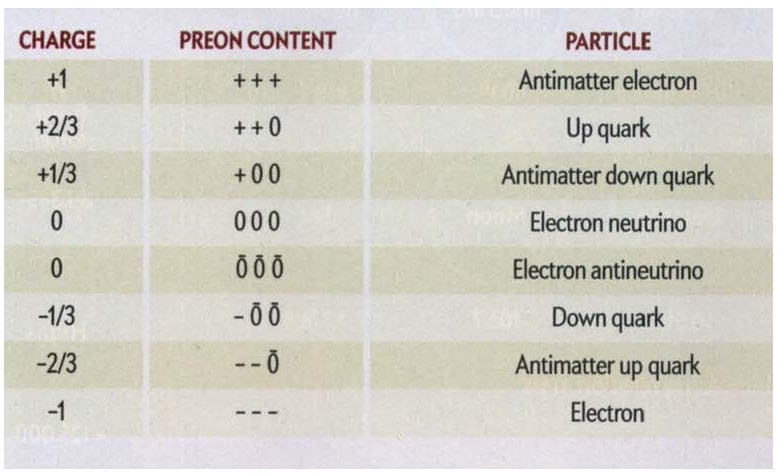
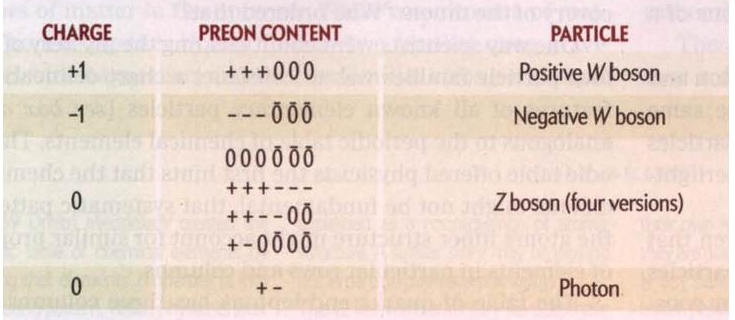
<p>Now, a very interesting observation is that, with the difference interpretation, we can build the standard model of particle physics, as shown <a href="http://www.lrcphysics.com/scalar-physics/2007/3/22/preon-models.html">here</a>, and, with the quotient interpretation, we can build the periodic table of elements.</p>
<p>Larson&#8217;s <a href="http://reciprocalsystem.com/nbm/nbm10.htm">mathematical pattern for the periodic table</a> is 4n<span style="vertical-align: super; font-size: 80%;">2</span>, to which he gives a physical meaning in order to obtain the four periods, 2<span style="vertical-align: super; font-size: 80%;">2&nbsp;</span>= 4; 4<span style="vertical-align: super; font-size: 80%;">2 </span>= 16; 6<span style="vertical-align: super; font-size: 80%;">2&nbsp;</span>= 36; 8<span style="vertical-align: super; font-size: 80%;">2&nbsp;</span>= 64 of the table. These are the double periods of the <a href="http://www.lrcphysics.com/wheel">Wheel of Motion</a>, as opposed to the 2n<span style="vertical-align: super; font-size: 80%;">2</span> half-periods of quantum mechanics, obtained using the four quantum numbers, n, l, m and s.&nbsp;</p>
<p>The trouble is, in each case, the periodic nature of the table is built on the variability of constituent particles of atomic structure (QM), or on the variability of constituent motions of the atom (RSt). Both work out fairly well in accounting for the order of the elements, but neither theory conforms to the new <a href="http://www.lrcphysics.com/scalar-physics/2009/11/28/square-roots-1st-2nd-orderings-of-the-periodic-table.html">empirical data shown by Le Cornec</a>, which uses a ratio of square roots of atomic ionization potentials to order the elements by their energy levels. Le Cornec shows that in the QM theory of the atom, the &#8220;s&#8221; and &#8220;p&#8221; energy level groups are reversed, while in the development of his <a href="http://www.lrcphysics.com/larsons-new-system-of-physical/">RSt</a>, Larson altogether abandoned the effort to explain the spectroscopic data of the elements, using scalar rotations.</p>
<p>With the new numbers, however, the quantitative relations of the periods fall out from the physical concept of the 3D oscillation. The sequence of 2, 4, 6, 8 of the new number series under the quotient interpretation, shown above, contains 4, 16, 36 and 64 positive &#8220;slots&#8221; for the respective, positive, inverses. Since these results come from the advanced/retarded functions of the 3D oscillation, the relation of square roots and their inverses, as described above, it&#8217;s easy to conclude that a connection with Le Cornec&#8217;s work is plausible.</p>
<p>At least that&#8217;s what I&#8217;m hoping, but this unorthodox view of a mathematical group may end up derailing the whole thing. I guess we&#8217;ll see if it&#8217;s valid or not, in the end.&nbsp;</p>
<p>&nbsp;</p>
]]></content:encoded></rss:item><rss:item rdf:about="http://www.lrcphysics.com/trouble-with-physics/2011/2/22/expanded-version-of-essay.html"><rss:title>Expanded Version of Essay</rss:title><rss:link>http://www.lrcphysics.com/trouble-with-physics/2011/2/22/expanded-version-of-essay.html</rss:link><dc:creator>Doug</dc:creator><dc:date>2011-02-22T21:03:19Z</dc:date><dc:subject></dc:subject><content:encoded><![CDATA[<p>As I have already mentioned in a comment to the last entry, I received a lot of comments on the draft of the essay that was just submitted to the FQXi essay contest, &#8220;Is Reality Digital or Analog?&#8221;</p>
<p>Horace and his friends, as well as others, including George, reviewed the draft and made some very helpful comments on it. The trouble is I didn&#8217;t realize that they were in the comment format of MS Word and I didn&#8217;t realize that I had to turn that feature on in order to see them. As a result, I wasn&#8217;t able to take advantage of them.</p>
<p>That is too bad, because those comments would have improved the essay considerably. Therefore, I decided to go ahead and incorporate them into the essay, expanding it a little bit, and publish the expanded version on this site.</p>
<p>Here is a link to essay, entitled <a href="http://www.lrcphysics.com/storage/documents/What%20Is%20Reality%20Point.pdf">&#8220;What is the Point of Reality?&#8221;</a></p>
<p>I wish I could swap it out for the one I sent to FQXi, but oh well. It wouldn&#8217;t matter, even if it were perfect. They just aren&#8217;t prepared for Larson&#8217;s advanced ideas, yet.</p>
]]></content:encoded></rss:item><rss:item rdf:about="http://www.lrcphysics.com/trouble-with-physics/2011/2/15/what-is-the-point-of-reality.html"><rss:title>What is the Point of Reality?</rss:title><rss:link>http://www.lrcphysics.com/trouble-with-physics/2011/2/15/what-is-the-point-of-reality.html</rss:link><dc:creator>Doug</dc:creator><dc:date>2011-02-15T21:25:10Z</dc:date><dc:subject></dc:subject><content:encoded><![CDATA[<p>Well, I did it. The essay I promised to write and submit to the FQXi Essay Contest was submitted yesterday, on my birthday! It&#8217;s entitled <a href="http://fqxi.org/community/forum/topic/896">&#8220;What is the Point of Reality?&#8221;</a> in answer to the contest question, &#8220;Is Reality Digital or Analog?&#8221;</p>
<p>My answer is that it is both, because the continuum can be digitized by the RST scalar &#8220;direction&#8221; reversals. One might think that would be an easy essay to write, but believe me, it wasn&#8217;t. I struggled with how to best communicate the idea in only 25,000 characters and nine pages with one inch margins.</p>
<p>It was tough, but I&#8217;m pleased to announce that I did it.</p>
<p>Hopefully, my readers will read it and let me know what they think. The ongoing discussion is taking place at the FQXi site as I write. There are a whole lot of essays there. Let&#8217;s see how this one stacks up.</p>
<p>I will be expanding on the essay on the LRC blogs. Maybe I&#8217;ll even make a YouTube video on the subject.</p>
]]></content:encoded></rss:item></rdf:RDF>