<?xml version="1.0" encoding="UTF-8"?>
<!--Generated by Squarespace Site Server v5.11.5 (http://www.squarespace.com/) on Sat, 31 Jul 2010 04:17:45 GMT--><feed xmlns="http://www.w3.org/2005/Atom" xmlns:dc="http://purl.org/dc/elements/1.1/"><title>The New Math</title><subtitle>The New Math</subtitle><id>http://www.lrcphysics.com/scalar-mathematics/</id><link rel="alternate" type="application/xhtml+xml" href="http://www.lrcphysics.com/scalar-mathematics/"/><link rel="self" type="application/atom+xml" href="http://www.lrcphysics.com/scalar-mathematics/atom.xml"/><updated>2010-05-08T13:29:26Z</updated><generator uri="http://www.squarespace.com/" version="Squarespace Site Server v5.11.5 (http://www.squarespace.com/)">Squarespace</generator><entry><title>The New Math</title><id>http://www.lrcphysics.com/scalar-mathematics/2010/4/26/the-new-math.html</id><link rel="alternate" type="text/html" href="http://www.lrcphysics.com/scalar-mathematics/2010/4/26/the-new-math.html"/><author><name>Doug</name></author><published>2010-04-26T15:16:50Z</published><updated>2010-04-26T15:16:50Z</updated><content type="html" xml:lang="en-US"><![CDATA[<p>It&#8217;s been a long time since my last entry on this blog. Mostly that&#8217;s due to time constraints, but also because I&#8217;ve written about things on the new physics blog that probably should have gone here. Sometimes, though, it&#8217;s hard to separate the math from the physics topics.</p>
<p>However, there&#8217;s no doubt where this topic goes. I want to take the new math from the top, and lay out the new concepts from the beginning. I will be referring to them as I develop the physics theory on the other blog.</p>
<p>The first concept that must be clearly understood from the start is that the reason for calling it the new math is that there are two interpretations of number. the first interpretation of number is the usual quantitative one that is a measure of how much or how many of something there is. In the second, the operational number represents a relation between two quantities.&nbsp;</p>
<p>We begin by viewing the familiar quantitative number line below in light of these two interpretations of number.</p>
<p><span class="full-image-block ssNonEditable"><img src="http://www.lrcphysics.com/storage/Number-line.gif?__SQUARESPACE_CACHEVERSION=1269285107717" alt="" width="538" height="57" /></span></p>
<p><strong>Figure 1.</strong> The Quantitative Interpretation of Number Line</p>
<p>In the quantitative interpretation of number, the whole numbers and proper fraction, rational, numbers lie to the right of 0 on the number line, in all cases. For instance, the number 1 occupies the first place to the right from 0, and 1/2 lies half way between 0 and 1 on the quantitative number line. The negative numbers and negative proper fractions to the left of 0 are somewhat problematic and were only accepted by mathematicians gradually and grudgingly. Wikipedia defines them as follows:</p>
<blockquote>
<p>Negative integers can be regarded as an extension of the <a title="Natural  number" href="http://en.wikipedia.org/wiki/Natural_number">natural numbers</a>, such that the expression <em>x</em> &ndash; <em>y</em> has a well-defined value for all values of <em>x</em> and <em>y</em>. Other  number systems, such as the <a title="Rational  number" href="http://en.wikipedia.org/wiki/Rational_number">rational numbers</a>, are then derived as progressively more  elaborate extensions and generalizations from the integers.</p>
</blockquote>
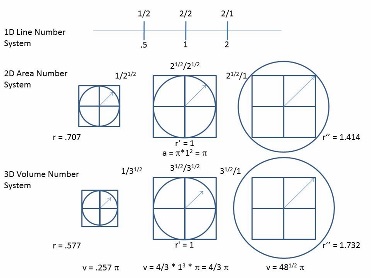
<p>On the other hand, in an operational interpretation of a rational number, we can take the relation of the numerator and denominator, say the difference between them, instead of the quotient, and it permits us to replace all the positive numbers on the number line with the reciprocal of proper fractions that replace all the negative numbers on the line, none of which are less than 1.</p>
<p>This way, we get a new number line,</p>
<p>1/n, &#8230;1/3, 1/2, 1/1, 2/1, 3/1, &#8230;n/1,</p>
<p>which is an operational equivalent of the quantitative number line in figure 1, above, but which is not based on integers, but constitutes a new generalization from which integers themselves are derived. In this case, however, instead of positive and negative numbers, we have a rational number and its inverse. To be sure, while the rational numbers are not the same as the quantitative numbers on the quantitative number line, their operational interpretation is; That is,&nbsp;</p>
<p>1/n = 1-n; &#8230;1/3 = -2; 1/2 = -1; 1/1 = 0; 2/1 = 1, 3/1 = 2, &#8230;n/1 = n-1;</p>
<p>In Larson&#8217;s new system of physical theory (RST), as opposed to the legacy system of physical theory (LST), there are two, reciprocal, sectors of the physical universe, the sector where motion is above unity (the cosmic sector), and the sector where motion is below unity (the material sector.) Within each of these two sectors, there is an important sub-sector, the interior of unit distance, which Larson refers to as the time region (inside unit space) and the space region (inside unit time).</p>
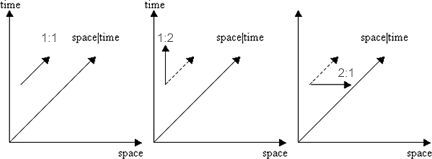
<p>A complete mathematical analogy of this space-time structure can be reproduced by considering the quantitative and operational interpretations of number together. The operational interpretation extends outward from 0 (1/1) to infinity, in both &#8220;directions,&#8221; while the quantitative interpretation extends inward from 1 and -1 (i.e. 2/1 and 1/2 respectively) to 0 (i.e. 1/1), in both &#8220;directions.&#8221;</p>
<p>However, there is another important distinction between these two interpretations of number, besides their respective data of 0 and 1, and it must be understood as well. In the operational interpretation, we must pick a perspective; that is, we must view the reciprocal side of the datum from its inverse perspective, just as we must view a see-saw from one side or the other. We cannot view the operational interpretated number line from both sides at the same time, any more than we can view the see-saw profile from both sides of the fulcrum at the same time. In terms of motion, this means we must choose to interpret both views as above and below unit motion, or above and below unit inverse-motion (s/t or t/s, but not both together.)</p>
<p>On the other hand, in the quantitative interpretation of number, we must view the reciprocal side of the datum from its own perspective, where one side is motion, while the other side is inverse-motion (s/t and t/s, at the same time.) This difference is illustrated in figure 2 below.</p>
<p><span class="full-image-block ssNonEditable"><img src="http://www.lrcphysics.com/storage/NumberLines.jpg?__SQUARESPACE_CACHEVERSION=1272288314873" alt="" /></span></p>
<p><strong>Figure 2.</strong> Operationally and Quantitatively Interpreted Number Lines</p>
<p>The division operation of the quantitative (how much or how many) interpretation of number requires us to differentiate the positive and negative quantities, as if they were real, even though there is no such thing as a negative quantity. As Sir Rowland Hamilton observed:</p>
<blockquote>
<p>it requires no peculiar scepticism to doubt, or even to disbelieve, the doctrine of Negatives<br />and Imaginaries, when set forth (as it has commonly been) with principles like these: that a<br />greater magnitude may be subtracted from a less, and that the remainder is less than nothing; that two negative numbers, or numbers denoting magnitudes each less than nothing, may be multiplied the one by the other, and that the product will be a positive number, or a number denoting a magnitude greater than nothing; and that although the square of a number, or the product obtained by multiplying that number by itself, is therefore always positive, whether the number be positive or negative, yet that numbers, called imaginary, can be found or conceived or determined, and operated on by all the rules of positive and negative numbers, as if they were subject to those rules, although they have negative squares, and must therefore be supposed to be themselves neither positive nor negative, nor yet null numbers, so that the magnitudes which they are supposed to denote can neither be greater than nothing, nor less than nothing, nor even equal to nothing.</p>
</blockquote>
<p>Contemplating the arbitrary nature of the quantitative number line, Hamilton sought a better approach using the dynamic concept of order in progression, rather than the static concept of bounded magnitude. This was a good idea, as far as it went, but it requires two orders of progression to make it work, not just one. Hamilton&#8217;s idea was to use the flow of time to give algebra an intuitional foundation, but Larson&#8217;s idea was to use the flow of time, together with the flow of space, to put physics on an intuitional foundation.</p>
<p>At first Larson&#8217;s idea seems absurd, and it would never had ocurred to Hamilton, but today the flow of space has actually been observed. The logical conclusion is that the two should be considered together. The difficulty is recognizing that they are not separate quantities, but actually two aspects of the same quantity, motion. We start with unit motion and go in both &#8220;directions,&#8221; toward greater or less than unit motion, when the flow of one aspect is less than the flow of the other.</p>
<p>Larson&#8217;s conclusion was that the only possiblility of introducing a difference between the two flows, is to assume that one or the other of them periodically reverses its &#8220;direction.&#8221; He called this simple harmonic motion, and he pointed out that it was just as reasonable to believe that the flow of space, or of time, could oscillate as not, and that this is the basis of all physics.</p>
<p>Were this the summum and bonum of the subject, we would be home free, but it is not complete at this point, because the two inverse aspects of the universal motion, the two flowing quantities, if you will, do not have the same dimensions. The flow of space exists in three dimensions, while the flow of time has no dimensions. Mathematically, then, the natural progression is not linear. If:</p>
<p>s/t = 2<span style="vertical-align: super;">3</span>/2<span style="vertical-align: super;">0</span></p>
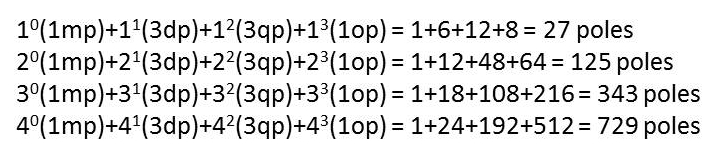
<p>then it does not give us a natural progression of 0, 1, 2, 3, &#8230; but rather it gives us a progresssion of 0, 8, 216, 512, &#8230;, and, at first glance, it&#8217;s totally impractical to construct a number line from such a non-linear progression.</p>
<p>However, it turns out that, within this 3D progression, there is an associated 0D, 1D and 2D progression as well, and by recognizing that the natural progression contains all four numerical progressions, we can construct a new, composite, number line and with it a new number system to use in our investigations of the RST. We will take a look at it next time.</p>
]]></content></entry><entry><title>Toward Non-pathological Algebras</title><id>http://www.lrcphysics.com/scalar-mathematics/2008/7/16/toward-non-pathological-algebras.html</id><link rel="alternate" type="text/html" href="http://www.lrcphysics.com/scalar-mathematics/2008/7/16/toward-non-pathological-algebras.html"/><author><name>Doug</name></author><published>2008-07-16T12:40:09Z</published><updated>2008-07-16T12:40:09Z</updated><content type="html" xml:lang="en-US"><![CDATA[<p>Arguably, the two most challenging mathematical/philosophical problems for the Greeks were manifest in the attempt to square the circle and to accept the existence of irrational numbers. In modern times, we&rsquo;ve proven that the former is impossible, and the latter is actually quite useful. However, as discussed in the previous post, it is possible that there are other approaches to meeting these formidable challenges, unknown to us, which might even prove more useful than our current method of handling them.</p>
<p>The crucial analysis of the fundamentals that seems to provide us with the clues that this might be so starts with Larson&rsquo;s idea of <a href="../../scalar-motion/">scalar motion</a>. As regular visitors of the LRC site know, scalar motion is a definition of motion without reference to moving objects. The equation of motion, v =ds/dt, simply involves a change in space over time, and a changing location of an object is not required to produce the equation&rsquo;s change of space, just as it is not required to produce its change of time.</p>
<p>In <a href="../../larsons-new-system-of-physical/">Larson&rsquo;s system</a>, the initial condition of the universe assumes a natural space clock as well as a natural time clock, the one being the inverse, or reciprocal, of the other. Hence, this assumption defines a universal motion, as the physical datum of the system.&nbsp; There are several important differences between the new natural type of motion, with no motion of an object involved, and the motion of objects with which we are familiar. One of the most basic differences is that the familiar motion of an object Y, from point X to point Z, increases the distance XY and decreases the distance YZ. On the other hand, the new natural type of motion changes distance itself; that is, both the distance XY and YZ are increased, or decreased, at the same time, making it impossible to define the motion of the object Y, in terms of the changing distance relative to X and Z, with one increasing and the other decreasing. It&rsquo;s as if the size scale of the system were changing.</p>
<p>This expansion/contraction motion, though easily observed in nature, is quite unlike the motion of an object from one point to another, specified in some specific direction that can be defined in terms of three dimensions. In a 3D system, scalar motion would change the size of a spatial location in all three dimensions simultaneously. This makes scalar motion more difficult to work with in some respects, because the system&rsquo;s locations (x, y, z), regardless of size, must continuously expand. While at first this is very disconcerting, it turns out that there are ways to cope with it that are straightforward.</p>
<p>Consider a 1D scalar expansion for instance, disregarding the expansion of the points themselves momentarily, the distance between points A and B increases over time. We can choose location A as a reference and measure the expansion in terms of B&rsquo;s motion away from A, or we can choose B as the reference and measure the expansion in terms of A&rsquo;s motion away from B, in the opposite direction. Either way, we can conclude that each dimension of scalar motion has two, opposed, directions. In a 1D system there are two scalar directions, in a 2D system there are four scalar directions, and in a 3D system there are eight scalar directions.&nbsp;</p>
<p>Assigning numbers to the binary directions in each dimension, we get 2<sup>0</sup> = 1 direction, in the zero-dimensional system (more on this exception below), 2<sup>1</sup> = 2 directions, in the one-dimensional system, 2<sup>2</sup> = 4 directions, in the two-dimensional system, and 2<sup>3</sup> = 8 directions, in the three-dimensional system. Substituting these numbers in the equation of motion, we would get:</p>
<p>ds/dt = d2<sup>0</sup>/d2<sup>0</sup>, for zero-dimensional motion,</p>
<p>ds/dt = d2<sup>1</sup>/d2<sup>1</sup>, for one-dimensional motion,</p>
<p>ds/dt = d2<sup>2</sup>/d2<sup>2</sup>, for two-dimensional motion,</p>
<p>ds/dt = d2<sup>3</sup>/d2<sup>3</sup>, for three-dimensional motion,</p>
<p>However, as we observe time, it&rsquo;s clear that it has only one direction, called the &ldquo;arrow of time,&rdquo; which is increasing magnitude only; that is, a point in time has no direction, and therefore no extent, in space. On this basis, we can consider time as a zero-dimensional scalar, something that can be counted, but not expanded. Meanwhile, it&rsquo;s clear that the space that we occupy is three-dimensional; that is, it extends into three dimensions, and, since scalar motion has no specifiable direction, by definition (i.e. it is motion with magnitude only), the expansion of space must be effective in all of the dimensions of the system (i.e. space is a pseudoscalar). Modifying the equation of scalar motion accordingly, we get</p>
<p>ds/dt = d2<sup>3</sup>/d2<sup>0</sup>,</p>
<p>where space, s, has 2<sup>3</sup> = 8 directions, and time, t, has 2<sup>0</sup> = 1 direction, the scalar &ldquo;direction&rdquo; of increasing magnitude only. By defining space and time this way, as the reciprocals of each other, in the equation of motion, the quantity space is differentiated from the quantity distance, which becomes the product of motion and time, as in the ordinary vectorial motion (i.e. motion with direction defined by locations with three dimensions). However, in this case, using the scalar motion equation, distance, d, is a three-dimensional quantity, not a one-dimensional quantity:</p>
<p>&nbsp;d = &Delta;s<sup>3</sup>/&Delta;t<sup>0</sup> * t<sup>0</sup> <br /> &nbsp;&nbsp;&nbsp; = (n2)<sup>3</sup>/(n2<sup>0</sup>) * n2<sup>0</sup>&nbsp; <br /> &nbsp;&nbsp;&nbsp; = (8*1<sup>3</sup>)/(1*1) <br /> &nbsp;&nbsp;&nbsp; = 8*1<sup>3</sup></p>
<p>for each unit of change, n. For example, for two n, we get</p>
<p>d = ((2*2)<sup>3</sup>/(2*2<sup>0</sup>) * (2*2<sup>0</sup>) = (64*1<sup>3</sup>/2) *&nbsp;2 = 64*1<sup>3</sup>,</p>
<p>or 64 cubic units of volume expansion in two units of time. The expansion series, or &ldquo;distance&rdquo; d, as time, t, marches on then is not the familiar linear series of lengths 1<sup>1</sup>, 2<sup>1</sup>, 3<sup>1</sup>, 4<sup>1</sup>, &hellip;n<sup>1</sup>, but the less familiar, non-linear, series of volumes, 8<sup>3</sup>, 64<sup>3</sup>, 216<sup>3</sup>, 512<sup>3</sup>, &hellip;n<sup>3</sup>.</p>
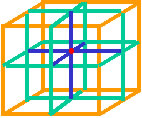
<p>Geometrically, the first term in this expansion series corresponds to the initial 2x2x2 stack of one-unit cubes, dubbed Larson&rsquo;s Cube, at the LRC. It is shown in figure 1 below.</p>
<p><span class="full-image-block ssNonEditable"><img src="http://www.lrcphysics.com/storage/larsonscube.jpg?__SQUARESPACE_CACHEVERSION=1252939530753" alt="" /></span>&nbsp;</p>
<p><strong>Figure 1.</strong> Larson&rsquo;s Cube as the 8 Unit Stack of One-Unit Cubes.&nbsp;</p>
<p>The red dot in the center corresponds to the 2<sup>0</sup> = 1, dimensionless, time magnitude, while the stack of eight 3D cubes corresponds to the 2<sup>3</sup> = 8 * 1<sup>3</sup> space magnitudes, at t<sub>1</sub> - t<sub>0 </sub>= 1.&nbsp;Expanding in the next unit of time, at t<sub>2</sub> - t<sub>0 </sub>= 2,&nbsp;to two units of space in all directions, it&rsquo;s easy to see that the stack of one unit cubes, consisting of of 2x2x2 = 8, one-unit, cubes, in figure 1, expands to a 4x4x4 = 64 stack of one-unit cubes. In the third unit of time, the stack expands to a 6x6x6 = 216 units, then to a 8x8x8 = 512 units, and so on, <em>ad infinitum</em>.&nbsp;Meanwhile, the 2<sup>0</sup> point at the intersection of the cubes, does not expand.</p>
<p>However, this mathematical expansion of the pseudoscalar does not correspond to a physical expansion, because a physical expansion of the pseudoscalar must expand in all directions, defined by three dimensions, not just the three orthogonal directions that constitute its three dimensions. Thus, the physical expansion is manifested as an expanding sphere, not as an expanding cube, and this presents us with the fundamental challenge faced by the Greeks: &ldquo;How do we calculate the volume of the sphere that corresponds to the volume of the stack of one-unit cubes?&rdquo; In other words, we need a geometric algebra of quantities that includes the areas of circles and the volume of spheres, as well as the linear extent of right lines, an algebra, which corresponds to a fully functional, non-pathological, numeric algebra, for doing physical calculations in a scalar/pseudoscalar system. In other words, it&rsquo;s back to the old conundrum of squaring the circle.</p>
<p>Unlike the Greeks, however, we now know that multiplying the sides of a polygon inside the sphere will always result in an approximation, and thus it can&rsquo;t be represented by a rational number. Since in our universe of discrete motion, as in the Pythagorean universe of discrete numbers, all is number, this is hardly welcome news.</p>
<p>Nevertheless, as we consider the problem, we see that there are <strong><em><span style="text-decoration: underline;">two</span></em></strong> spheres that can be related to the stack of one-unit cubes. One sphere that can be drawn to fit just inside the stack, and the other that can be drawn to just contain the stack. A two-dimensional view of the one-unit instance of these three figures is shown below.</p>
<p><span class="full-image-block ssNonEditable"><img src="http://www.lrcphysics.com/storage/images/SpheresCube.jpg?__SQUARESPACE_CACHEVERSION=1252939830979" alt="" /></span><span class="full-image-float-none">&nbsp;</span></p>
<p><strong>Figure 2.</strong> Two-Dimensional View of 2x2x2 Stack of One-Unit Cubes with Inner and Outer Spheres&nbsp;&nbsp;</p>
<p>In figure 2, the radius, c,&nbsp;of the outer sphere, S<sub>1</sub>, is the square root of 2, by the Pythagorean theorem, while the radius, d, of the inner sphere, S<sub>2</sub>, is 1, since the radius is r = a = b = 1. By the formula for the area of the surface of a sphere,</p>
<p>A = 4&pi; * r<sup>2</sup>,</p>
<p>the area of the surface of the sphere S<sub>1</sub> is 8&pi;, while the area of the surface of the sphere S<sub>2</sub> is 4&pi;. Also, by the formula for the volume of a sphere,</p>
<p>V = 4/3&pi; * r<sup>3</sup>,</p>
<p>the volume of the sphere S<sub>1</sub> is the square root of 2, cubed, times the volume of S<sub>2</sub>, which is just 4/3&pi;, since its radius is 1.</p>
<p>Table 1 shows the tabulated circumferences (2*r*&pi;), areas and volumes for spheres S<sub>1</sub> and S<sub>2</sub>, and their ratios, for units 1, 2, 3 and 4.</p>
<p><span class="full-image-block ssNonEditable"><img src="http://www.lrcphysics.com/storage/images/InverseSpheres.jpg?__SQUARESPACE_CACHEVERSION=1252940099994" alt="" width="583" height="193" /></span>&nbsp;</p>
<p><strong>Table 1.</strong> Circumferences, Areas and Volumes for Units, 1, 2, 3 and 4</p>
<p>Notice that the S<sub>1</sub>/S<sub>2</sub> ratio is just a power of the radius of S<sub>1</sub>, or a power of the square root of 2, in each case, denoted &ldquo;r<sup>n</sup>&rdquo; in the last column of the table. The ratio of the surface areas of the spheres is the square of r, or 2, while the ratio of the volumes of the spheres is twice the radius of S<sub>1</sub>, which is equivalent to the square root of 2, or r, cubed.</p>
<p>This is an amazing fact that we should be able to exploit in order to replace the 2<span style="vertical-align: super;">0</span>, 2<sup>1</sup>, 2<sup>2</sup>, 2<sup>3</sup>, numerical units that are so hard to reconcile in a non-pathological, multi-dimensional, algebra.</p>
<p>Recall that, currently, for one-dimensional units, we resort to complex numbers (z = a+bi), the algebra of which is not ordered; For two-dimensional units, we resort to quaternions, the algebra of which is not ordered or commutative, and, for three-dimensional units, we resort to octonions, the algebra of which is not ordered, commutative, or associative!</p>
<p>All of these traditional units depend on one or more imaginary numbers to define their dimensionality, arbitrarily defined as the square root of -1, in the different dimensions of the respective algebras. Of course, in reality, there is no unit that can be physically identified that, when multiplied by itself, is equal to -1, in any dimension.</p>
<p>However, we should remember that the purpose of using the plus and minus signs is only to differentiate between a given dimension&rsquo;s two &ldquo;directions.&rdquo; There&rsquo;s nothing meaningful about them otherwise. As already noted above, in scalar motion, the choice of a fixed reference (point A or B), with which to measure scalar change, is completely arbitrary.</p>
<p>The same thing is true with numbers. Each number has its inverse and the designation as to which is the number and which is the inverse number is completely arbitrary. Nevertheless, with the number 1, we say that it is its own inverse, and we use this convention to build group theory, where 1 is the identity element.</p>
<p>However, if we could change our number system, from one based on multi-dimensional numbers, using imaginary numbers to define their dimensions, and plus and minus labels to define the two directions of each of their dimensions, to one based on the properties of spheres (i.e. 1D circumferences, 2D surfaces and 3D volumes), the inverse of 1 would no longer have to be itself, but would now be 2, the inverse of 2 would be 4, etc, by the formula for inverse geometry, r&rsquo;<sup>2</sup> = r * r&rsquo;&rsquo;.</p>
<p>In this way, negative numbers are eliminated conceptually, although the change is actually only one of perspective. It&rsquo;s like saying that the inverse of -1 is 2 units above it; the inverse of -2 is 4 units above it; the inverse of -3 is 6 units above it, etc. In this case, however, the unit referred to is the square root of 2, r, which is not imaginary, but is the relation between unit dimensions, defining the radius of a sphere.</p>
<p>Just like in the traditional mathematics, the new unit, r, defines the identity element of a group. Figure 3 shows the number 1 of the group, P, the group identity element, P&rsquo; (equal to the square root of 2), and the inverse of number 1, p&rsquo;&rsquo; (equal to P&rsquo; squared, or 2).</p>
<p><strong><span class="full-image-block ssNonEditable"><img src="http://www.lrcphysics.com/storage/images/Inverse%20Circles2.jpg?__SQUARESPACE_CACHEVERSION=1252940897600" alt="" /></span>&nbsp;</strong></p>
<p><strong>Figure 3.</strong> The number 1 of the group (P), the identity element (P&rsquo;), and the inverse of number 1 (P&rsquo;&rsquo;).</p>
<p>In figure 3, P is the radius (1) of the inner sphere, the generator of one 1d (circumference) quantity, one 2d (surface) quantity and one 3d (volume) quantity. Radius P&rsquo; generates the 1d, 2d and 3d quantities of the identity element (square root of 2), while P&rdquo; is the radius (2), or the inverse of radius P (by P&rsquo;<sup>2</sup> = P * P&rsquo;&rsquo;), the generator of its 1d, 2d and 3d quantities.</p>
<p>This is no different than the number line, where -1 is one unit removed from 0 and two units removed from +1. The difference is huge, though, because we can represent all three of the dimensional numbers with one radius, and do away for the need of imaginary numbers (C = circumference; A = area; V = volume for the given dimension&#8217;s P, P&#8217; and P&#8221; quantities):</p>
<p>1) 1D: C<sub>Sp</sub> = 2&pi; (i.e. -1); C<sub>Sp&rsquo;</sub> = 2&pi;*r (i.e. 0); C<sub>Sp&rdquo;</sub> = 4&pi; (i.e. +1)</p>
<p>2) 2D: A<sub>Sp</sub> = 4&pi; (i.e. -1<sup>2</sup>); A<sub>Sp&rsquo;</sub> = 4&pi;*r<sup>2&nbsp;</sup> (i.e. 0); A<sub>Sp&rdquo;</sub> = 16&pi; (i.e. +1<sup>2</sup>)</p>
<p>3) 3D: V<sub>Sp</sub> = (4/3)&pi; (i.e. -1<sup>3</sup>); V<sub>Sp&rsquo;</sub> = (4/3)<sup>&nbsp;</sup>&pi;*r<sup>3</sup> (i.e. 0); V<sub>Sp&rdquo;</sub> = (32/3)&pi; (i.e. +1<sup>3</sup>)</p>
<p>The fact that each successive dimension has it&rsquo;s own &#8220;zero&#8221; quantity, or identity element, might take some getting used to, but it would be well worth it, if it enables us to get rid of imaginary numbers and the pathology of higher-dimensional algebras.</p>
<p>In that case, we would have an algebra of 0D scalars, an algebra of 1D pseudoscalars, an algebra of 2D pseudoscalars, and an algebra of 3D pseudoscalars, each one with all three algebraic properties of order, commutativity and associativity.</p>
<p>We&#8217;ll see.</p>
]]></content></entry><entry><title>Fundamental Consequences</title><id>http://www.lrcphysics.com/scalar-mathematics/2008/6/28/fundamental-consequences.html</id><link rel="alternate" type="text/html" href="http://www.lrcphysics.com/scalar-mathematics/2008/6/28/fundamental-consequences.html"/><author><name>Doug</name></author><published>2008-06-28T12:07:15Z</published><updated>2008-06-28T12:07:15Z</updated><content type="html" xml:lang="en-US"><![CDATA[<p>There&#8217;s a tendency in our society to understand the history of human thought as a more or less linear progression from primitive to sophisticated. As we think of&nbsp;Western civilization&#8217;s technological progress, from horse and buggy, to manned space flight, it&#8217;s easy to view our revolutionary capabilities in science and technology as the pinnacle of human&nbsp;achievement, and to suppose that there is no other way forward, but along the way we have traveled.</p>
<p>However, the ancient Hebrews&nbsp;envisioned our days and characterized them, not as the pinnacle of civilization&#8217;s progress, but rather as&nbsp;the deterioration of civilization&#8217;s worth, inferior to&nbsp;the quality of previous civilizations. The&nbsp;image of&nbsp;the relatively inferior status&nbsp;of modern nations was&nbsp;explained by&nbsp;the Hebrew Daniel, when he saw and interpreted the king of Babylon&#8217;s dream, portraying the&nbsp;progressive degradation of the quality of earth&#8217;s civilizations, from that time to this.</p>
<p>According to this vision, the ancient Babylonian kingdom was the highest quality civilization in the world, followed by the&nbsp;inferior, but stronger,&nbsp;Persians,&nbsp;who were followed by the still more inferior, but stronger,&nbsp;Greeks, then by the vastly more inferior and stronger&nbsp;Romans, and finally by the remnants of the Romans, mixed in with the conquering Barbarians, the most inferior, totally fragmented, uncivilized&nbsp;nations of all, who were as clay&nbsp;mixed in&nbsp;with&nbsp;the metal of the Romans. The Romans were as iron compared to the more highly prized bronze of the Greeks and to the sliver of the Persians and to the gold of the Babylonians.</p>
<p>Of course, in the end, all of this is irrelevant, as the vision portrayed all of these old kingdoms as being replaced by&nbsp;a new&nbsp;Hebrew kingdom, which would come rolling forth like a stone down a mountain, smashing the image of Western civilization&#8217;s heritage, in all these old kingdoms, to dust.&nbsp;Consequently, the dust of the pulverized&nbsp;image simply&nbsp;blows away, like chaff in the wind,&nbsp;and disappears!</p>
<p>But what does this have to do with modern mathematics and science? We don&#8217;t know much about the mathematics and&nbsp;science of the Persians and Babylonians,&nbsp;and what we do know comes to us primarily from the Greeks, who learned from the Babylonians, the Persians, and the Egyptians (who, like the Asians,&nbsp;were never a world dominating nation, but nevertheless were sometimes significant players in mathematics and science).</p>
<p>Clearly, however, the <em>strength</em> of the Persians, relative to the Babylonians, and the Greeks, relative to the Persians, and the Romans, relative to the Greeks, and, in general,&nbsp;the modern nations&nbsp;relative to the ancient ones,&nbsp;is based, in part at least,&nbsp;on the progress of technology. Whether it&nbsp;is based on advanced strategic technology, such as provides greater sustenance,&nbsp;infrastructure and internal strength for the&nbsp;nation as a whole, or on advanced tactical technology, providing for improved weapons, communications and mobility to the nation&#8217;s armies, navies, and air forces, technology has always played a crucial role&nbsp;in the strength of civilizations.</p>
<p>The interesting&nbsp;aspect of this in the present context&nbsp;is&nbsp;that, while&nbsp;it shows us how understanding the simple fundamentals of mathematics and&nbsp;science makes a profound difference in the power and technological capabilities of nations, it also shows us that there may be&nbsp;nothing particularly&nbsp;enduring about it either. Civilizations come and go, and the particular aspect of their understanding of math and science that made them capable of great feats of organization, engineering and technological exploitation, comes and goes with them.&nbsp;</p>
<p>From the smallest of means, proceeds that which is great, the ancients said. For example,&nbsp;who could have guessed&nbsp;that the ability of&nbsp;a few&nbsp;Renaissance&nbsp;scientists to deal with the esoteric concepts of&nbsp;irrational and&nbsp;negative numbers would eventually lead to the modern ability to transcend the technology of the ancients so dramatically? But so it is. Without the ability to&nbsp;abstract the square root of 2 and -1, the whole of modern technology would be impossible.</p>
<p>However, knowing this, we are soon lead to ask what other, simple, fundamentals&nbsp;might we&nbsp;be missing? The fundamentals that some future civilization (perhaps the&nbsp;triumphant kingdom of the Hebrews foreseen by Daniel) might discover,&nbsp;might enable them to transcend our technology as much as we have transcended that of the ancients (or even more).</p>
<p>In thinking about this, one might be tempted to revisit the whole notion of irrational and imaginary numbers, the foundation of modern technology, and seek to understand what it&nbsp;is about this whole approach that makes it so powerful. If there is one way to do this,&nbsp;might there be another, maybe even better way to do it?</p>
<p>Of course, readers of these blogs know that here at the LRC we believe there is, and that we are taking our&nbsp;clues&nbsp;on how to proceed from the works of Hamilton, Grassmann, Clifford, Hestenes, and Larson. Hamilton showed us how&nbsp;defining numbers, as traditionally taken for granted, leaves algebra without a suitable scientific basis. Grassmann showed us that there is&nbsp;an underlying connection between geometry and algebra that the Greeks couldn&#8217;t make, and Clifford showed us how the two directions of each dimension forms an algebra. Thanks to the work of Hestenes, which brought the works of Grassmann and Clifford to light, we are provided with tremendous insight into the&nbsp;underlying nature of complex and quaternion numbers, and the imaginary numbers that they are built with.</p>
<p>Finally, none of it would have even caught our attention had it not been for the transcendent work of Larson. It is his brilliant recognition and intriguing development of the new and unfamiliar notions of scalar motion that provides us with&nbsp;the motivation for digging into all these&nbsp;ancient mysteries, driving us to uncover the old foundations,&nbsp;in search of new insight&nbsp;into what makes modern math and&nbsp;physics tick.</p>
<p>What we have found astounds us. Could it be that, as Thales and Pythagoras apparently learned from their predecessors, &#8220;Everything is number,&#8221; after all? The fact that this faith seemed horribly contradicted by the theorem of triangular squares, that squaring the circle could only be approximated, and that the hare could never catch up with the tortoise,&nbsp;and that today, after centuries of effort,&nbsp;we can now name irrational numbers, use them&nbsp;in&nbsp;the calculus to&nbsp;send robots to explore particular parcels&nbsp;of Martian terrain, use computers to calculate &pi; out to a gazillion decimal places, and work with infinite sets, as easily as the Greeks worked with integers,&nbsp;appears to make the whole issue moot.</p>
<p>&#8220;Who cares, if the Greeks thought all was number,&#8221; one might think. &#8220;Our technology, our math and our science&nbsp;reach so far beyond anything ever dreamed of by the Greeks, that it&#8217;s patently clear&nbsp;that we have overcome their&nbsp;intellectual obstacles. Let&#8217;s just move on.&#8221; Ironically, however, that&#8217;s just what we can&#8217;t do, and the reason that we can&#8217;t do it is that the essence of these very same obstacles stands in our way.&nbsp;We now know that nature is both discrete, definitely measured,&nbsp;like numbers, and, at the same time,&nbsp;continuous, infinitely divisible,&nbsp;like distance.</p>
<p>Yet, in spite of&nbsp;the vaunted &#8220;work arounds&#8221; of our modern mathematics,&nbsp;which have served us so magnificently, irrational, transcendental,&nbsp;and imaginary numbers, finite and infinite sets, etc, we still cannot do as nature does and seamlessly combine the continuous with the discrete. It is frustrating in the extreme. It appears that, if the ancients taught Thales and Pythagoras that all was number, then they were probably just hopelessly naive and the Greeks were simply beguiled by their priestly robes and their high social status. If we can&#8217;t do it today, surely the ancient Babylonians and Persians couldn&#8217;t do it either.</p>
<p>That may be so, but it doesn&#8217;t mean that they didn&#8217;t have a valuable&nbsp;insight into numbers and geometry, which has since been lost, one that&nbsp;might prove to be the key&nbsp;to doing what we so desperately want to do. For instance, even though their approximation&nbsp;of &pi; might have been very rough, compared to our very&nbsp;refined approximation, how do we know that it doesn&#8217;t matter, in the end? Of course, barring some&nbsp;unexpected archeological find, we are not likely to ever know&nbsp;more about&nbsp;how the ancients thought than the ancient Greeks did, who were in direct contact with them. The point is not, however, that the ancients had the answers we seek. They probably didn&#8217;t, but they may have thought about the fundamentals in a way that hasn&#8217;t occurred to us, which could prove to be the key&nbsp;for finding the answers.</p>
<p>As it turns out, there are many intriguing clues that the way&nbsp;the ancients thought about numbers, is close to the&nbsp;new way we are thinking about them here at the LRC. In the next&nbsp;post, we will get&nbsp;into some of the details of this.</p>
]]></content></entry><entry><title>Natural Numbers</title><id>http://www.lrcphysics.com/scalar-mathematics/2008/5/19/natural-numbers.html</id><link rel="alternate" type="text/html" href="http://www.lrcphysics.com/scalar-mathematics/2008/5/19/natural-numbers.html"/><author><name>Doug</name></author><published>2008-05-19T16:36:43Z</published><updated>2008-05-19T16:36:43Z</updated><content type="html" xml:lang="en-US"><![CDATA[<p>As discussed in the last post, it seems like the only consistent way to produce the natural numbers is via a natural progression of points; that is, the 0D mathematical series</p><p>1<sup>0</sup>, 2<sup>0</sup>, 3<sup>0</sup> &#8230; </p><p>must be&nbsp;actually</p><p>1*2<sup>0</sup>/2<sup>0</sup>, 2*2<sup>0</sup>/2<sup>0</sup>,&nbsp;3*2<sup>0</sup>/2<sup>0</sup>, &#8230;</p><p>because, when, starting with space and time only,&nbsp;there are no &#8220;things&#8221; to count, which implies that the natural series,</p><p>1<sup>1</sup>, 2<sup>1</sup>, 3<sup>1</sup> &#8230; </p><p>is mathematically&nbsp;incorrect, as an initial condition in a&nbsp;space|time progression,&nbsp;since </p><p>1*2<sup>1</sup>/2<sup>0</sup>, 2*2<sup>1</sup>/2<sup>0</sup>,&nbsp;3*2<sup>1</sup>/2<sup>0</sup>&#8230;,</p><p>is a natural progression of <em>double</em> magnitudes (one in each &#8220;direction&#8221;) not single magnitudes. Therefore,&nbsp;as a space|time progression, the natural 1D mathematical series&nbsp;<em>necessarily</em> begins with 2, not 1, and increases by 2, 1D, magnitudes, not 1:</p><p>2*1<sup>1</sup>, 4*1<sup>1</sup>, 6*1<sup>1</sup>&#8230;,</p><p>while&nbsp;the natural series,</p><p>1<sup>2</sup>, 2<sup>2</sup>, 3<sup>2</sup> &#8230;,</p><p>is also incorrect, because</p><p>1*2<sup>2</sup>/2<sup>0</sup>, 2*2<sup>2</sup>/2<sup>0</sup>,&nbsp;3*2<sup>2</sup>/2<sup>0</sup>, &#8230;&nbsp;</p><p>is&nbsp;the natural mathematical progression of area, which begins with 2<sup>2 </sup>= 4, 2D, magnitudes, not 1,&nbsp;or 2, increasing the base of the series&nbsp;by a factor of&nbsp;2:</p><p>4*1<sup>2</sup>, 16*1<sup>2</sup>,&nbsp;36*1<sup>2</sup>&#8230;.</p><p>Finally, the natural 3D series:</p><p>1<sup>3</sup>, 2<sup>3</sup>, 3<sup>3</sup> &#8230;</p><p>is also&nbsp;incorrect, as a space|time progression,&nbsp;because it is actually,</p><p>1*2<sup>3</sup>/2<sup>0</sup>, 2*2<sup>3</sup>/2<sup>0</sup>,&nbsp;3*2<sup>3</sup>/2<sup>0</sup>, &#8230;,&nbsp;</p><p>which is&nbsp;the natural progression of volume, its magnitudes beginning with 2<sup>3</sup> = 8, 3D, magnitudes, not 1,&nbsp;not 2,&nbsp;not 4, again increasing the base of the previous series by a factor of 2:</p><p>8*1<sup>3</sup>, 64*1<sup>3</sup>,&nbsp;216*1<sup>3</sup> &#8230;</p><p>All of this means, among other things, that the algebra of these numbers begins with the&nbsp;pseudoscalar value of an n-dimensional progression (2<sup>n</sup>), not&nbsp;its scalar value (2<sup>0</sup>); that is,&nbsp;each series begins with the corresponding right side of the tetraktys, not the left side. This is because one line has two directions, and one area has four directions, not two, and it is therefore&nbsp;incorrect to&nbsp;write the progression of 1D magnitudes beginning with the scalar magnitude&nbsp;1 (2<sup>0</sup>), or&nbsp;to write the progression&nbsp;of area beginning with the&nbsp;2<sup>1</sup>,<sup> </sup>or 1D,&nbsp;pseudoscalar magnitude. Likewise, one volume has eight directions, not two,&nbsp;and not&nbsp;four, and therefore&nbsp;the natural volumetric series&nbsp;must begin with eight cubic scalars, not one. To accurately denote this, we need to rewrite the 1D progression as</p><p>(1*2)<sup>1</sup>/(1*2)<sup>0</sup>, (2*2)<sup>1</sup>/(2*2)<sup>0</sup>,&nbsp;(3*2)<sup>1</sup>/(3*2)<sup>0</sup>, &#8230;,</p><p>the 2D progression as</p><p>(1*2)<sup>2</sup>/(1*2)<sup>0</sup>, (2*2)<sup>2</sup>/(2*2)<sup>0</sup>,&nbsp;(3*2)<sup>2</sup>/(3*2)<sup>0</sup>, &#8230;,</p><p>and the 3D progression as&nbsp;</p><p>(1*2)<sup>3</sup>/(1*2)<sup>0</sup>, (2*2)<sup>3</sup>/(2*2)<sup>0</sup>,&nbsp;(3*2)<sup>3</sup>/(3*2)<sup>0</sup>, &#8230;.&nbsp;</p><p>It&#8217;s important to&nbsp;recognize that, when the uniform 3D progression is <em>measured</em> from a given point (2<sup>0</sup> = 1), at t<sub>n</sub> - t<sub>0</sub>, the apparent one-dimensional interval&nbsp;characterizes the expanding volume&nbsp;by its 1D radius. However, to calculate&nbsp;the true 1D interval, which is the diameter of the volume, the radius&nbsp;must&nbsp;be&nbsp;doubled; to calculate the true 2D interval, the doubled radius, the diameter,&nbsp;must be&nbsp;squared, and to calculate the 3D interval, it must be&nbsp;cubed:</p><p>2*1<sup>1</sup>&nbsp;= 2r = d,</p><p>4*1<sup>2</sup>&nbsp;= d<sup>2</sup>,</p><p>8*1<sup>3</sup> = d<sup>3</sup></p><p>However, this brings us face to face with the age old problem of the quadrature, or of&nbsp;&#8220;squaring the circle,&#8221; because the 2D space component of the 3D space|time expansion must&nbsp;expand geometrically over time, or circularly, and the 3D&nbsp;component must&nbsp;expand spherically, while the&nbsp;algebraic square&nbsp;and the&nbsp;algebraic cube are&nbsp;necessarily rectilinear, and therefore&nbsp;an issue&nbsp;of 2D and 3D numerical integration, or quadrature, and cubature, as it&#8217;s sometimes referred to, arises.&nbsp;</p><p>That this problem is related to the foundations of quantum mechanics is indicated, when it&#8217;s recognized that only&nbsp;one point on the surface of an expanding circle, or sphere, can be measured at any given time. Special relativity makes it impossible to <em>simultaneously</em>&nbsp;specify t<sub>n</sub> at any more than one point on the 2D, or 3D, surface of the expansion, because points on these surfaces are always moving apart. Therefore, we are brought back to consider the physical enigma of point/wave duality, and the&nbsp;mathematical dilemma of quadrature, and the logical challenge of unifying the concept of the discrete numbers of algebra&nbsp;with the concept of the smooth functions of geometry.</p><p>In the next post, we will&nbsp;discuss how the ancient way of dealing with these fundamental issues turns out to be remarkably congruent with our ideas of the space|time progression; that is, what has been called the &#8220;mediato/duplatio&#8221; (halving/doubling) method of ancient reckoning, intimately associated with the notion of the tetraktys, turns out to be our &#8220;factor of 2,&#8221; playing in the space|time progression series, as described above, and we will discuss the correspondence between them next time. </p><p>This topic is&nbsp;very interesting as it relates the modern concept of rotation, implemented with complex numbers,&nbsp;to our new concept of 3D expansion, implemented with scalars and pseudoscalars, which is a crucial point to understand, I believe.</p>
]]></content></entry><entry><title>LRC Seminar - Scalar Algebra</title><id>http://www.lrcphysics.com/scalar-mathematics/2007/12/26/lrc-seminar-scalar-algebra.html</id><link rel="alternate" type="text/html" href="http://www.lrcphysics.com/scalar-mathematics/2007/12/26/lrc-seminar-scalar-algebra.html"/><author><name>Doug</name></author><published>2007-12-26T16:45:49Z</published><updated>2007-12-26T16:45:49Z</updated><content type="html" xml:lang="en-US"><![CDATA[<p>In the previous posts, we&#8217;ve seen how to define the &#8220;directions&#8221; of natural numbers, by defining number as Hamilton did, as order in progression, instead of increased or diminished magnitude. By taking two of these progression-defined numbers, as the two, reciprocal, aspects of one progression, as Larson did, and by defining two interpretations of these reciprocal numbers, we have been able to establish two groups, one group under addition, analogous to the integers, with an identity element of 0, and one group under multiplication, analogous to the fractions, with an identity element of 1.</p><p>In the previous post, we showed how combining the unit magnitudes of the positive and negative &#8220;directions&#8221; defines a two unit &#8220;distance,&#8221; or interval, analogous to a spatial distance, with two algebraic &#8220;directions,&#8221; one negative and one positive:</p><p>1|2 + 2|1 = 3|3 = 0<br />(1|2) = -(2|1)<br />(2|1) = -(1|2)</p><p>However, the fact that the pipe symbol indicates that the reciprocal relation is to be interpreted as the value of the difference (sum of opposite signs) between the numerator and the denominator means that any number n|n can be used as the identity element, and since the quantities in the numerator and denominator are defined in terms of order in progression, rather than as increased, or diminished, quantities, it is necessary to recognize how those quantities differ; that is, how does 1 become 2 and 2 become 3, or 1? </p><p>With non-reciprocal numbers defined as magnitudes, 1 becomes 2, when two independent magnitudes are summed:</p><p>1 + 1 = 2, 2 + 1 = 3,</p><p>which represents an arbitrary action of addition.&nbsp;</p><p>However, with non-reciprocal numbers defined as order in progression, 1 becomes 2 and 2 becomes 3,&nbsp;as the progression proceeds:</p><p>1, 2, 3, &#8230;&nbsp;</p><p>but what are the dimensions of these steps of progression? Ordinarily, the absence of a superscript with a number&nbsp;indicates that&nbsp;it is 1-dimensional, and we have seen that in ordinary mathematics, any number raised to the zero power is defined by the law of exponents, as the number 1,&nbsp;since all such numbers </p><p>n/n = n<sup>1</sup>/n<sup>1</sup> = 1<sup>1-1</sup> = 1<sup>0</sup> = 1.</p><p>However, as we saw in the last post, this definition is problematic, theoretically, because&nbsp;it means that&nbsp;the unit cube, 1<sup>3</sup>, must be defined as </p><p>n<sup>4</sup>/n<sup>1</sup> = 1<sup>4 -1</sup> = 1<sup>3</sup> = 1</p><p>and&nbsp;since, in a 3D system,&nbsp;we can&#8217;t define the four-dimensional <em>unit</em> required to do this, confusion results. Fortunately, we avoid this problem in the mathematics of reciprocal numbers, because the dimensions of the numbers express their&nbsp;<em>inherent</em> dual &#8220;directions&#8221; (positive and negative), which gives meaning to 1<sup>0</sup>, as a number with no degree of freedom.&nbsp; So, we simply start with dimension 0, at the top of the tetraktys, meaning there&nbsp;is no, dual,&nbsp;degree of freedom in the initial number of the tetraktys. It&nbsp;simply corresponds to a geometric point.&nbsp;</p><p>Ordinarily, we would regard a progression of reciprocal numbers, with two, reciprocal, aspects,&nbsp;as an ordered series of 0-dimensional units, or scalars, which would&nbsp;constitute a series of points, not 1D lines. Yet, an unexpressed exponent is assumed to equal 1. So, writing the series,</p><p>1|1, 2|2, 3|3, &#8230;&nbsp;</p><p>implies an exponent of 1 in the numerator and the denominator, but in this case we can&#8217;t subtract the exponent of the denominator from the exponent of the numerator, because the pipe symbol indicates that the reciprocal operation of the reciprocal number is not multiplication (division), but addition (subtraction).&nbsp; Therefore, the exponents must be the same in both&nbsp;cases, because the subtraction operation (actually sum of opposite signs) wouldn&#8217;t be valid otherwise, since we can&#8217;t subtract (add)&nbsp;two numbers with different exponents, or dimensions.&nbsp;</p><p>Yet, from our knowledge of the tetraktys, we know that the reciprocal of the scalar (dimension 0) is the pseudoscalar (dimension 3,&nbsp;at the 3D level, or bottom of the tetraktys). So, if one of the terms in a reciprocal number&nbsp;is a 0D scalar, the meaning of the pipe symbol, &#8220;|&#8221;, requires the other term to be&nbsp;the reciprocal of the scalar, the pseudoscalar!&nbsp;</p><p>We can see that this makes sense, because the series of reciprocal numbers</p><p>1<sup>0</sup>|1<sup>0</sup>, 2<sup>0</sup>|2<sup>0</sup>, 3<sup>0</sup>|3<sup>0</sup>, &#8230;&nbsp; =&nbsp; 0<sup>0</sup>, 0<sup>0</sup>, 0<sup>0</sup>, &#8230;</p><p>is meaningless.&nbsp;A point&nbsp;is&nbsp;only its own reciprocal,&nbsp;when no degree of freedom is present (the n<sup>0</sup>:n<sup>0 </sup>numbers&nbsp;at the top of the tetraktys). Its reciprocal, with any non-zero degree of freedom, is always the pseudoscalar.&nbsp;Hence, the 3D&nbsp;pseudoscalar is the appropriate&nbsp;reciprocal of the 0D scalar in the Euclidean space&nbsp;(i.e. the 2<sup>3</sup> numbers at the bottom of the tetraktys).</p><p>Consequently,&nbsp;in&nbsp;the&nbsp;three-dimensional system of numbers (the Grassmann algebra), the progression of reciprocal numbers must take the form&nbsp;</p><p>1<sup>3</sup>|1<sup>0</sup>, 2<sup>3</sup>|2<sup>0</sup>, 3<sup>3</sup>|3<sup>0</sup>, &#8230;</p><p>which is a series of reciprocal numbers expressing a numerical progression of cubes, combined with reciprocally related points, corresponding to the geometric structure of&nbsp;Larson&#8217;s cube, with the 0D scalar at the intersection of the stack of 2x2x2 cubes.</p><p>However, because the difference between the numerator and the denominator is&nbsp;the difference between reciprocal quantities <em>of different dimensions</em>, we can express its value,&nbsp;as&nbsp;some mathematically meaningful&nbsp;result, only if the denominator is always the 0D scalar, while the numerator is the, reciprocal, pseudoscalar, since subtracting 0 from anything is essentially meaningless, and&nbsp;the breaking of the rule of exponents has no consequences in this case. As they say in the gym, no harm, no foul.&nbsp;</p><p>However, if we change from the pipe operation to the slash operation, then, according to the same mathematical rules,&nbsp;it&#8217;s possible to express the operational result as a meaningful quantity. That is to say,</p><p>1<sup>3</sup>/1<sup>0</sup>, 2<sup>3</sup>/2<sup>0</sup>, 3<sup>3</sup>/3<sup>0</sup>, &#8230; = 1<sup>3-0</sup>, 1<sup>3-0</sup>, 1<sup>3-0</sup>, &#8230; = 1<sup>3</sup>, 1<sup>3</sup>, 1<sup>3</sup>, &#8230;</p><p>Why is this? I submit that it&#8217;s because, in the slash operation, the ratio of reciprocals, as a quotient,&nbsp;defines the unit of a function. So, 1<sup>3</sup> is a cubic unit of the function, which equates to a cubic pseudoscalar unit per scalar unit. On the other hand, in the pipe operation, 1<sup>3</sup>|1<sup>0</sup>,&nbsp;the ratio&nbsp;of reciprocals defines the&nbsp;unit of volume, as a 3D interval,&nbsp;with eight directions, between the 0D point and the 3D cube.&nbsp;</p><p>This difference between the two operations enables us&nbsp;to distinguish, in an important manner, the difference between scalar magnitudes of motion, <em>with</em> two &#8220;directions,&#8221; and vector magnitudes of motion, <em>in</em> two directions. The difference in the magnitudes is the difference in the point of reference. We represent the&nbsp;opposite direction of a vector, by placing the arrow head at the opposite end of&nbsp;the line:</p><p>&#8212;&#8212;&#8212;&#8212;&#8212;&#8212;&#8212;&#8212;&#8212;&gt;&nbsp;or &lt;&#8212;&#8212;&#8212;&#8212;&#8212;&#8212;&#8212;&#8212;&#8212;&#8212;</p><p>However, we represent the opposite &#8220;directions&#8221; of scalars, by placing the arrow head at both ends of a line, pointing in opposite &#8220;directions,&#8221; like this:</p><p>&lt;&#8212;&#8212;&#8212;&#8212;&#8212;&#8212;&#8212;&#8212;&gt;</p><p>This is because motion, as a 1D scalar magnitude,&nbsp;is an expansion from the center outward, in opposite directions, while motion, as&nbsp;a 1D vector magnitude, is a transference from one end of&nbsp;a line to the other. Thus, a scalar line always has a middle point associated with it, which is not part of a vector line. Therefore, the reciprocal number,</p><p>1<sup>1</sup>|1<sup>0 </sup>= 1&nbsp;</p><p>is a numerical expression of the double headed arrow</p><p>&lt;&#8212;&#8212;&#8212;&#8212;-0&#8212;&#8212;&#8212;&#8212;-&gt;</p><p>or the result, or interval, we might say, of a 1D scalar expansion outward from a point.</p><p>By the same token, the reciprocal number, </p><p>1<sup>2</sup>|1<sup>0</sup> = 1<sup>2</sup></p><p>is a numerical expression&nbsp;of the four headed arrow</p><p><span class="full-image-float-none"><img style="width: 131px; height: 131px" alt="4headedarrow.jpg" src="http://www.lrcphysics.com/storage/images/4headedarrow.jpg" /></span></p><p>or the result of a 2D expansion from a point.</p><p>Finally, the reciprocal number</p><p>1<sup>3</sup>|1<sup>0</sup> = 1<sup>3</sup></p><p>is a numerical expression of the six headed arrow</p><p><span class="full-image-float-none"><img style="width: 131px; height: 131px" alt="6headedarrow.jpg" src="http://www.lrcphysics.com/storage/images/6headedarrow.jpg" /></span></p><p>or the result of a 3D expansion from a point.</p><p>The important difference in scalar motion versus vector motion&nbsp;is that the two &#8220;directions&#8221; in one dimension&nbsp;of scalar motion produce two 1D scalar magnitudes (one in each &#8220;direction&#8221;), in one unit of time, the&nbsp;four &#8220;directions&#8221; in&nbsp;two dimensions of scalar motion&nbsp;produce four 2D scalar magnitudes, in one unit of time, while the six &#8220;directions&#8221; in three dimensions of scalar motion produce eight 3D scalar magnitudes, in one unit of time.</p><p>This means that to represent the&nbsp;unit progression of the RST, with reciprocal numbers, we write the series</p><p>1<sup>3</sup>:1<sup>0</sup>, 2<sup>3</sup>:2<sup>0</sup>, 3<sup>3</sup>:3<sup>0</sup>, &#8230;</p><p>where the colon symbol for ratio&nbsp;is used as&nbsp;a general symbol for reciprocity, which can&nbsp;be interpreted as&nbsp;either of the two operations we have defined.&nbsp;Consequently, this&nbsp;gives us two representations of the reciprocal operation: One is a geometric interval, and the other is a function, which produces that interval; that is, one is a representation&nbsp;of a&nbsp;scalar&nbsp;&#8220;distance&#8221;&nbsp;with two <em>fixed</em>, reciprocal, aspects, the&nbsp;scalar and&nbsp;pseudoscalar, while the other is a representation of&nbsp;a function, with two <em>changing</em>,&nbsp;reciprocal, aspects, the scalar and pseudoscalar.</p><p>On this basis, the 0D scalar progression, or&nbsp;scalar expansion of a point, is</p><p>1<sup>0</sup>:1<sup>0</sup>, 2<sup>0</sup>:2<sup>0</sup>, 3<sup>0</sup>:3<sup>0</sup>, &#8230; = 1<sup>0</sup>, 2<sup>0</sup>, 3<sup>0</sup>, &#8230;<sup><br /></sup></p><p>where the expanded scalar intervals, i<sub>n</sub>, are </p><p>i<sub>n</sub> = 1<sup>0</sup>|1<sup>0</sup>, 2<sup>0</sup>|2<sup>0</sup>, 3<sup>0</sup>|3<sup>0</sup>, &#8230; = 1<sup>0</sup>, 2<sup>0</sup>, 3<sup>0</sup>&#8230; (0, 0, 0,&#8230;)<br /></p><p>And the function of the scalar progression, f(p<sup>0</sup>), which produces them,&nbsp;is</p><p>f(p<sup>0</sup>) = &Delta;1<sup>0</sup>/&Delta;1<sup>0</sup>.</p><p>The 1D scalar progession, or&nbsp;scalar expansion, of a line, is&nbsp;</p><p>1<sup>1</sup>:1<sup>0</sup>, 2<sup>1</sup>:2<sup>0</sup>, 3<sup>1</sup>:3<sup>0</sup>, &#8230; = 1<sup>1</sup>, 2<sup>1</sup>, 3<sup>1</sup>, &#8230;<br /></p><p><br />where the expanded scalar intervals are<br /><br />i<sub>n</sub> = 1<sup>1</sup>|1<sup>0</sup>, 2<sup>1</sup>|2<sup>0</sup>, 3<sup>1</sup>|3<sup>0</sup>, &#8230; = 1<sup>1</sup>, 2<sup>1</sup>, 3<sup>1</sup> (&lt;-0-&gt;, &lt;&#8212;0&#8212;&gt;, &lt;&#8212;-0&#8212;-&gt;, &#8230;)<br /><br />And the scalar function, which produces them,&nbsp;is</p><p>f(p<sup>1</sup>) = &Delta;1<sup>1</sup>/&Delta;1<sup>0</sup></p><p>However, notice that this time, due to the fact that there are TWO directions in the ONE dimension, the progression of the 1D units, as opposed to the progression of the 0D units, is an increase in multiples of two 1D units, one &#8220;positive&#8221; unit, relative to zero, and one negative unit, relative to zero: 2, 4, 6, &#8230;, or the 1D progression, P<sup>1</sup>, is P<sup>1</sup> = (2*1<sup>1</sup>), (2*2<sup>1</sup>), (2*3<sup>1</sup>), &#8230;<br /></p><p>Now, the 2D scalar progession, or&nbsp;scalar expansion, of an area, is&nbsp;</p><p>1<sup>2</sup>:1<sup>0</sup>, 2<sup>2</sup>:2<sup>0</sup>, 3<sup>2</sup>:3<sup>0</sup>, &#8230; = 1<sup>2</sup>, 2<sup>2</sup>, 3<sup>2</sup>, &#8230;&nbsp; <br /></p><p>where the expanded scalar intervals are<br /></p><p>i<sub>n</sub> = 1<sup>2</sup>|1<sup>0</sup>, 2<sup>2</sup>|2<sup>0</sup>, 3<sup>2</sup>|3<sup>0</sup>, &#8230; = 1<sup>2</sup>, 2<sup>2</sup>, 3<sup>2</sup>, &#8230;</p><p>&nbsp;<span class="full-image-float-none"><img style="width: 207px; height: 70px" alt="2DScalarExpansion.jpg" src="http://www.lrcphysics.com/storage/images/2DScalarExpansion.jpg" /></span> </p><p>And the scalar function, which produces them,&nbsp;is</p><p>f(p<sup>2</sup>) = &Delta;1<sup>2</sup>/&Delta;1<sup>0</sup></p><sup></sup><p>Again, however, due to the fact that there are TWO directions in each of the TWO dimensions, the progression of the 2D units, as opposed to the progression of the 1D units, is an increase in multiples of four 2D units, two polarized units in two independent directions, relative to zero, and two oppositely polarized units in two opposite independent directions, relative to zero: 4, 16, 36, &#8230;, or the 2D progression, P<sup>2</sup>, is P<sup>2</sup>&nbsp; = (4*1<sup>2</sup>), (4*2<sup>2</sup>), (4*3<sup>2</sup>), &#8230;</p><p>Finally, the 3D scalar progession, or&nbsp;scalar expansion, of a volume, is&nbsp;</p><p>1<sup>3</sup>:1<sup>0</sup>, 2<sup>3</sup>:2<sup>0</sup>, 3<sup>3</sup>:3<sup>0</sup>, &#8230; = 1<sup>3</sup>, 2<sup>3</sup>, 3<sup>3</sup>, &#8230; &nbsp;&nbsp;&nbsp; <br /></p><p>where the expanded scalar intervals are<br /><br />i<sub>n</sub> = 1<sup>3</sup>|1<sup>0</sup>, 2<sup>3</sup>|2<sup>0</sup>, 3<sup>3</sup>|3<sup>0</sup>, &#8230; = 1<sup>3</sup>, 2<sup>3</sup>, 3<sup>3</sup>, &#8230; &nbsp; </p><p>&nbsp;</p><p><img style="width: 273px; height: 56px" alt="3DScalarExpansion.jpg" src="http://www.lrcphysics.com/storage/images/3DScalarExpansion.jpg" /></p><p>&nbsp;</p><p>And the scalar function, which produces them,&nbsp;is</p><p>f(p<sup>3</sup>) = &Delta;1<sup>3</sup>/&Delta;1<sup>0</sup></p><sup></sup><p>Now, due to the fact that there are TWO directions in each of the THREE dimensions, the progression of the 3D units, as opposed to the progression of the 2D units, is an increase in multiples of eight 3D units, four polarized units in three independent &#8220;positive&#8221; directions, relative to zero, and four polarized units in three independent &#8220;negative&#8221; directions, relative to zero: 8, 64, 216, &#8230;, or the 3D progression, P<sup>3</sup>, is P<sup>3</sup> = (8*1<sup>3</sup>), (8*2<sup>3</sup>), (8*3<sup>3</sup>), &#8230; <br /></p><p>Of course, in the context of the RST, this immediately raises the possibility of the inverse of these intervals, and the functions, which produce them; that is, it is the progression of the temporal tetraktys, in the form of the temporal 2x2x2 stack of cubes. Would this take the form of</p><p>f(p<sup>-n</sup>) = &Delta;1<sup>-n</sup>/&Delta;1<sup>0</sup>?&nbsp;</p><p>This is heavy stuff!</p>
]]></content></entry><entry><title>LRC Seminar - Explaining the Dimensions of Scalars</title><id>http://www.lrcphysics.com/scalar-mathematics/2007/12/25/lrc-seminar-explaining-the-dimensions-of-scalars.html</id><link rel="alternate" type="text/html" href="http://www.lrcphysics.com/scalar-mathematics/2007/12/25/lrc-seminar-explaining-the-dimensions-of-scalars.html"/><author><name>Doug</name></author><published>2007-12-25T12:50:31Z</published><updated>2007-12-25T12:50:31Z</updated><content type="html" xml:lang="en-US"><![CDATA[<p>In the previous two posts, I&#8217;ve sketched how, in the <a href="http://www.lrcphysics.com/lrc-news/">upcoming seminar</a>, I will approach explaining the three properties of scalar numbers that correspond to the three properties of physical magnitudes - quantity, &#8220;direction,&#8221; and dimension. Essentially, we&#8217;ve seen that it is order in reciprocal progressions that defines numerical quantity with the dual &#8220;directions&#8221; observed in nature, and that these reciprocal quantities can be arithmetically, or algebraically, combined, by resorting to two, operational, interpretations of number, symbolized by a slash and a pipe symbol, and restricting the operations of multiplication (division) and addition (subtraction) to these interpretations, respectively.</p><p>Now we come to the question of dimension, the third property of physical magnitudes that we want to define as a corresponding property of numbers. At first this might seem impossible, because scalar quantities, even those with dual &#8220;directions,&#8221; can&#8217;t be rotated as physical quantities can. Yet, while this is certainly true, we need to remember that dimensions of physical magnitudes, i.e. length, width, and depth, are simply independent variables, and that it is through the operation of rotation that the independence of these fundamental physical dimensions is established. However, nothing precludes us from establishing independence of variable quantities through some means other than rotation.</p><p>For example, three points, separated in space, are independent points, in terms of their different locations, whether those locations are confined to a one-dimensional line, a two-dimensional plane, or a three-dimensional volume. As explained in the previous posts below, combining a positive and negative quantity, in the form of two reciprocal numbers, defines a &#8220;distance,&#8221; or an interval, between them; that is,</p><p>1|2 + 2|1 = 3|3 = 0, so it follows algebraically that<br /></p><p>1|2 = -(2|1), and</p><p>2|1 = -(1|2).</p><p>Plotting these two quantities on a number line, we get</p><p>1|2&#8212;&#8212;&#8212;-0&#8212;&#8212;&#8212;-2|1 or -1&#8212;&#8212;&#8212;-0&#8212;&#8212;&#8212;-1</p><p>So, the difference, or interval,&nbsp;between them is two units</p><p>(1|2) - (2|1) = -1 - (1) = -2, or</p><p>(2|1) - (1|2) = 1 - (-1) = 2.</p><p>Hence, the algebra is non-commutative, because ordinary arithmetic is non-commutative (i.e. the order of operations matters in subtraction)&nbsp;. But the non-commutativity of the subtraction operation is tantamount to a conservation of the &#8220;direction&#8221; property of the reciprocal number, which we have defined without recourse to an imaginary number, in the form of the square root of -1.&nbsp;</p><p>However, the question then arises, what is the square root of the negative quantity, 1|2? Is there a reciprocal number that when raised to the power of 2 equals 1|2? The answer is yes, there is, but to understand it requires us to delve into the meaning of raising numbers to powers and then extracting&nbsp;roots from&nbsp;them. What does it mean to raise the number 1 to the power of 2, and then extracting that power from it, as its root? We are taught in middle school that</p><p>1<sup>0</sup> = 1<br />1<sup>1</sup> = 1<br />1<sup>2</sup> = 1x1 = 1<br />1<sup>3</sup> = 1x1x1 = 1,</p><p>and we learn to think of the base number as a factor and the exponent as the number of factors in the product equal to the exponentiation. However, we are&nbsp;also taught to relate these numbers to the dimensions of a coordinate system (which Hestenes likens to catching a debilitating virus). This may be a little confusing to adults (children seldom question it), because, while 1<sup>1</sup> can readily be understood as a linear unit, 1<sup>2</sup> as an area unit, and 1<sup>3</sup> as a cubic unit, in a 3D coordinate system, how is it that 1<sup>0</sup> = 1? Logically it would follow that it should be analogous to a point at the origin of the coordinate system, but the origin has to be zero, not 1.</p><p>The way this is normally explained in terms of a binary operation&nbsp;is that, by a law of exponents, we understand that 1<sup>1</sup>/1<sup>1</sup> = 1<sup>1-1</sup> = 1<sup>0</sup> = 1, where 1 must be understood as a dimensionless number, a unit with no dimensions&nbsp;(so I guess zero is defined as 0<sup>1</sup>/0<sup>1</sup>?!!). Yet, to a jaded adult that seems&nbsp; a little suspect, because 0 and 1 are quite different. Besides, if we go that route, it means that 1<sup>1</sup> = 1<sup>2</sup>/1<sup>1</sup>, 1<sup>2</sup> = 1<sup>3</sup>/1<sup>1</sup>, and 1<sup>3</sup> = 1<sup>4</sup>/1<sup>1</sup>, which also means that 1<sup>1</sup> * 1<sup>0</sup> = 1<sup>1</sup>, or a unit line times a unit point is a unit line, and 1<sup>1</sup> * 1<sup>1</sup> = 1<sup>2</sup>, or a unit line times a unit line is a unit area, and 1<sup>2</sup> * 1<sup>1</sup> = 1<sup>3</sup>, or a unit area times a unit line is a unit volume, and 1<sup>3</sup> * 1<sup>1</sup> = 1<sup>4</sup>, or a unit volume times a unit line is a <em>what</em>? A hypervolume? What&#8217;s that?</p><p>The only thing that we have accomplished, with this law of exponents, is a trade-off. We had no explanation, at one end of the tetraktys, and we traded it for no explanation at the other end of it! Besides that,&nbsp;in what sense&nbsp;is a point times a line equal to a line? Nevertheless we learn to glibly state that any number raised to the zero power is equal to one, without noting that this also requires us to believe that, in order to raise any number to the third power, we must define something as a unit that is clearly indefinable as a unit (i.e 1<sup>4</sup>).&nbsp; Of course, we do it anyway, because, for most uses, it doesn&#8217;t affect us, and a point magnitude, somehow becoming a scalar multiplier of a line magnitude, makes sense in practice, if not in theory.</p><p>Fortunately, however, we don&#8217;t&nbsp;encounter the&nbsp;same theoretical problem with the dimensions of reciprocal numbers, because we can define dimensions, or powers of a number, as sets of dual &#8220;directions&#8221; inherent in the numbers.&nbsp;On this basis, we can describe four units using four numbers with&nbsp;increasing sets of &#8220;directions&#8221;:</p><p>1<sup>0</sup>:1<sup>0</sup> = units with no dual &#8220;directions&#8221; (corresponding to geometric points)<br />1<sup>1</sup>:1<sup>1</sup> = units with one set of dual &#8220;directions&#8221; (corresponding to geometric lines)<br />1<sup>2</sup>:1<sup>2</sup> = units with two sets of dual &#8220;directions&#8221; (corresponding to geometric areas)<br />1<sup>3</sup>:1<sup>3</sup> = units with three sets of dual &#8220;directions&#8221; (corresponding to geometric volumes)</p><p>where the colon is used as a generic symbol of operation, representing either the slash, or the pipe, symbol of our two operational interpretations of number.</p><p>This clarification of the definition of numerical dimensions, as simply the difference in the number of sets of dual &#8220;directions,&#8221; in a given number, makes it possible to identify a numerical, or scalar, &#8220;geometry&#8221; with the customary vector geometry of Euclidean three space, when these scalar dimensions are independent variables, which is tantamount to the definition of orthogonality in spatial dimensions. </p><p>As Larson first pointed out, with what is now called Larson&#8217;s cube, there are a total of eight &#8220;directions&#8221; possible in a 3D magnitude. These &#8220;directions&#8221; are analogous to the eight vector directions in the cube, delineated by connecting the eight corners of the cube with four diagonal lines, intersecting at the origin of the cube, when it is formed from a stack of 2x2x2 cubes, as shown in figure 1 below:</p><p>&nbsp;<span class="full-image-float-none"><img src="http://www.lrcphysics.com/storage/images/LarsonsCubeDiag.png" alt="LarsonsCubeDiag.png" /></span></p><p><strong>Figure 1.</strong> The Eight Directions of Larson&#8217;s Cube</p><p>In the next post, we will analyze the cube in terms of eight scalar &#8220;directions,&#8221;&nbsp;which, as we will see,&nbsp;are eight&nbsp;3D scalar magnitudes, or, what is tantamount to the same thing, eight 3D&nbsp;numbers, completing the generalization of number as magnitude.</p>
]]></content></entry><entry><title>LRC Seminar (cont)</title><id>http://www.lrcphysics.com/scalar-mathematics/2007/12/24/lrc-seminar-cont.html</id><link rel="alternate" type="text/html" href="http://www.lrcphysics.com/scalar-mathematics/2007/12/24/lrc-seminar-cont.html"/><author><name>Doug</name></author><published>2007-12-24T10:34:06Z</published><updated>2007-12-24T10:34:06Z</updated><content type="html" xml:lang="en-US"><![CDATA[<p>In the previous post, I discussed the combination of 1/2 and 2/1 as combining two, equal, numbers with opposite &#8220;directions.&#8221; Since, in ordinary arithmetic, the sum of these two numbers is taken as the sum of a fraction and a whole number that can&#8217;t be equal to one another, by definition, this seems strange.</p><p>However, as soon as it&#8217;s understood that the interpretation of the reciprocal numbers is not a quantitative interpretation, but an operational interpretation, and that there are two operations that can be found, things begin to clear up. The first operational interpretation is the ordinary interpretation of division of whole numbers. Thus, under this interpretation, 1/2 = .5 and 2/1 = 2, but, under the second interpretation, 1/2 = -1 and 2/1 = +1, which shows us that, under the first interpretation of division, 2/1 = 2 is actually +.5, the inverse of 1/2 = -.5, when we take reciprocal &#8220;directions&#8221; into account.&nbsp; </p><p>Of course, it&#8217;s true that we can&#8217;t ignore the difference that the &#8220;direction&#8221; of a reciprocal number makes in the relative value, because 2 (+.5 in disguise, we might say) is four times greater than -.5. For example, if we divide +.5 by -.5 on a calculator, we get</p><p>.5/-.5 = -1,</p><p>not 4. Hence, we have to recognize that +.5 is the operational interpretation of 2/1, but that</p><p>1/2 * 2/1 = 2/2 = 1/1 = 1, </p><p>just as </p><p>.5 * 2 = 1.</p><p>In other words, In using reciprocal numbers, it&#8217;s best not to interpret the value of the reciprocal relation, until the arithmetic is completed, in order to avoid error and confusion. Indeed, to help eliminate confusion, as much as possible, we use a different symbol, the pipe symbol, to indicate the reciprocity of the number, when it is to be interpreted under addition,</p><p>1|2 + 2|1 = 3|3 = 1|1 = 0 (i.e. -1 + 1 = 0).</p><p>When the reciprocal relation is to be interpreted under multiplication, we use the customary symbol, the slash symbol, to indicate the reciprocity of the number,</p><p>1/2 * 2/1 = 2/2 = 1/1 = 1 (i.e. .5 * 2 = 1).</p><p>It has been suggested that we need a different symbol for the sum operation to avoid the confusion with ordinary arithmetic, where</p><p>1/2 + 2/1 = .5 + 2 = 2.5</p><p>and</p><p>-1 * 1 = -1.</p><p>However, it&#8217;s clear that this is not necessary, if we understand that the addition operation is always used with the reciprocity indicated by the pipe symbol, and multiplication operation is always used with the reciprocity indicated by the slash symbol.&nbsp; In both cases, as long as numerators are combined with numerators, and denominators with denominators, under the appropriate binary operation for the indicated reciprocity, no confusion results.&nbsp;</p><p>What about combined operations? For example, what is the meaning of</p><p>(1|2)/(2|1) = -1/1 = -1, or (1/2)|(2/1) = (-.5)|(2) = -1.5?</p><p>This is problematic, because &#8220;direction&#8221; is only defined in the reciprocal relation of whole numbers, not in the numbers themselves. Since the numerators and denominators are inverses of each other, the operations should yield the appropriate identities of the respective groups (i.e. 1 and 0).&nbsp; However, if we do what we have always done in the ordinary arithmetic of fractions, invert and multiply the denominator, we get, for the slash reciprocity, <br /></p><p>(1|2)/(2|1) = (1|2) * (1|2) = (-1) * (-1) = 1.</p><p>If we do the same thing for the piped reciprocity; that is, if we invert the denominator and the operation, which means we invert and add, instead of subtract, we have to recognize that the inversion doesn&#8217;t change the &#8220;direction&#8221; of the denominator,</p><p> (1/2)|(2/1) = (1/2) + (1/2) = (-.5) + (+.5) = 0,</p><p>which yields the respective identities in each case, as required.&nbsp;</p><p>I won&#8217;t be able to go into this level of detail in the presentation, certainly, but if the question comes up, I&#8217;ll be prepared with the answer: The &#8220;directions&#8221; of numbers are conserved in the sum and multiplication (subtraction and division) operations of reciprocal numbers. Once that is established, I will proceed to show how we find the third property of numbers, multiple dimensions, clarifying the difference between the powers of a number, as multiple factors, and the dimensions of a number, as independent sets of reciprocal, or dual, &#8220;directions.&#8221;<br /></p><p>That will be in the next post for sure this time.&nbsp;</p>
]]></content></entry><entry><title>LRC Seminar</title><id>http://www.lrcphysics.com/scalar-mathematics/2007/12/22/lrc-seminar.html</id><link rel="alternate" type="text/html" href="http://www.lrcphysics.com/scalar-mathematics/2007/12/22/lrc-seminar.html"/><author><name>Doug</name></author><published>2007-12-22T20:07:24Z</published><updated>2007-12-22T20:07:24Z</updated><content type="html" xml:lang="en-US"><![CDATA[<p>An <a href="http://www.lrcphysics.com/lrc-news/">LRC seminar</a> is scheduled for next month in which I am to present the new concepts of the <a href="http://www.lrcphysics.com/reciprocal-system-mathematics/">reciprocal system of mathematics</a> (RSM) to a group of professional mathematicians, physicists, and engineers. Some are familiar with Larson&#8217;s <a href="http://www.lrcphysics.com/rst/">reciprocal system of physical theory</a> (RST), but others are not. Needless to say, the challenge seems formidable at this point.</p>   <p>I&#8217;m planning on placing the discussion in the context of empirical discoveries as much as possible, starting with the discovery of the Pythagorean incommensurables. I&#8217;ll talk about the historical effort from that point on to generalize the concept of number enough to identify its properties with the properties of physical magnitudes in the attempt to found a geometric algebra. I&#8217;ll point out the often overlooked, or misunderstood, significance of the mathematical implications of Newton&#8217;s third law of motion, which leads to the corollary that for every direction there is an opposite direction, or, which is tantamount to the same thing, that each dimension of space has reciprocal, or dual, directions.</p>   <p>Then I&#8217;ll want to show that Hamilton discovered that, for the science of algebra, as opposed to the science of geometry, considering the mathematical inequalities in the order in progression makes more sense than considering them in terms of increasing and diminishing magnitudes, but that this has gone unrecognized in the world opened up by Dedekind and Cantor.</p>   <p>I probably won&#8217;t be able to sufficiently, and succinctly, capture the compelling drama between the misdirected development of mathematical ideas, lamented by Hamilton, and the success of their physical applications, which obscures their imperfections, without confusing the audience. So, instead, I&#8217;ll just try to show that what Hamilton discovered, when combined with what Larson discovered, sheds light on what Hestenes revealed lies hidden in the Clifford algebra, based on the Grassmann algebra, when combined with Hamilton&#8217;s ideas: namely, that the generalization of number in terms of the definition of geometric algebra&#8217;s (GA) geometric product enables us to work with coordinate-free vectors in 3D space, under a new interpretation of imaginaries, interpreted as rotations, defined in terms of GA multivectors, arising out of the four vector spaces of the three-dimensional line of the tetraktys (1331), enabling the formation of an eight dimensional algebra, corresponding to the three-dimensional geometry of the tetraktys. </p>   <p>However, I will make the point that GA does not eliminate the idea of imaginaries in its formulation. It merely transforms this enigmatic, ad hoc, invention of the human mind, which was invented to deal with negative numbers, from the quantitative interpretation of the square root of -1, to the operational interpretation of a &pi;/2 rotation, by introducing two products, one the dual, or the reciprocal, of the other.</p>   <p>Then, I hope to make clear that this idea of a &pi;/2 rotation originated in the four dimensional quaternions, coming to Clifford from Hamilton, and thus on to Hestenes and the eight-dimensional GA of today. The great significance of this fact is that GA is founded on a mistaken notion that not only caused a hundred years of great confusion (before Hestenes&#8217; work and the advent of GA), which is aptly described by Simon Altmann, but incredibly enough, goes on to connect the RSM to the tetraktys and its geometry found in Larson&#8217;s cube, the foundation of the RSM, and the basis for the RST-based theoretical development at the LRC.<br />  </p>   <p>To show what I mean, I will begin with a one-dimensional magnitude, a line segment, and treat its properties logically. To wit: If we divide it into two equal lengths, each length will be .5 times the original 1 unit, but the half-lengths have opposing direction with respect to the center cut of the original. Yet, combining them arithmetically, as usual, we generally ignore this difference in the direction to get </p>   <p>.5 + .5 = 1,</p>   <p>because, if we include the opposite direction information, we get</p>   <p>-.5 + .5 = 0,</p>   <p>which, in terms of physical length, makes no sense, because combining the two half-lengths should give us the original unit length again, not nothing, a point.  Of course, if we put opposing arrow heads on the two lengths, representing two magnitudes with two opposing directions, the result of combining them is 0, as in the resultant zero motion of two opposing force vectors. </p>   <p>However, when Larson recognized the two &#8220;directions&#8221; of speed-displacement that the two reciprocal, space|time, progressions can take, we were able to see that the same two numbers can take a different form</p>   <p>-.5 + .5 = 1/2 + 2/1 = -1 + 1 = 1,</p>   <p>even though it makes no sense in the context of usual arithmetic, which we would normally understand as tantamount to writing<br />   </p>   <p>0 = 2.5 = 0 = 1.</p>   <p>Even so, this complete nonsense, in terms of grade school arithmetic, makes perfect sense in terms of recombining two half-lengths, if we understand that -.5 = 1/2 and .5 = 2/1, in terms of a unit displacement in two, opposite, directions, as when two girls are on one side of a teeter-totter opposite one boy, or vice versa. The displacement is one unit in one direction, or the the other: One is in a vertical position that is a positive unit, while the other is in a vertical position of equal magnitude that is a negative unit relative to the equilibrium condition. If we place two boy and girl teeter-totter triplets, one with two boys and the other with two girls, onto one teeter-totter, we will have three kids on each side of the teeter-totter, and, if they all weigh the same, it will be balanced. So, the arithmetic<br />  </p>   <p>1/2 + 2/1 = 3/3 = 1/1 = 1 </p>   <p>is ordinary arithmetic after all, when we interpret the numbers as reciprocal numbers, with opposing directions.</p>   <p>The teeter-totter analogy is very useful in this respect.  For instance, if we have, say, two boys standing in the middle of the device, they could walk in opposite directions, and, if they were careful enough, they could keep the beam balanced until they reached the ends and took their seats. As far as the condition of equilibrium is concerned, though, no change has taken place, although now there is a distance between them, which didn&#8217;t exist before. Clearly, this is analogous to the equation</p>   <p>1/1 = -1 + 1 = 1,</p>   <p>if we interpret the numbers in such a way that the positive and negative values offset one another, but do not annihilate each other. In this interpretation, the numerator and denominator of reciprocal numbers are interpreted as having opposing &#8220;directions,&#8221; where placing quotations around the word directions indicate that we mean the dual directions of polarity, not the dual directions of space.</p><p>Therefore, we can clearly establish that the reciprocal number has both quantity and the dual direction of dimension. After establishing this important concept in the presentation, I will try to show that these reciprocal numbers also have the third property of physical magnitudes, the property of three dimensions. Once that is established, I will want to go on to show how these numbers, with their three properties of physical magnitudes, quantity, dimension, and &#8220;direction,&#8221; define an eight-dimensional scalar algebra, that is remarkably similar to the eight-dimensional vector algebra, GA. </p><p>More on that next.&nbsp;</p>
]]></content></entry><entry><title>Developing SA</title><id>http://www.lrcphysics.com/scalar-mathematics/2007/12/10/developing-sa.html</id><link rel="alternate" type="text/html" href="http://www.lrcphysics.com/scalar-mathematics/2007/12/10/developing-sa.html"/><author><name>Doug</name></author><published>2007-12-10T11:26:36Z</published><updated>2007-12-10T11:26:36Z</updated><content type="html" xml:lang="en-US"><![CDATA[<p>Just the thought of developing a&nbsp;3D scalar algebra (SA)&nbsp;is enough to make me want to run home, climb in bed, and assume a fetal position. I am so intimidated by this prospect, yet I have to face the challenge no matter how daunting, if we are to have any hope of making&nbsp;significant progress toward&nbsp;our goal of calculating the atomic spectra, and&nbsp;the properties of matter, using RST-based theory. </p><p>The truth is that scalar motion is not vector motion, and the difference makes a 3D scalar algebra (and a scalar calculus) necessary. However, just as the scalar magnitudes are not unrelated to vector magnitudes, scalar algebra (and calculus) are not unrelated to vector algebra (and calculus.)</p><p>Our approach is based on using <a href="http://en.wikipedia.org/wiki/Geometric_algebra">geometric algebra</a> (GA) as a guide in the development of SA, because we have found the relation between the reciprocal numbers of the <a href="http://www.lrcphysics.com/reciprocal-system-mathematics/">RSM</a>,&nbsp;and the binomial expansion - based Clifford algebras that the 3D GA is built on, through the <a href="http://www.lrcphysics.com/rsm-part-iii">tetraktys</a>. Nevertheless, the difference between the 1D vector motion in 3D space that GA describes, and the&nbsp; multidimensional scalar motion in 3D&nbsp;space|time that the SA must describe, makes it imperative that the development of SA is based on logical deduction from first principles; that is, we must ensure that its principles follow as necessary consequences from the fundamental postulate that we have assumed: that all mathematics stems from order in two, reciprocal, progressions. This is an extension of Hamilton&#8217;s premise, as expanded by Larson.</p><p>As explained in previous posts below, the discovery that two groups are defined from one set of reciprocal numbers (RNs) by the operational interpretation of number, wherein the difference operation between the numerator and denominator of the&nbsp;RN forms a group under addition,&nbsp;while the division operation&nbsp;forms a group under multiplication, enables us to achieve a level of unprecedented mathematical integration, even though&nbsp;all the ramifications of that fact are not all understood yet.</p><p>What we are trying to do now is apply the RN to the tetraktys, so that we can use the analogy of vector geometry, that is the points, lines, areas, and volumes of Euclidean geometry, to shed light on scalar &#8220;geometry.&#8221; Clearly, the idea of&nbsp;scalar geometry seems absurd, until we realize that the &#8220;direction&#8221; of scalar poles is analogous to the direction of vector distance, and the&nbsp;independence of scalar combinations is analogous to the orthogonality of vector dimensions. </p><p>However, once this much is understood, we can proceed to analyze the&nbsp;way GA&nbsp;applies to vector geometry and vector physics, and use that&nbsp;knowledge to illuminate our path to understanding how&nbsp;SA would apply to scalar &#8220;geometry&#8221; and scalar physics.&nbsp;In the previous posts below, we saw that (n/n)<sup>0</sup> represents a given number of steps of reciprocal progression, and that, with one step (1/1)<sup>0</sup>, we have no degrees of freedom in our inherent duality, the two&nbsp;opposing&nbsp;scalar &#8220;directions.&#8221; This, then, is analogous to the point in vector space, our initial number in the tetraktys, representing a single&nbsp;system of numbers (in the legacy system of mathematics (LSM), this is the class of real (1D) numbers.)&nbsp;</p><p>But with two steps of progression (2/2)<sup>0</sup>, we have one degree of freedom, giving us an expanded system of numbers, with two classes of numbers analogous to points and lines in vector space (in the LSM, this is the system of complexes (i.e. 2D numbers.)) With four steps of progression (4/4)<sup>0</sup>, we have two degrees of freedom, expanding the number system further to include a third class of numbers, analogous to areas&nbsp;in vector space (in the LSM, this is the system of quaternions (i.e. 4D numbers.)) With eight steps of progression (8/8)<sup>0</sup>, we have three degrees of freedom, giving us the fully expanded system of numbers, with a total of four classes of numbers, analogous&nbsp;to points, lines, areas, and volumes in vector space (in the&nbsp;LSM, this is the system of octonions (i.e. 8D numbers.))</p><p>Of course, the&nbsp;LSM number system uses the invented concept of the &#8220;imaginary&#8221; number to accommodate the inherent duality of directions&nbsp;in vector geometry, which GA reinterprets&nbsp;in a specific and well-defined way,&nbsp;eliminating in the process&nbsp;much of the complexity that this <em>ad hoc</em> invention introduces into mathematics.&nbsp;It turns out, however, that the approach used in GA to do this is also based on a non-intuitive, <em>ad hoc</em>, invention called the geometric product, and thus this advance actually&nbsp;complicates our efforts to apply the concepts of GA to the development of SA, in a straightforward manner.</p><p>Nevertheless, we&#8217;ve made some progress, by taking advantage of the fact that Larson&#8217;s cube encodes the geometry&nbsp;of the tetraktys,&nbsp;which&nbsp;enables us to distinguish&nbsp;the difference between the geometry of duality in GA, and the geometry of&nbsp;the inherent, 3D,&nbsp;duality that SA must incorporate. We can clearly see that the difference stems from the contrast of vector and scalar motion. Vector motion is 1D motion in 3D space, while scalar motion is 3D motion (with 1D and 2D components.)</p><p>With the knowledge of this difference, we were able to discovery the degeneracy of the three dimensions in vector space, wherein one dimension must always be redundant, and thus hidden, in the three, orthogonal, axes of Larson&#8217;s cube. This is apparent, because, as we double the inherent duality of scalar space, in the tetraktys, the (8/8)<sup>0</sup> point of the cube consists of the intersection of four (2/2)<sup>1</sup> &#8220;lines.&#8221; These are the four diagonals of Larson&#8217;s cube indicating the eight directions of 3D vector space, as well as the eight &#8220;directions&#8221; of scalar space.</p><p>The degeneracy&nbsp;is not important to GA, since the 3D volume (pseudoscalar) space of the tetraktys is the container of 1D vector motion. Of course, this&nbsp;is not the case for scalar motion, where the pseudoscalar is the inverse of the scalar, and&nbsp;constitutes the&nbsp;highest form of the motion itself.&nbsp;For this reason, we have to choose a different basis set of unit &#8220;directions&#8221; for SA, which&nbsp;immediately confronts us with the challenge of redefining multiplication in SA, bringing us to the consideration of the almost imponderable geometric product of GA.</p><p>Our new basis set is</p><p>e<sub>0</sub>, the (8/8)<sup>0</sup> scalar at the intersection&nbsp;of the 2x2x2 stack of unit cubes:</p><p>(2/2)<sup>0</sup> + (2/2)<sup>0</sup> + (2/2)<sup>0</sup> + (2/2)<sup>0</sup> = 8/8<sup>0</sup>, and</p><p>e<sub>1</sub>, e<sub>2</sub>, e<sub>3</sub>, e<sub>4</sub>, </p><p>the positive unit &#8220;directions&#8221; formed by the four 2/1 halves of the eight diagonals, each with their inverses, the four negative unit &#8220;directions&#8221; formed by the four, reciprocal, halves of&nbsp;the eight diagonals (1/2).</p><p>This is a big change, because not only&nbsp;is the number of&nbsp;elements in the 1D basis set one&nbsp;more in the SA set, than in the GA set, but the&nbsp;inverses (negatives) of each of these is&nbsp;an independent&nbsp;negative unit,&nbsp;on the other side of the intersection (unity) of the four diagonals. In contrast, the three unit vectors used as the basis set in GA, if I understand correctly,&nbsp;have their inverses&nbsp;construed as the reverse direction of the same unit; that is, the three positive directions diverge from the point,&nbsp;while the three negative directions converge to the point.</p><p>Thus, in effect, the geometry of GA is derived from one of the eight unit cubes in the 2x2x2 stack, called the dextral basis set, or right-handed set, of unit vectors. This&nbsp;is huge&nbsp;in our effort to understand how to &#8220;map&#8221; the GA algebra to the SA algebra. We know that we have four basis&nbsp;scalars, as we might call them, but&nbsp;they are 1D scalars,&nbsp;analogous to the four diagonals in the four&nbsp;unit cubes on one side of the&nbsp;2x2x2 stack of unit cubes, diagonally opposite the four diagonals in the four unit cubes on the other side of the stack. Thus,&nbsp;we have to have, in effect,&nbsp;a different basis set for each of the eight 3D cubes in the stack. It&#8217;s hardly worth calling them basis sets,&nbsp;because there is no basis common to them all.&nbsp;&nbsp; </p><p>When we think about it this way, we see that the dextral basis set in GA is used to describe points, vectors, and bivectors, in one cube, or in one 3D volume, of the eight 3D volumes that are available in the 2x2x2 stack, the geometric version of the tetraktys. In the RST-based theory, we have no need for a mathematical language, such as GA, to describe points, or the locations of points, or the orientations, directions and magnitudes of lengths between points, or the orientations and magnitudes of planes between lengths, in the dextral cube, of the stack. Instead, we need a mathematical language to describe the distribution of scalar magnitudes within the 2x2x2 stack, as a whole, within a fixed scale, although there still is an infinite set of possible scalar combinations in the stack, just as there is an infinite set of possible vector combinations in the dextral cube, with a variable scale.<br /></p><p>That is to say, the basis values in GA, inside the dextral cube, represent the scale of lengths, which are then taken as the value of the scalar, or multiplier, &alpha;, used to multiply, or divide, individual vectors and bivectors in the algebra, while the basis value in SA, that which sets the scale of the system, must be the scalar itself! Thus, in SA, if we start with the minimum point (1/1)<sup>0</sup>, the scale of the system is set to the scale of a single point; If we double the scalar to (2/2)<sup>0</sup>, the scale of the system is expanded up to the scale of lines; If we double the scalar again to (4/4)<sup>0</sup>, the scale of the system is expanded up to the scale of planes; Finally, if we double the scalar once more, to (8/8)<sup>0</sup>, the scale of the system is fully expanded to include points, lines, planes, and volumes. </p><p>Of course, we can double again, and again, ad infinitum, in principle, but, as we do, we increase the density of points, lines, planes, and volumes, so to speak. It&#8217;s why Bott&#8217;s periodicity theorem limits us to period eight. We complete a 3D system with every factor of eight scalar expansions, as the scalar continues to double. However, we are getting ahead of ourselves. We need to fully understand the first tetraktys at this point. Later on, we double it in the second tetraktys.</p><p>In the first T, we have eight 3D cubes that make up one 2x2x2 stack. We know that the scalar, at the intersection of the stack, has the value (8/8)<sup>0</sup>, made up of the four diagonals, the four (2/2)<sup>0</sup> values it takes to create four independent 1D numbers, each containing 1/2 and 2/1 &#8220;directions,&#8221; or one degree of freedom. Now we can see that taking four of these eight cubes on the same side of the scalar (intersection at the center of the cube) defines a plane of cubes, with an inverse plane on the other side of the intersection point (scale-setting scalar), and that there are exactly three ways to select a plane of four cubes in the stack, corresponding to the three, orthogonal, faces of the planes in the stack.</p><p>Interestingly enough, this gets us back to the 2<sup>3</sup> = 8 total dimensions of the four linear spaces, giving us the binomial expansion of the fourth line of the tetraktys, associated with Larson&#8217;s cube; that is, the total numbers of these spaces is 1421 = 8, which is isomorphic to the standard 1331 = 8 (I guess we lose our connection with string theory&#8217;s 10 dimensions, though. Oh well!). </p><p>Clearly however, if this is the way to go from 1D to 2D geometrically, then we need to find an algebraic operation that will raise and lower the dimensions of these numbers. Yet, this seems problematic from the outset, because the 2D plane is made up of four 3D cubes! To do this we have to consider the four 1D lines, as 3D points, or 3D &#8220;directions,&#8221; not 1D &#8220;directions.&#8221;</p><p>Of course, that was exactly Larson&#8217;s point: The four diagonals are the four dual, or eight, 3D, &#8220;directions,&#8221; of scalar magnitudes.&nbsp; This may give us a clue as to the needed operations of SA: Instead of multiplying, we divide, and instead of thinking of building up from the 0D scalar (actually 1D vector) to the 3D pseudoscalar (volume), we think of decomposing, from the 3D pseudoscalar to the 0D scalar (actually 1D line). On this basis, the plane is a two-part division of the 2x2x2 stack of unit cubes, the line is a two-part division of the plane of cubes, and the point is a two-part division of the line. Notice that the &#8220;direction&#8221; of each division operation is orthogonal, or independent, of the others: The line division &#8220;cut&#8221; is orthogonal to the plane division &#8220;cut,&#8221; while the point division &#8220;cut&#8221; is orthogonal to both. </p><p>This bodes well for the prospect of defining a scalar algebra for the scalar tetraktys. <br /></p>
]]></content></entry><entry><title>Analyzing SA's Ten Dimensions</title><id>http://www.lrcphysics.com/scalar-mathematics/2007/12/8/analyzing-sas-ten-dimensions.html</id><link rel="alternate" type="text/html" href="http://www.lrcphysics.com/scalar-mathematics/2007/12/8/analyzing-sas-ten-dimensions.html"/><author><name>Doug</name></author><published>2007-12-08T11:52:58Z</published><updated>2007-12-08T11:52:58Z</updated><content type="html" xml:lang="en-US"><![CDATA[<p>In the previous entry below, we found that the four linear spaces of our new scalar algebra (SA) do not have the same number of dimensions as the four vector spaces of geometric algebra (GA), the 1+3+3+1 = 8 dimensions of dual directions, using the word dimension in the mathematical sense of independent variables. Instead, they contain 1+4+4+1 = 10 dimensions. The same number of space dimensions in string theory (m-theory).</p><p>Yet, that these 10 mathematical dimensions are contained in the 3D geometric space of the tetraktys is now clear, when we see them as the 2x2x2 stack of cubes, which Larson used to describe the 3D units of scalar motion. String theorists, unaware of the concept of scalar motion, have tried for many decades to employ these dimensions in terms of the usual concepts of vectorial motion, without success, leading to confusion of thought and perplexing complications in their topological approaches (see the <a href="http://en.wikipedia.org/wiki/Calabi-Yau_manifold">Calabi-Yau manifold</a>), with serious theoretical, philosophical, and even sociological ramifications (see our <a href="http://www.lrcphysics.com/trouble-with-physics/">Trouble With Physics blog</a>).</p><p>However, if we compare the four linear spaces of GA, with the analogous spaces of SA, in terms of the geometric properties of Larson&#8217;s cube, we get a view of the scalar spaces in terms of linear, circular, and spherical expansions and contractions, as discussed last time.&nbsp; Nevertheless, it&#8217;s not clear yet what we gain by this transformation, and we are still investigating it. In the meantime, though, it&#8217;s not difficult to see that the four &#8220;lines&#8221; of the 1D scalar space can be used algebraically to generate four groups of 2D scalar space, and that these groups have exactly 12 2D entities, which correspond to the 12 2D panels in the three intersecting, orthogonal, planes of the stack.<br /></p><p>That these 12 2D scalar values correspond to the 12 2D areas of the vector space is also very intuitive, but, the comparison of them has revealed something odd about GA, which is not very intuitive. To explain this, we need to analyze the geometry of the 2x2x2 stack of unit cubes. Using the four diagonal lines of the stack to generate the 12 2D &#8220;areas,&#8221; we can describe them as the 2D products of the four sets shown in the graphic below.<br /></p><p>&nbsp;<span class="full-image-float-none"><img style="width: 581px; height: 139px" alt="2DSASpaces.jpg" src="http://www.lrcphysics.com/storage/images/2DSASpaces.jpg" /></span></p><p><strong>Figure 1.</strong> Four Sets of 2D Scalar Products&nbsp;</p><p>As can be seen above, we first denote one end of each diagonal in the stack, as a, b, c, and d, starting with the upper left corner of one face of the 2x2x2 stack, as indicated, in the left-most face in the graphic. The inverse of each 1D diagonal (reflection symmetry in 1D space), is the opposite end of the diagonal, in the diagonally opposing, 3D, unit cube (recall there are eight of these).&nbsp; Thus, the unit cube containing -a is diagonally opposite the unit cube containing a, while -b is diagonally opposite b, and so on.</p><p>Next, we designate each 2D area, the product of two 1D diagonals, with numbers, beginning with 1 and continuing clockwise. On this basis, the first face contains four 2D products, but the point where the diagonals cross is in the center of the cube, so the face is indented at the center. Hence, the face of the stack of cubes is actually the projection of the diagonal lines onto the stack face, while the lines themselves only contact the face at the corners a, b, c, and d, forming a four-sided pyramid in the interior of the stack, with the apex at the center of the stack, and each numbered facet constituting a congruent isosceles triangle.</p><p>Rotating the stack clockwise, as viewed from the top, to view the next face, shown on the right of the first in the graphic, illustrates the second set of pyramid forming triangles, with the four points at the base of the interior pryamid (projecting the next face of the stack) now rotated into the plane of the page, and its apex coinciding with the apex of the first pyramid, at the point of intersection, at the center of the stack. </p><p>Notice that there are only three unique, numbered, facets in this set, since one facet is common to the first set (facet number 2, of the first face, now rotated into the page). A second rotation brings up the third set, which, again, has a common (thus not counted) facet, with the preceding set.&nbsp; Finally, the fourth set has only two unique triangles, in the pyramid, since it has common facets with both the beginning set and the preceding set of facets.&nbsp;</p><p>It&#8217;s interesting to note that the degeneracy of the three axes, in the vector spaces (see discussion below), which we have removed by switching to the four diagonals of the 2x2x2 stack, seems to reappear in the redundant form of the four common facets. However, there seems to be something else, even more significant, revealed by the switch to these scalar spaces (recall that the directions inherent in the stack of 8 unit cubes are actually scalar &#8220;directions&#8221; in this view.) This revelation is the fact that we would expect that the algebraic properties of these scalar spaces are distributive, commutative, and associative, since they are <em>scalar</em> spaces with &#8220;direction,&#8221; not <em>vector</em> spaces with direction.</p><p>In GA, a 1331 basis is selected, where e<sub>1</sub>, e<sub>2</sub>, and e<sub>3</sub> are regarded as the three 1D unit vector directions. In this way, the e<sub>1</sub>^e<sub>2</sub>, e<sub>1</sub>^e<sub>3</sub>, and e<sub>2</sub>^e<sub>3</sub> bivectors define three 2D unit outer products (we&#8217;ll ignore the inner and geometric products for now), and any of these wedged with the odd man out, (e<sub>1</sub>^e<sub>2</sub>)^e<sub>3</sub>, (e<sub>1</sub>^e<sub>3</sub>)^e<sub>2</sub>, (e<sub>2</sub>^e<sub>3</sub>)^e<sub>1</sub>, define one of three, 3D, trivectors. In other words, the pseudoscalar can be defined in three, equivalent, outer products. </p><p>Notice, however, that the scalar is not derived, and neither are the three basis vectors, but, as we have seen, they represent the assumed 0D point space and the three, orthogonal, dimensions of geometry, from which all else is derived. The scalar is designated &alpha;, and it is used to multiply the unit vectors in the algebra. All these spaces taken together, form a multivector, which has proven very useful for doing physical calculations.</p><p>However, in the scalar spaces of the SA, everything is defined, beginning with the 0D scalar and then proceeding to the 3D pseudoscalar. In this algebra, the scalar is defined and the basis is actually derived, because it grows, as the scalar grows. Thus, at zero dimensions, (1/1)<sup>0</sup> and (8/8)<sup>0</sup> are both a point, and there is no distinction, but at three dimensions, (8/8)<sup>0</sup> and (2/2)<sup>3</sup> form an assembly of a point expanded in three &#8220;directions,&#8221; defining eight, one-unit, cubes, in the 2x2x2 stack. So, we can say that (8/8)<sup>0</sup> really is the potential of (2/2)<sup>3</sup>; that is, one is transformable into the other, both numerically and physically. &nbsp;&nbsp;&nbsp; </p><p>So, what can we take as a basis for these multi-dimensional scalar units in SA? The logical answer is the four, two-unit, scalar, &#8220;distances,&#8221; (a to -a), (b to -b), (c to -c), and (d to -d) above. This would give us the bases for the 10 dimensions of the 1441 scalar tetraktys:<br /></p><p>e<sub>0</sub>; e<sub>1</sub>, e<sub>2</sub>, e<sub>3</sub>, e<sub>4</sub>; e<sub>1</sub>^e<sub>2</sub>, e<sub>2</sub>^e<sub>3</sub>, e<sub>3</sub>^e<sub>4</sub>, e<sub>4</sub>^e<sub>1</sub>; (e<sub>1</sub>^e<sub>2</sub>)^e<sub>3</sub>(^e<sub>4</sub>); (e<sub>2</sub>^e<sub>3</sub>)^e<sub>1</sub>(^e<sub>4</sub>); (e<sub>3</sub>^e<sub>4</sub>)^e<sub>1</sub>(^e<sub>2</sub>); (e<sub>4</sub>^e<sub>1</sub>)^e<sub>2</sub>(^e<sub>3</sub>);</p><p>where the parentheses around the fourth dimension indicate that the basis of the 3D scalar can be formed in one of two, equivalent, ways, as a product of each 2D scalar, with either of the two remaining 1D diagonals, forming the 3D scalar (pseudoscalar). Now, the interesting thing about this is, following GA, each n-dimensional scalar should have its inverse. For instance, the 1D scalars|inverse scalars would be:</p><p>e<sub>1</sub>|-e<sub>1</sub>; e<sub>2</sub>|-e<sub>2</sub>; e<sub>3</sub>|-e<sub>3</sub>; e<sub>4</sub>|-e<sub>4</sub>;&nbsp;</p><p>but where the negative sign does not indicates the opposite direction of a vector, but the opposite &#8220;direction&#8221; of a scalar; that is, positive and negative in a real sense. In other words, using reciprocal numbers, we get four pairs of (1/2)|(2/1), that are equivalent to the four diagonals.</p><p>e<sub>1</sub>|-e<sub>1</sub> = (1/2):(2/1)|(2/1):(1/2),<br />e<sub>2</sub>|-e<sub>2</sub> = (1/2):(2/1)|(2/1):(1/2),<br />e<sub>3</sub>|-e<sub>3 </sub>= (1/2):(2/1)|(2/1):(1/2),<br />e<sub>4</sub>|-e<sub>4 </sub>= (1/2):(2/1)|(2/1):(1/2), </p><p>where the colon symbol is used to indicate the &#8220;difference&#8221; between the positive and negative reciprocal numbers (RNs), and the pipe symbol is used to separate the &#8220;directions&#8221; of the positive and negative bases. Therefore, we see that the eight scalar &#8220;directions&#8221; are perfectly analogous to the eight vector directions, relative to the center intersection of the four diagonals, in the 2x2x2 stack.</p><p>However, this is where the odd aspect of GA begins to show up. No one would suggest that this set of four diagonal directions would be taken as a basis set in vector algebra, because they are not independent, or orthogonal.&nbsp; Yet, as we see in figure 1 above, the projection of them onto the respective faces <em>is</em> orthogonal. In fact, the change in the location of the intersection, from the center of the face to the center of the stack, at the apexes of the four pyramids, constitutes a change in an independent direction and therefore does not affect the magnitude in the two, orthogonal, dimensions. Thus, there is no inherent reason why we couldn&#8217;t use the set of four diagonals as a basis set, but only a practical reason not to: It simply complicates matters from a vector point of view, and with no motivation for doing it, it has never been done, at least as far as I know.</p><p>Indeed, in GA, if I understand correctly, the basis set, the dextral, or right-handed, set, taken as the basis set, is not the set of vectors defined at the interior intersection of the stack, as I have always assumed, but it is the set of vectors defined from one of the exterior corners of the stack! Thus, the negative basis represents a <em>reversal</em> of the outward direction, a reversal of the outward direction from one corner, to the inward direction toward the corner. In other words, in GA, the geometric interpretation of the positive basis set diverges from the dextral corner, while the negative basis set converges to the dextral corner.</p><p>Therefore, the difference between the basis set of three directions in GA, and the basis set of the four diagonals we are contemplating using for SA, is a divergence|convergence of the three directions at the corner, as opposed to the divergence|convergence of the four directions at the intersection.</p><p>This difference has many implications that we need to explore. <br /></p>
]]></content></entry></feed>