The Trouble With Physics
Nothing Has Changed
 Doug
Doug
 Post a Comment
 Print
PrintIt’s been a long, long time since I have written on this blog, but nothing much has changed with the dilemma of the LST community, since my last entry in 2015. However, I want to write now about the journey I have taken, as I have continued to develop the LRC’s RSt.
I want to do this in hopes of illuminating “the trouble with physics,” for sure, but I also want to include some of the mathematical and theoretical discussion, which might or might not be found on my other two blogs on this site. The reason for this kinda amalgamation is that I intend to post it on FB too, to sort of re-activate things there also.
Ok, so I’ve already posted a few things on the LRC’s FB page, talking about the new number system that I’ve had the audacity to call the “Reciprocal System of Mathematics,” or the RSM. I wrote about the fact that the subatomic particles can be regarded as their own number system. Naturally, when I discovered this, I doubted whether or not I was going to end up with egg on my face, but as it turns out, quite the contrary. I believe we’re on to something here.
Stay tuned.
Is Our world Ruled by Four Fundamental Forces?
Fundamental physics theorists in the legacy physics community continue to be perplexed by the challenges facing them. So much so that now some of them are entertaining philosophical arguments, which promise to get them off the hook.
In a conference in Germany, as reported in a Quanta Magazine article, the heaviest of the heavy discussed it for two days.

The photo above, heading up the article, conveys the angst of it all. Because of untestable string theory, these physicists find themselves in a “battle for the heart and soul of [legacy] physics.”
However, the trouble with physics started long before string theory first beguiled physicists into redefining elementary particles of matter, as elementary vibrations, in hopes of solving the dilemma facing them when trying to reconcile the incompatible theories of quantum mechanics and general relativity.
It was Dewey B. Larson, the amateur investigator friend of Linus Pauling, who pointed out to them long ago that they were fooling themselves, by not recognizing that there cannot be any such thing as autonomous forces, as legacy physics has come to regard them.
These physicists have been led down a dead-end road by their impressive successes for more than half a century, and they just can’t let it go after all these generations of stellar university careers and elite professions, which have built and played with Western civilization’s magnificent colliding machines.
That they can understand and predict the paths of debris coming from highly energetic collisions of elementary particles is intoxicating, but the inevitable hang-over comes with the dawn of realization that they can’t get there from here. In the words of Stephen Weinberg, “[They] are stuck.”
In an article last month, Professor Lance Dixon of Stanford University, explained his group’s non-string theory approach to searching for a successful quantum theory of gravity, a theory that would be compatible with quantum mechanics and the standard model of particle physics.
The article is written for a general audience, so Dixon begins by declaring: “Our world is ruled by four fundamental forces,” and then he proceeds to explain how three of these theoretical forces are understood, but the fourth is not
With the exception of gravity, we can describe nature’s fundamental forces using the concepts of quantum mechanics. In these theories, which are summarized in the Standard Model of particle physics, forces are the result of an exchange of tiny quanta of information between interacting particles. Electric charges, for instance, attract or repel each other by exchanging photons – quanta of light that carry the electromagnetic force. The strong and weak forces have corresponding carriers called gluons and W and Z bosons, respectively.
We routinely use these theories to calculate the outcome of subatomic processes with extraordinary precision. For example, we can make accurate predictions for the complex proton-proton collisions at CERN’s Large Hadron Collider, the most powerful man-made particle accelerator.
But gravity is different. Although Albert Einstein’s general theory of relativity explains gravity on larger scales as the result of massive objects distorting the fabric of space-time, it doesn’t tell us anything about what happens to subatomic particles gravitationally. Quantum gravity is an attempt to combine Einstein’s general relativity with quantum mechanics. In analogy to the other forces, we predict gravity to be mediated by a force carrier as well, the graviton.
“Mediated by a force carrier,” he says. If you find this statement perplexing, you are not alone. To get to the bottom of its meaning, you’re welcome to delve into the stacks of books and papers on particle physics trying to explain it, but, in the end, you will probably benefit more from the young man explaining it in the following video than from anything else:
Professor Dixon and the rest of legacy physics theorists do not hesitate to exclaim how impressively successful this theory of virtual particles, different ones carried by various elementary particles, has been. Even Linus Pauling, way back in the days of Richard Feynman, tried to convince his friend Dewey, that the thinking for fundamental physics had been done and that it was a waste of time and resources to entertain any alternative.
Of course, today they are all deceased, but the younger generation, as we can see in the video above, are not taught and have no idea of the errors that are being propagated, by this belief that there is no alternative to the thinking that constitutes the program of Newtonian physics, still in play today, which assumes that reality consists of fundamental particles existing on the stage of space and time, ruled by fundamental forces.
Clearly, they should ponder the picture above.
Our Preon Toy Model Continues to Amaze Us
 2 References
Dr. Randell Mills is at odds with the Legacy System of Theory (LST) community over its concept of the electron and the atom. Randy has his own theory of these physical entities, which has placed him smack dab in the middle of the cold fusion controversy, the free-energy controversy, and the interpretation of quantum mechanics controversy.
He disavows the first, he explains that the second is misunderstood, but he takes the third controversy head-on. He has a new replacement theory, based on a reconsideration of the postulates of traditional quantum mechanics, which he claims “has given rise to a closed form solution of a Schrodinger-like wave equation, based on first principles.”
In general, his contention is that traditional QM is mathematical, not physical, and that’s why the physical interpretation is so mysterious. He asserts that all the trouble stems from the assumption of the boundary condition of the Schrodinger equation, which assumes that “the wavefunction goes to zero as the radius goes to infinity.” In his theory, “an extended distribution of charge may accelerate without radiating energy.”
Unlike Larson, however, he produces a prodigious mountain of mathematics to accomplish his work, which is impressively comprehensive. He writes:
From two basic equations, the key building blocks of organic chemistry have been solved, allowing the true physical structure, charge distribution, and parameters of an infinite number of organic molecules of boundless extent and complexity to be obtained including proteins, RNA, and DNA. These equations were also applied to other major fields of chemistry, fundamental forms of matter, bonding, and behavior such as the allotropes of carbon, the solid bond of silicon and the semiconductor bond, the ionic bond, the metallic bond, bonding in condensed matter such as dipole-dipole, hydrogen, and van der Waals bonds, bonding of silicon, tin, aluminum, boron, organometallics, coordinate compounds, and other classes of compounds and materials, reaction kinetics, and thermodynamics.
Also like Larson, he doesn’t stop there at the microcosm, but is audacious enough to go on to treat cosmology, as well:
Further, the Schwarzschild Metric is derived by applying Maxwell’s Equations to electromagnetic and gravitational fields at particle production. This modifies General Relativity to include conservation of spacetime and gives the origin of gravity, the masses of fundamental particles, the acceleration of the expansion of the universe (predicted by Dr. Mills in 1995 and since confirmed experimentally), and overturns the Big Bang model of the origin of the universe.
Quite impressive stuff, indeed. Yet, the LST community is not exactly beating a path to his door. He is not invited to speak at their theoretical conferences, or awarded any of their prestigious prizes, primarily because his theory justifies a form of hydrogen the energy of which is claimed to be a fraction of the known “ground state” of hydrogen, which makes him a pariah among the professionals.
According to traditional QM theory, these fractional states of hydrogen, dubbed “hydrinos,” by Mills, cannot exist, and therefore modern physicists in the LST community criticize Mills’ work and reject the physical evidence he presents, even though it is claimed to have been confirmed by independent investigations.
The fact that Mills has been trying to patent and commercialize the production of hydrinos, since the late Twentieth Century, doesn’t help matters, though. To be fair, however, the establishment actively resisted his patent efforts politically, attempting to have his patents denied, based on scientific, if not economic and thus political bias, delaying his success for eleven years.
Indeed, I’m surprised that the man is still alive, given the iconoclastic nature of his ideas and the incredible social impact of their potential, if brought to fruition. That’s because producing energy from hydrino technology would not only make it possible to dramatically reduce energy costs across the board, making it so inexpensive and ubiquitous that it ceases to be a significant factor in the course of human affairs, destroying oil-based economies in the process, but it would also revolutionize physical theory, destroying QM-based acacemia and research institutions, that depend upon the mystery of QM to maintain the funding of their aloof fiefdoms.
Yet, in spite of all the opposition, Mills may be on the verge of triumph. He demonstrated the key components of his technology last July and reportedly demoed a prototype “SunCell” to investors, raising $16 million dollars in production funding, in September, as a result. Now the world is waiting with bated breath, as 2015 gets underway.
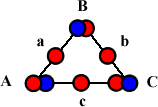
In the meantime, I was curious to understand how the LRC model of hydrinos would fare. It didn’t take long to discover that it fares well, although it may take some courage to publish it. It’s easy to see that our preon model of the electron and the photon allows for increasing the energy of the hydrogen atom from the ground state to an excited state, by absorbtion of photons:
 +
+  =
=
When the electron absorbs the photon, the S|T unbalance (qualitatively indicated by the color at the nodes a, b and c, in the figure above) is not affected. Thus, no change in the “charge” of the electron, going from ground state (1/2, red), to an excited state (1/2 + 1/1 = 2/3, red) is realized, even though the actual number of the S|T units in the ratio is doubled, by the event.
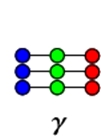
However, going to a lower state, a fraction of the ground state, is not so easy, since obviously it can’t be done by adding S|T balanced units of the photons (S|T = 1/1, green) to the unbalanced S|T units of the electron (S|T = 1/2, red), as happens in the excited state transitions.
In Mills theory, the electron gives up energy from its central field to a catalyst, through a “non-radiative” process of energy transfer, more like a potential - kinetic energy exchange, which, of course, he must do, in a theory formed within the Newtonian system of theory, based on the vectorial motion of classical physics.
The LRC model, however, has no recourse to such motion, since our model is strictly based on the scalar motion of the Reciprocal System of Physical Theory (RST). Consequently, we are forced to add the unbalanced units of another boson to the electron, the W- boson, in order to “lower” the energy of the hydrogen-bound electron by some “fraction,” and form a hydrino.
Certainly, this is going to be problematic, since the W- boson incorporated into the standard model is so short lived, it can only be presumed to exist. Nevertheless, in our RST-based model, it is a combination of S|T units that must exist, because it is one of the 20 possible combinations of S|T units (16 fermions and 4 bosons). Whether it is short lived or not, would depend on the environment in which it finds itself.
Nevertheless, combining this boson with an electron bound in an hydrogen atom, in our toy model, is as straightforward as combining such an electron with a photon boson:
+  =
=
But now, by this process, the unbalanced S|T ratio (charge) doubles! It goes from S|T = 1/2 to S|T = (1/2 + 1/2) = 2/4. Therefore, the electron charge changes from -1 to -2, and the electron’s orbit moves closer to the nucleus (in the LST model), by a fraction (1/2) energy-wise in the new hydrino state.
Now, this may still take place “non-radiatively,” if there is an equivalent phonon vibration in the catalyst equivalent to the W- boson. In other words, it may be a kinetic - potential energy exchange just as Mills theory requires.
Well, I wrote to Mills and we have had a few short discussions about it, but, understandably, he is in no position to comprehend the LRC’s RST-based model, and so remains unconvinced, seeing it as numerology. I imagine that only empirical evidence would be convincing enough to get him to consider it, but his people are not looking to see a change in e-, so it’s not likely to be discovered, by them, if it actually exists.
The exciting thing for us, though, is that this just might prove to be a prediction of the LRC’s RST-based model of scalar motion combinations.
Wow.
Update: March 13, 2015
The Missing Principle
Dr. David Gross, in a recent talk given at New York University, surveyed the past, the present and the future of theoretical physics. He concluded, once again, that the challenge lies in finding a new concept of space-time. “We suspect,” he says, “that space-time,” which is the non-dynamical basis for a framework of quantum fields, and the dynamical basis for string theory, as he describes it, “is emergent.”
So, given this reality, the question that arises is, “What are the rules of physics without spacetime?” He has no answer, of course, but the legacy system of theoretical physics (LST), “is alive and well,” he assures us, because it is in this “period of utter confusion.”
The only idea he foresees with any hope is to switch the system from one originating in fixed-space concepts, extending to the dynamics of space-time (quantum gravity), to one somehow originating in time, extending to space-time, where fixed-space is emergent.
The trouble is, of course, he knows of no one who knows how to do that, or even where to begin. Hence, the LST community is “stuck,” as Steven Weinberg put it many years ago, and David Gross just puts the same grim conclusion in more expansive terms, when he asks, “What is the framework of theoretical physics?” The “True answer is,” he says, “we have no idea!”
He goes on to say, “We have no idea how to even formulate it, what the boundaries are, or what the rules are, the equations, the thing that replaces the path intregal, the action, or anything like that.” To be a true framework of theoretical physics, the current collection of “tools” used to calculate quantum states that are consistent, must have a principle that is missing, he proclaims. This missing principle, or theory, of symmetry, of dynamics, of consistentcy, of (whatever), would lead us to a UNIQUE solution of cosmology, not a vacuum, but a space-time.
Well, as you can imagine, this talk is just as provocative for those of us familiar with Dewey B. Larson’s works, as his earlier talks, given about eight years ago, when he said essentially the same thing:
In string theory I think we’re in sort of a pre-revolutionary stage. We have hit upon, somewhat accidentally, an incredible theoretical structure…but we still haven’t made a very radical break with conventional physics. We’ve replaced particles with strings—that in a sense is the most revolutionary aspect of the theory. But all of the other concepts of physics have been left untouched…many of us believe that that will be insufficient…That at some point, a much more drastic revolution or discontinuity in our system of beliefs will be required. And that this revolution will likely change the way we think about space and time.
His confidence in string theory may have waned somewhat since then, but the same “revolution, or discontinuity in our system of beliefs,” is still required, according to Gross.
That the Reciprocal System of Physical Theory (RST) is just such a revolution in the frameword of theoretical physics is clear, but only amatures and little league professionals are able to recognize it at this point. It is the missing principle, a system based on the concept of scalar motion coming before the vectorial motion of matter. One which forms the boundaries of a fixed reference system, at the moment a space/time oscillation (a SUDR, or a TUDR) comes into existence.
When such an entity exists, a zero-dimensional point is definable. When two such entities exist, a one-dimensional line between them is definable. When three such entities exists, not all in a line, a two-dimensional area between them is definable. When four or more of these entities exist, not all in a plane, a three-dimensional volume between them is definable.
Thus, because the distances between these points is measurable, in terms of elapsed space/time, so-called space-time, or geometry, emerges. The known rules of geometry and physics apply to this newly defined space, over time, and effect further combinations of the two oscillating entities, in ways that are observed.
Matter emerges in the pattern of logical combinations of these entities, as they form, from simple to complex. The properties of these combinations, including “charge,” “mass” and “spin,” proceed from the nature of these combinations, or relations between them, but, ultimately, they are nothing but combinations of scalar motion, the new principle of space/time reciprocity. which is missing from the current framework of theoretical physics.
Debate: Why Something Rather Than Nothing?
The question that Larson answered for me a long time ago was debated recently by well known personalities in the LST community. They actually changed the question from “Why?” to “How?” but I can’t see much difference. To ask, “How is it that something can come from nothing?” may be clearer, than “Why is it there is something rather than nothing?” but, in either case, nothing has to be defined and that is the key.
They talk about virtual particles in a vacuum being nothing, because they can’t be measured, but becoming real, when, say, a positron and electron are produced, the energy and charges of this pair of particles balancing out to zero. This is a highly unlikely and unsatisfying manipulation of ad hoc definitions to my mind.
I agree, though, that the definition of nothing has to be modified to something that is nothing, because it can’t be measured, like the balance of a scale. It points to 0 when it’s balanced, but that doesn’t necessarily mean that nothing is on either side. It can also mean that two, equal quantities are on opposite sides of the scale, which can be changed, unbalancing the scale and therefore producing something.
Interestingly enough, the definition of nothing as something that cannot be measured, brings up the question of law. If we define nothing as something undetectable, which turns into something detectable, it has to do so as a matter of law. A law must govern nothing that transforms it into a lawful something.
However, in the LST community, an anthropomorphic set of infinite environs now sits opposed to this legalistic determinism of traditional thought. The 10^500 possibilities of the vacua facing string theory imply that there are that many possible sets of laws that can be observed by any observer who may be part of a given system, meaning nothing has meaning in an absolute sense, which has led to the idea of multiverses.
Unfortunately, Larson’s ideas cannot be brought to the LST table of discussion, but we can see their power and beauty, by imagining that they were permitted. Larson defines nothing as a perfect balance between the rates of changing quantities of space and changing quantities of time. Given a change of unit space, for each change of unit time, defines a unit motion that cannot be measured.
The law of this nothing that is something is the fundamental law of algebraic relations, the greater than, less than or equal to relations of these two changing quantities that define nothing, when they are in equilibrium. This law of algebraic relations governs the universe of motion, for by it something comes from nothing, when the equilibrium of the two rates of change is altered.
It is astounding to me that from this law all the elements of the standard model emerge. The less thans are connected to the more thans, and these become the equal tos, which are compounded into different equal tos, of greater and greater power, and these three are compoundable into combinations of balanced and unbalanced more thans, less thans and equal tos, which just happen to form the exact number of different kinds of particles and anti-particles found in the standard model of LST particle physics.
But then, if that were not enough, these fundamental combinations compound, still following the same algebraic law, into combinations identical to the protons and neutrons of the LST nuclear physics, which, along with the electron, compound into the 117 elements of the LST chemistry, forming the periodic table of elements.
It remains to learn more about how they combine and uncombine and otherwise relate to each other, but even this much would make for a much more interesting discussion at the LST table than the boring speculation about the multiverse that their current discussion inevitably devolves to.