<?xml version="1.0" encoding="UTF-8"?>
<!--Generated by Squarespace Site Server v5.9.2 (http://www.squarespace.com/) on Fri, 12 Mar 2010 11:28:48 GMT--><rdf:RDF xmlns:rdf="http://www.w3.org/1999/02/22-rdf-syntax-ns#" xmlns:rss="http://purl.org/rss/1.0/" xmlns:dc="http://purl.org/dc/elements/1.1/" xmlns:sy="http://purl.org/rss/1.0/modules/syndication/" xmlns:admin="http://webns.net/mvcb/" xmlns:content="http://purl.org/rss/1.0/modules/content/" xmlns:cc="http://web.resource.org/cc/"><rss:channel rdf:about="http://www.lrcphysics.com/scalar-physics/"><rss:title>The New Physics</rss:title><rss:link>http://www.lrcphysics.com/scalar-physics/</rss:link><rss:description></rss:description><dc:language>en-US</dc:language><dc:date>2010-03-12T11:28:48Z</dc:date><admin:generatorAgent rdf:resource="http://www.squarespace.com/">Squarespace Site Server v5.9.2 (http://www.squarespace.com/)</admin:generatorAgent><rss:items><rdf:Seq><rdf:li rdf:resource="http://www.lrcphysics.com/scalar-physics/2009/11/28/square-roots-1st-2nd-orderings-of-the-periodic-table.html"/><rdf:li rdf:resource="http://www.lrcphysics.com/scalar-physics/2009/10/28/the-glaring-lacuna.html"/><rdf:li rdf:resource="http://www.lrcphysics.com/scalar-physics/2009/9/19/the-tetraktys-and-oscillating-pseudoscalars.html"/><rdf:li rdf:resource="http://www.lrcphysics.com/scalar-physics/2009/4/23/oscillating-pseudoscalars.html"/><rdf:li rdf:resource="http://www.lrcphysics.com/scalar-physics/2008/11/7/the-arrow-of-time.html"/><rdf:li rdf:resource="http://www.lrcphysics.com/scalar-physics/2008/11/5/cosmology-the-universe-of-motion.html"/><rdf:li rdf:resource="http://www.lrcphysics.com/scalar-physics/2008/9/29/forming-atoms.html"/><rdf:li rdf:resource="http://www.lrcphysics.com/scalar-physics/2008/9/20/from-preons-to-bosons-fermions-and-atoms.html"/><rdf:li rdf:resource="http://www.lrcphysics.com/scalar-physics/2008/7/2/the-periodic-table-of-cosmic-elements.html"/><rdf:li rdf:resource="http://www.lrcphysics.com/scalar-physics/2008/6/19/discovering-larsons-factor-3.html"/></rdf:Seq></rss:items></rss:channel><rss:item rdf:about="http://www.lrcphysics.com/scalar-physics/2009/11/28/square-roots-1st-2nd-orderings-of-the-periodic-table.html"><rss:title>Square Roots &amp; 1st &amp; 2nd Orderings of the Periodic Table</rss:title><rss:link>http://www.lrcphysics.com/scalar-physics/2009/11/28/square-roots-1st-2nd-orderings-of-the-periodic-table.html</rss:link><dc:creator>Doug</dc:creator><dc:date>2009-11-28T21:34:22Z</dc:date><dc:subject></dc:subject><content:encoded><![CDATA[<p>In 1929, Charles Janet published <a href="http://www.ipgp.fr/%7Etarantola/Files/Professional/Mendeleev/Janet_1929.pdf">his paper</a>, &ldquo;Deliberations on the Structure of the Nuclear Atom,&rdquo; in which he proposed an interesting alternative to today&rsquo;s Periodic Table of Elements. Although it has been almost completely ignored, his table was loosely based on the same 2n<sup>2</sup> periodic relationship used in quantum mechanics, but, as shown in figure 1 below, with an interesting twist. The first period contains four elements!</p>
<table border="0" cellspacing="0" cellpadding="0" align="left">
<tbody>
<tr>
<td width="12" height="15">&nbsp;</td>
</tr>
<tr>
<td>&nbsp;</td>
<td>&nbsp;</td>
</tr>
</tbody>
</table>
<p>&nbsp;<span class="full-image-block ssNonEditable"><img src="http://www.lrcphysics.com/storage/images/Janet%20Table1.jpg?__SQUARESPACE_CACHEVERSION=1259444474850" alt="" width="583" height="429" /></span></p>
<p><strong>Figure 1.</strong> The Periodic Table of Charles Janet Published in 1929.</p>
<p>This table, appearing on Albert Tarantola&rsquo;s website, is based on Janet&rsquo;s work, which Tarantola refers to as the &#8220;first ordering&#8221; of the elements. It follows the accepted electron configuration sequence in ascending atomic order, so even though the two columns of akali metals and akaline earth metals are moved over to the right under hydrogen and helium, the accepted order of electron shell filling is maintained, as shown in table 1 below.</p>
<p>&nbsp;</p>
<table border="1" cellspacing="0" cellpadding="0" align="left">
<tbody>
<tr style="text-align: center;">
<td width="31" valign="top">
<p>&nbsp;<strong>&nbsp;</strong></p>
</td>
<td width="36" valign="top">
<p>&nbsp;<strong>&nbsp;</strong></p>
</td>
<td width="36" valign="top">
<p>&nbsp;<strong>&nbsp;</strong></p>
</td>
<td width="36" valign="top">
<p><strong>1s</strong></p>
</td>
</tr>
<tr>
<td width="31" valign="top">
<p>&nbsp;<strong>&nbsp;</strong></p>
</td>
<td width="36" valign="top">
<p>&nbsp;<strong>&nbsp;</strong></p>
</td>
<td width="36" valign="top">
<p>&nbsp;<strong>&nbsp;</strong></p>
</td>
<td width="36" valign="top">
<p><strong>2s</strong></p>
</td>
</tr>
<tr>
<td width="31" valign="top">
<p>&nbsp;<strong>&nbsp;</strong></p>
</td>
<td width="36" valign="top">
<p>&nbsp;<strong>&nbsp;</strong></p>
</td>
<td width="36" valign="top">
<p><strong>2p</strong></p>
</td>
<td width="36" valign="top">
<p><strong>3s</strong></p>
</td>
</tr>
<tr>
<td width="31" valign="top">
<p>&nbsp;<strong>&nbsp;</strong></p>
</td>
<td width="36" valign="top">
<p>&nbsp;<strong>&nbsp;</strong></p>
</td>
<td width="36" valign="top">
<p><strong>3p</strong></p>
</td>
<td width="36" valign="top">
<p><strong>4s</strong></p>
</td>
</tr>
<tr>
<td width="31" valign="top">
<p>&nbsp;<strong>&nbsp;</strong></p>
</td>
<td width="36" valign="top">
<p><strong>3d</strong></p>
</td>
<td width="36" valign="top">
<p><strong>4p</strong></p>
</td>
<td width="36" valign="top">
<p><strong>5s</strong></p>
</td>
</tr>
<tr>
<td width="31" valign="top">
<p>&nbsp;<strong>&nbsp;</strong></p>
</td>
<td width="36" valign="top">
<p><strong>4d</strong></p>
</td>
<td width="36" valign="top">
<p><strong>5p</strong></p>
</td>
<td width="36" valign="top">
<p><strong>6s</strong></p>
</td>
</tr>
<tr>
<td width="31" valign="top">
<p><strong>4f</strong></p>
</td>
<td width="36" valign="top">
<p><strong>5d</strong></p>
</td>
<td width="36" valign="top">
<p><strong>6p</strong></p>
</td>
<td width="36" valign="top">
<p><strong>7s</strong></p>
</td>
</tr>
<tr>
<td width="31" valign="top">
<p><strong>5f</strong></p>
</td>
<td width="36" valign="top">
<p><strong>6d</strong></p>
</td>
<td width="36" valign="top">
<p><strong>7p</strong></p>
</td>
<td width="36" valign="top">
<p><strong>8s</strong></p>
</td>
</tr>
</tbody>
</table>
<p>&nbsp;</p>
<p>&nbsp;</p>
<p>&nbsp;</p>
<p>&nbsp;</p>
<p>&nbsp;</p>
<p>&nbsp;</p>
<p>&nbsp;</p>
<p>&nbsp;</p>
<p>&nbsp;</p>
<p><strong>Table 1.</strong> Z-Ordered Electron Configuration of Janet Table (Read left to right, top to bottom)</p>
<p>This is interesting in the context of the LRC&rsquo;s RST-based research, because the periods of Larson&rsquo;s periodic table (<a href="http://www.meta-synthesis.com/webbook/35_pt/pt_database.php?PT_id=205">here</a>) are based on his 4n<span style="vertical-align: super; font-size: 70%;">2</span> relationship, which requires four elements in the first period. Of course, it&rsquo;s always been assumed that the three missing elements in the first period were incomplete elements such as the proton, neutron and electron (or neutrino, or massless neutron, etc.)</p>
<p>However, the placing of helium, lithium and beryllium into the first period is very interesting, although it &ldquo;dethrones the noble gases from their key positions in the table, which is especially disappointing in view of the LRC&rsquo;s <a href="http://rstheory.org/articles/Bundy/WheelOfMotion.html">Wheel of Motion</a> form of the table.</p>
<p>Interestingly, as <a href="http://www.ipgp.fr/%7Etarantola/Files/Professional/Mendeleev/">Tarantola</a> and others have pointed out, another form of the table can be constructed from a ratio of square roots of atomic ionization potentials, as first shown by <a href="http://www.ipgp.fr/%7Etarantola/Files/Professional/Mendeleev/LeCornec.pdf">Le Cornec</a> in 2002, using actual ionization data from the existing literature. Although Tarantola dismisses the significance of Le Cornec&rsquo;s work, because he offers no theory to explain it, he does acknowledges that it shows a reversal in the order of the &ldquo;s&rdquo; and &ldquo;p&rdquo; energy levels, which, unlike Le Cornec, who asserts that this indicates a major failure of quantum mechanics, he simply attributes to the fact that the atom is a &ldquo;complex object.&rdquo; Tarantola calls this table the &#8220;second ordering&#8221; and leaves it at that.</p>
<p>For us, though, the fact that the ionization pattern shows a different order, inconsistent with the standard atomic model, is extremely interesting. One of the reasons why appears in the mapping of the s, p, d and f energy levels to the tetraktys. If we place these sets of 2 energy levels into the tetraktys, with subscripts indicating each, we get table 2 below.</p>
<table border="1" cellspacing="0" cellpadding="0">
<tbody>
<tr>
<td width="31" valign="top">
<p>&nbsp;</p>
</td>
<td width="29" valign="top">
<p>&nbsp;</p>
</td>
<td width="30" valign="top">
<p align="center">&nbsp;</p>
</td>
<td width="30" valign="top">
<p>2s</p>
</td>
<td width="30" valign="top">
<p>&nbsp;</p>
</td>
<td width="30" valign="top">
<p>&nbsp;</p>
</td>
<td width="31" valign="top">
<p>&nbsp;</p>
</td>
</tr>
<tr>
<td width="31" valign="top">
<p align="center">&nbsp;</p>
</td>
<td width="29" valign="top">
<p align="center">&nbsp;</p>
</td>
<td width="30" valign="top">
<p align="center">2s</p>
</td>
<td width="30" valign="top">
<p align="center">&nbsp;</p>
</td>
<td width="30" valign="top">
<p align="center">2p</p>
</td>
<td width="30" valign="top">
<p align="center">&nbsp;</p>
</td>
<td width="31" valign="top">
<p align="center">&nbsp;</p>
</td>
</tr>
<tr>
<td width="31" valign="top">
<p align="center">&nbsp;</p>
</td>
<td width="29" valign="top">
<p align="center">2s</p>
</td>
<td width="30" valign="top">
<p align="center">&nbsp;</p>
</td>
<td width="30" valign="top">
<p align="center">2p</p>
</td>
<td width="30" valign="top">
<p align="center">&nbsp;</p>
</td>
<td width="30" valign="top">
<p align="center">2d</p>
</td>
<td width="31" valign="top">
<p align="center">&nbsp;</p>
</td>
</tr>
<tr>
<td width="31" valign="top">
<p align="center">2s</p>
</td>
<td width="29" valign="top">
<p align="center">&nbsp;</p>
</td>
<td width="30" valign="top">
<p align="center">2p</p>
</td>
<td width="30" valign="top">
<p align="center">&nbsp;</p>
</td>
<td width="30" valign="top">
<p>2d</p>
</td>
<td width="30" valign="top">
<p>&nbsp;</p>
</td>
<td width="31" valign="top">
<p>2f</p>
</td>
</tr>
</tbody>
</table>
<p>&nbsp;</p>
<p><strong>Table 2.</strong> Duality of Electron Configurations Mapped to the Duality of the Tetraktys</p>
<p>As will be readily noticed, the energy levels map perfectly to the tetraktys, in some respects. There is one of the four dual &ldquo;s&rdquo; sets at the top, with the remaining three &ldquo;s&rdquo; sets positioned in the same repeating fashion, at the beginning of each row, as the 2<sup>0</sup> values in the tetraktys. The total number of sets is consistent as well, with four dual &ldquo;s&rdquo; sets, three dual &ldquo;p&rdquo; sets, two dual &ldquo;d&rdquo; sets and 1 dual &ldquo;f&rdquo; set, each set having two, six, ten and fourteen members, respectively (the difference between the successive 2n<sup>2</sup> periods), arranged into four groups, corresponding to the four 4n<sup>2</sup> periods of Larson&rsquo;s table and the Wheel of Motion.</p>
<p>In fact, the only missing characteristic seems to be the accepted electron configuration order. However, Le Conec&rsquo;s ionization&rsquo;s order doesn&rsquo;t comply either. As shown in figure 2 below, Tarantola&rsquo;s table of second ordering takes lithium and beryllium out of the first period and puts them back into the second period, as indicated by Le Cornec&rsquo;s ionization results.</p>
<p>&nbsp;<span class="full-image-block ssNonEditable"><img src="http://www.lrcphysics.com/storage/images/Janet%20Table2.jpg?__SQUARESPACE_CACHEVERSION=1259444871188" alt="" width="453" height="224" /></span></p>
<p><strong>Figure 2.</strong> Tarantola&rsquo;s Modification of the Periodic Table (Second Ordering) Given Le Cornec&rsquo;s Results</p>
<p>But, if we take the fact that Janet&rsquo;s table, based on a 2n<sup>2</sup> period, concurs with Larson&rsquo;s table, based on a 4n<sup>2</sup> period, and the fact that Le Cornec&rsquo;s results contradict quantum theory, based on a ratio of square roots, we have to take notice, because, as it turns out, the oscillating pseudoscalars of the S|T units, contain both the 2n<sup>2</sup> and the 4n<sup>2</sup> terms, as the two factors in a series of ratios of square root products that fit the four periods of the table!</p>
<p>Again, the only thing missing is the order of the energy levels. If we map the four periods of the square root equations to the tetraktys, we get a perfect match, as shown in table 3 below.</p>
<table border="1" cellspacing="0" cellpadding="0" align="left">
<tbody>
<tr>
<td width="60" valign="top">
<p align="center">&nbsp;</p>
</td>
<td width="60" valign="top">
<p align="center">&nbsp;</p>
</td>
<td width="60" valign="top">
<p align="center">&nbsp;</p>
</td>
<td width="60" valign="top">
<p align="center">2x4</p>
</td>
<td width="60" valign="top">
<p align="center">&nbsp;</p>
</td>
<td width="60" valign="top">
<p align="center">&nbsp;</p>
</td>
<td width="60" valign="top">
<p align="center">&nbsp;</p>
</td>
</tr>
<tr>
<td width="60" valign="top">
<p align="center">&nbsp;</p>
</td>
<td width="60" valign="top">
<p align="center">&nbsp;</p>
</td>
<td width="60" valign="top">
<p align="center">2x4</p>
</td>
<td width="60" valign="top">
<p align="center">&nbsp;</p>
</td>
<td width="60" valign="top">
<p align="center">8x16</p>
</td>
<td width="60" valign="top">
<p align="center">&nbsp;</p>
</td>
<td width="60" valign="top">
<p align="center">&nbsp;</p>
</td>
</tr>
<tr>
<td width="60" valign="top">
<p align="center">&nbsp;</p>
</td>
<td width="60" valign="top">
<p align="center">2x4</p>
</td>
<td width="60" valign="top">
<p align="center">&nbsp;</p>
</td>
<td width="60" valign="top">
<p align="center">8x16</p>
</td>
<td width="60" valign="top">
<p align="center">&nbsp;</p>
</td>
<td width="60" valign="top">
<p align="center">18x36</p>
</td>
<td width="60" valign="top">
<p align="center">&nbsp;</p>
</td>
</tr>
<tr>
<td width="60" valign="top">
<p align="center">2x4</p>
</td>
<td width="60" valign="top">
<p align="center">&nbsp;</p>
</td>
<td width="60" valign="top">
<p align="center">8x16</p>
</td>
<td width="60" valign="top">
<p align="center">&nbsp;</p>
</td>
<td width="60" valign="top">
<p align="center">18x36</p>
</td>
<td width="60" valign="top">
<p align="center">&nbsp;</p>
</td>
<td width="60" valign="top">
<p align="center">32x64</p>
</td>
</tr>
</tbody>
</table>
<p>&nbsp;</p>
<p><strong>&nbsp;</strong></p>
<p>&nbsp;</p>
<p><strong>Table 3.</strong> Duality of S|T 2n<sup>2</sup> x 4n<sup>2</sup> Periodicity Mapped to Tetraktys</p>
<p>Though, at first, this seems counter intuitive, it works because the equations of the table are based on the equation of inverse geometry (r&rsquo;<sup>2</sup> = r * r&rsquo;&rsquo;), where the inverse of a given circle&rsquo;s, or sphere&rsquo;s, radius, works out to be twice, or half, its radius. Students of the RST will recognize the significance of this immediately, since 1/2 and 2/1 are the basic units of speed-displacement in the system.</p>
<p>Details to follow soon.</p>
]]></content:encoded></rss:item><rss:item rdf:about="http://www.lrcphysics.com/scalar-physics/2009/10/28/the-glaring-lacuna.html"><rss:title>The "Glaring Lacuna"</rss:title><rss:link>http://www.lrcphysics.com/scalar-physics/2009/10/28/the-glaring-lacuna.html</rss:link><dc:creator>Doug</dc:creator><dc:date>2009-10-28T11:38:10Z</dc:date><dc:subject></dc:subject><content:encoded><![CDATA[<p>One of the most important and immediate objectives of our research here at the LRC is to address the &ldquo;glaring lacuna&rdquo; in Larson&rsquo;s work, the inability to calculate the atomic spectra. Larson tried to work it out, but temporarily gave it up, when it appeared so complex and obtuse a subject that it became apparent that it would drain his resources and slow his progress in developing his RST-based theory, what we call his <a href="http://www.lrcphysics.com/reciprocal-system-theory/">Reciprocal System theory (RSt)</a>.</p>
<p>It was Nehru who gave it the label with which we still refer to it today. While noting this great contrast with the success of the LST&rsquo;s wave mechanics in explaining the &ldquo;vast wealth of spectroscopic data,&rdquo; he goes on to elaborate on the much heralded success of the <a href="http://www.lrcphysics.com/legacy-physics/">LST</a> theory:</p>
<p style="padding-left: 30px;">The several quantum numbers, n, l, m, etc. come out in a natural way in the theory. Even the &#8220;selection rules&#8221; that govern the transitions from one energy state to another could be derived. The fine and the hyperfine structures of the spectra, the breadth and intensity of the lines, the effects of electric and magnetic forces on the spectra could all be derived with great accuracy. In addition, it predicts many non-classical phenomena, such as the tunneling through potential barriers or the phenomena connected with the phase, which found experimental verification.</p>
<p>Of course, all of this began with Heisenberg&rsquo;s great discovery of the non-commutative multiplication in the first mathematical structure of quantum mechanics. As Bohr wrote Rutherford:</p>
<p style="padding-left: 30px;">Heisenberg is a young German of gifts and achievement. In fact, because of his last work, prospects have at one stroke been realized, which, although only vaguely grasped, have for a long time been the center of our wishes. We now see the possibility of developing a quantitative theory of atomic structure.</p>
<p>In developing an RST-based theory, however, the second postulate limits us to an algebra of magnitudes that is ordered (absolute), commutative and associative (meaning its geometry is Euclidean). Nehru&rsquo;s approach, an attempt to clarify the physical concepts of quantum mechanics, while keeping the mathematics, is therefore problematic, unless we drop the second fundamental postulate of the <a href="http://www.lrcphysics.com/rst/">RST</a>.</p>
<p>Fortunately, as described in the previous post, the new mathematics developed at the LRC, based on reciprocal numbers as analogs of the scalar/pseudoscalar ratios, maintains these essential algebraic properties. Using this algebra, we have been able to build a simple toy model of the motions and combinations of motions that is consistent with the second postulate and that contains the bosons and fermions (both quarks and leptons) of the standard model of particle physics and the baryons of the periodic table based on Larson&rsquo;s 4n<sup>2</sup> concept, as opposed to the 2n<sup>2</sup> concept of quantum mechanics.</p>
<p>The challenge, however, has, again, been to identify the quantitative relations between these bosons, quarks and leptons, as observed in the experimental energy levels of the baryons. In short, we need the RST breakthrough that corresponds to Heisenberg&rsquo;s quantum mechanical breakthrough.</p>
<p>Well, I&rsquo;m happy to announce today that the needed breakthrough has arrived; at least it has as far as the toy model is concerned. Recall that our RST-based model, unlike the LST model and Nehru&rsquo;s model, is not based on rotation, but rather the vibrations of the pseudoscalars, which we call S|T units, the SUDRs and TUDRs, which are inverse pseudoscalar/scalar oscillations. Figure 1 shows how these combine to form the entities of the standard model.</p>
<p>&nbsp;<span class="full-image-block ssNonEditable"><img src="http://www.lrcphysics.com/storage/images/ST%20Combos.jpg?__SQUARESPACE_CACHEVERSION=1256740346663" alt="" /></span></p>
<p><span class="full-image-block ssNonEditable"><img src="http://www.lrcphysics.com/storage/images/STBosons.png?__SQUARESPACE_CACHEVERSION=1256739489932" alt="" /></span></p>
<p><span class="full-image-block ssNonEditable"><img src="http://www.lrcphysics.com/storage/images/ST3Grps.png?__SQUARESPACE_CACHEVERSION=1256739559424" alt="" /></span>&nbsp;</p>
<p><strong>Figure 1.</strong> Scalar Motion Combinations</p>
<p>The middle colors, green, red and blue are used to indicate the relative balance of red SUDRs and blue TUDRs in a given combination. A green circle in the middle of a combo indicates an even number of each. A red color indicates more SUDRs than TUDRs, while a blue color indicates the reverse. We assume an initial value of one SUDR and one TUDR in the green balanced combo, and an excess of one kind of unit in the unbalanced combos.</p>
<p>This works out perfectly in terms of combining protons, neutrons and electrons, but the question has been how to fit the photons into these combos. In the quantum mechanical model, the electron is regarded as orbiting the nucleus (Bohr&rsquo;s model), even though this was modified (the cloud model) to fit Heisenberg&rsquo;s mathematical structure, wherein no definite orbital path could be identified.</p>
<p>In the S|T model, the electron doesn&rsquo;t rotate around the nucleus, but becomes an integral part of the atomic structure, as shown in figure 2 below:</p>
<p><span style="font-size: 140%;">Electron</span></p>
<p><span class="full-image-float-left ssNonEditable"><img src="../../storage/images/ElectronFermion.png?__SQUARESPACE_CACHEVERSION=1256740600433" alt="" /></span><span class="full-image-block ssNonEditable"><img src="http://www.lrcphysics.com/storage/images/Atomic%20Nuclei.jpg?__SQUARESPACE_CACHEVERSION=1256740485646" alt="" /></span></p>
<p><span class="full-image-block ssNonEditable"><span><img src="http://www.lrcphysics.com/storage/images/Deuterium.jpg?__SQUARESPACE_CACHEVERSION=1256743074678" alt="" /></span></span></p>
<p><strong>Figure 2.</strong> Combining Quarks and Leptons into Baryons&nbsp;</p>
<p>Even though the standard model is empirical, the mathematical relations of its entities are described by Heisenberg&rsquo;s fundamental mathematical structure developed in two theories: The first theory is quantum electro dynamics (QED), and the second theory is quantum chromo dynamics (QCD). Both of these theories are based on rotations and suffer from the algebraic pathology of higher dimensional numbers, as explained in previous posts. The underlying mathematical structure is described as based upon the principles of symmetry in U(1)xSU(2)xSU(3) groups, but these groups are formed from numbers derived from rotations.</p>
<p>In our theory, there are no rotations, so the challenge has been how to show the different energy levels of the atomic spectra in the new model, which has no orbits or electron shells. The breakthrough has come by realizing that the combinations of motions in the S|T combos, while numerically balanced and accurate in the baryons and their combos are nevertheless what we might call internally polarized. This was understood by simply tabulating the SUDR|TUDR counts at the nodes of the combos. For instance, tabulating the S|T nodes in the combination of a proton, neutron and electron, as shown in figure 3a below, results in a polarized triangle, representing the deuterium atom, as shown in figure 3b.</p>
<p><span class="full-image-block ssNonEditable"><span><img src="http://www.lrcphysics.com/storage/images/tabulated%20nodes%20of%20Deuteium.jpg?__SQUARESPACE_CACHEVERSION=1256743756329" alt="" /></span></span>&nbsp;</p>
<p><strong>Figure 3.</strong> The Polarization of Non-Ionized Deuterium</p>
<p>This is a remarkable and fortuitous result, since it permits the binding of a boson to the atom, as shown in figure 4 below, without changing anything, but the energy of the combo:</p>
<p><span class="full-image-block ssNonEditable"><span><img src="http://www.lrcphysics.com/storage/images/Photon%20Baryon%20Combo.jpg?__SQUARESPACE_CACHEVERSION=1256743778352" alt="" /></span></span></p>
<p><strong>Figure 4</strong>. Combining Photons with Baryons</p>
<p>On this basis, we may now begin to develop a quantitative relation between photons and atoms in our model &ndash; the atomic spectra! Indeed, we might say that, perhaps, the prospects at one stroke have been realized, which have, for a long time, been the center of our wishes!</p>
]]></content:encoded></rss:item><rss:item rdf:about="http://www.lrcphysics.com/scalar-physics/2009/9/19/the-tetraktys-and-oscillating-pseudoscalars.html"><rss:title>The Tetraktys and Oscillating Pseudoscalars</rss:title><rss:link>http://www.lrcphysics.com/scalar-physics/2009/9/19/the-tetraktys-and-oscillating-pseudoscalars.html</rss:link><dc:creator>Doug</dc:creator><dc:date>2009-09-19T13:23:35Z</dc:date><dc:subject></dc:subject><content:encoded><![CDATA[<p>The importance of the tetraktys in mathematics and physics is well known, as the Clifford algebras are intimately associated with the study of geometry and physical theory. Here at the LRC, we know that this is due to the fact that the union of mathematics and physics requires understanding that there are three properties of numbers and motion: magnitude, dimension and &ldquo;direction,&rdquo; where each non-zero dimension has magnitude in two &ldquo;directions,&rdquo; which we can think of as up and down, left and right, forward and backward.</p>
<p>The fact that rational numbers and scalar motion have inverses (two &ldquo;directions&rdquo;) means that the tetraktys should also have its inverse, and, in fact, it does. We can show this by writing the numbers of the tetraktys as ratios:</p>
<p>2<sup>0</sup>/2<sup>0</sup> = 1/1<br /> 2<sup>0</sup>/2<sup>0</sup> 2<sup>1</sup>/2<sup>0</sup> = 1/1, 2/1<br /> 2<sup>0</sup>/2<sup>0</sup> 2<sup>1</sup>/2<sup>0</sup> 2<sup>2</sup>/2<sup>0</sup> = 1/1, 2/1, 4/1<br /> 2<sup>0</sup>/2<sup>0</sup> 2<sup>1</sup>/2<sup>0</sup> 2<sup>2</sup>/2<sup>0</sup> 2<sup>3</sup>/2<sup>0</sup> = 1/1, 2/1, 4/1, 8/1</p>
<p>then its inverse is obviously,</p>
<p>2<sup>0</sup>/2<sup>0</sup> = 1/1<br /> 2<sup>0</sup>/2<sup>0</sup> 2<sup>0</sup>/2<sup>1</sup> = 1/1, 1/2<br /> 2<sup>0</sup>/2<sup>0</sup> 2<sup>0</sup>/2<sup>1</sup> 2<sup>0</sup>/2<sup>2</sup> = 1/1, 1/2, 1/4<br /> 2<sup>0</sup>/2<sup>0</sup> 2<sup>0</sup>/2<sup>1</sup> 2<sup>0</sup>/2<sup>2</sup> 2<sup>0</sup>/2<sup>3</sup> = 1/1, 1/2, 1/4, 1/8</p>
<p>This may not be of interest to the LST community, because they don&rsquo;t recognize scalar motion, let alone multi-dimensional scalar motion, and even if they did no doubt they would be stopped cold by the notion of super-luminal speeds.</p>
<p>But in the RST community, aware of the cosmic sector and its inverse speeds, the inverse tetraktys is of great interest, since it is a generalization of the multi-dimensional numbers, and their algebras, of the cosmic sector, just as the tetraktys is the generalization of those things in the material sector.</p>
<p>To truly understand the theoretical universe of the RST, both the tetraktys and the inverse tetraktys are necessary. Of course, this means that we need multi-dimensional numbers and units of motion that are scalar, or pseudoscalar, but, unfortunately, these don&rsquo;t exist in the LST community&rsquo;s system of mathematics. They have devised an imaginary number (the so-called square root of -1) to raise the dimension of scalar numbers, because they needed to stick with the 1D motion of objects, not realizing that motion without objects is also possible.</p>
<p>However, as we know, this has sickened their multi-dimensional algebras, forcing them to cope with trying to understand physics with nothing but scalars and vectors, or the 0D numbers of scalars and the 1D numbers of complex numbers. Because of this, most physicists and engineers would think we&rsquo;ve gone batty if we start referring to multi-dimensional scalars - to them, it&rsquo;s a contradiction in terms.</p>
<p>Nevertheless, that&rsquo;s really what pseudoscalars are. So now we want to go back and replace the imaginary square root of -1, upon which the superstructure of modern mathematics has been built, with the square root of 2, which is not an imaginary number, but a very real one (no pun intended here - lol).</p>
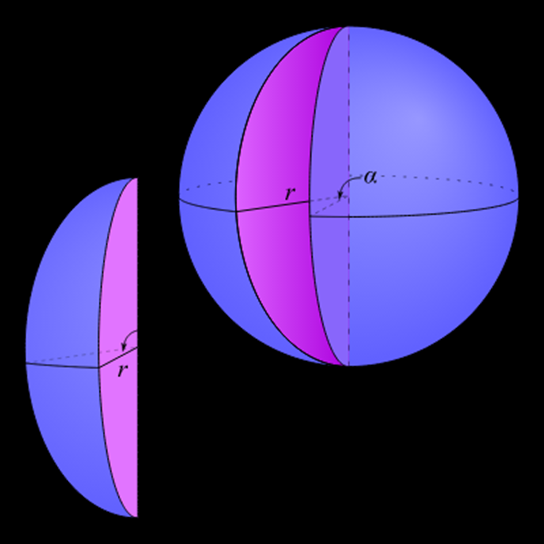
<p>The way I hope we can do that is, first, by recognizing that the 3D pseudoscalar has all the properties we need to coax matter out of scalar motion: Like the 3D gravitational property of matter, with its two &ldquo;directions,&rdquo; in and out, the 3D pseudoscalar has 3D volume with two &ldquo;directions,&rdquo; expansion and contraction. Likewise, the 2D magnetic property of matter, with its two &ldquo;directions,&rdquo; north and south, is analogous to the 3D pseudoscalar&rsquo;s 2D surface, having an inner and outer side, which cannot be separated. Finally, the 1D electrical property of matter, with its two &ldquo;directions,&rdquo; positive and negative, is reflected in the 3D pseudoscalar&rsquo;s 1D circumference, which also has two &ldquo;directions,&rdquo; clockwise and counter-clockwise.</p>
<p>Add to this the fact that the inverse pseudoscalar is already studied in the field of inversive geometry, and we have at least two good reasons to suspect that this line of investigation is worth pursuing.</p>
<p>As explained recently in the <a href="../../scalar-mathematics/">New Math</a> blog (See <a href="../../scalar-mathematics/2008/7/16/toward-non-pathological-algebras.html">here</a>), the square root of 2 turns out to be quite useful for defining numbers, in terms of the geometry of the three spheres, which correspond to -1, 0, +1, when -1 is understood to be 1, 0 is understood to be the square root of 2, and +1 is understood to be 2, the inverse of 1, and we replace these integers with the rational numbers, 1/2, 1/1, 2/1, using Larson&rsquo;s concept of speed-displacement.</p>
<p>This may sound crazy at first, but it&rsquo;s only necessary to understand that 0 doesn&rsquo;t really have to be understood in the way it&rsquo;s normally portrayed on the real number line, or in Cartesian coordinates. That is to say, the way we understand it in our LRC research is not like this:</p>
<p>-n &hellip;, -3, -2, -1, - 1/2, -1/3, &hellip; -1/n, 0, 1/n&hellip;1/4, 1/3, 1/2, 1, 2, 3, &hellip; n</p>
<p>where the unit distance is seen as infinitely divisible, but rather as,</p>
<p>1/n, &hellip;1/4, 1/3, 1/2, 1/1, 2/1, 3/1, 4/1, &hellip;n/1</p>
<p>where each unit is not infinitely divisible, but is discrete and has its discrete inverse unit, as in group theory. In this way, 0 does not have a place on the number line per se. Instead, it is implied by 1/1 = 0, when the binary operation of the group is changed from multiplication to addition, and the meaning of the &ldquo;/&rdquo; symbol becomes a &ldquo;displacement&rdquo; operation between the numerator and denominator, not an inverse multiplication operator.</p>
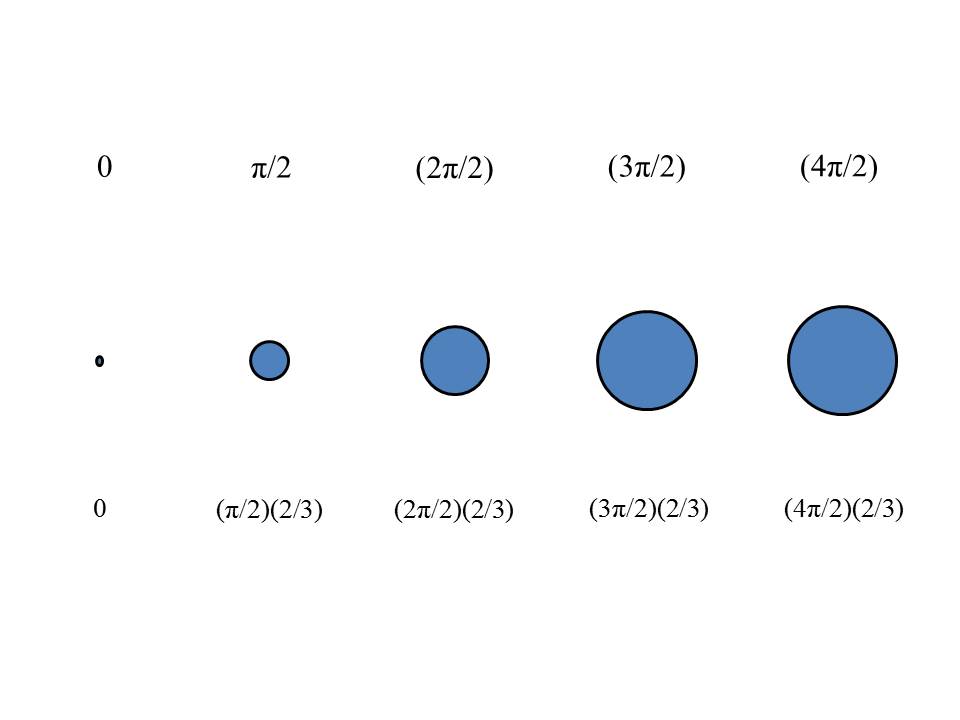
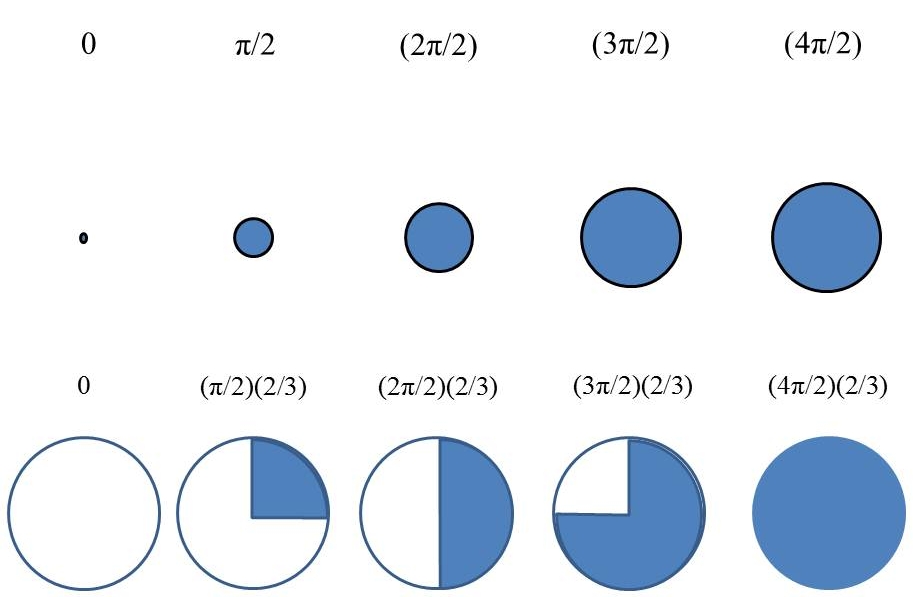
<p>With this much understood, we want to map the set of pseudoscalars, corresponding to the first two units of the expansion (t<sub>1</sub>-t<sub>0</sub> = 1 and t<sub>2</sub>-t<sub>0</sub> = 2), to the tetraktys and the inverse tetraktys, in the same way we map the rational numbers to it, using the intermediate pseudoscalar, with the unit ratio of the square root of 2, as the 0D tetraktys value, the ratio of the 1D circumferences as its 1D value, the ratio of the 2D surfaces as its 2D value, and the ratio of the 3D volumes as its 3D value.</p>
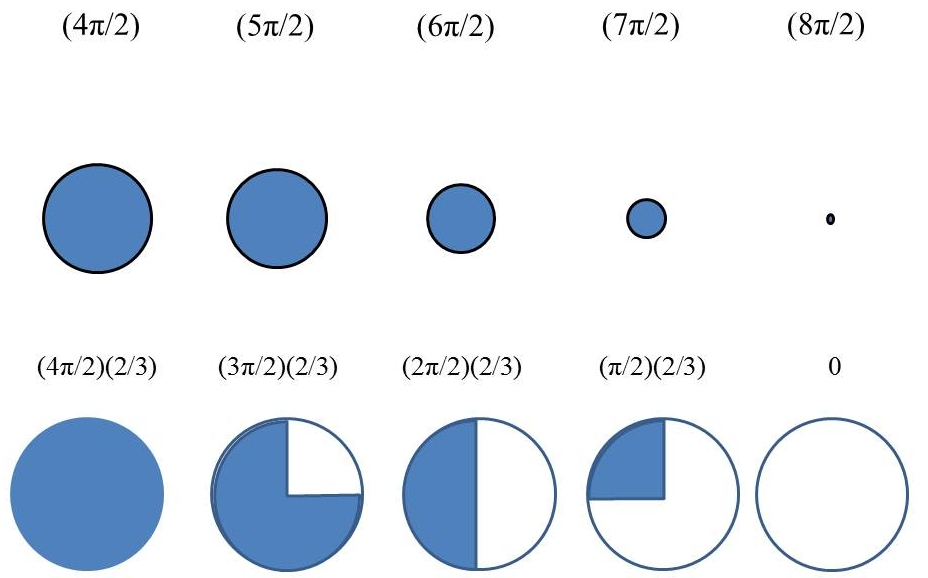
<p>We can use circles with differing patterns to indicate which aspect of the spheres is being symbolized, a pattern of dots for the 0D pseudoscalar, a pattern of lines for the 1D one, a pattern of squares for the 2D one, and a solid fill for the 3D one, as shown below:</p>
<p><span class="full-image-block ssNonEditable"><img src="http://www.lrcphysics.com/storage/images/Tetraktys%20Spheres.jpg?__SQUARESPACE_CACHEVERSION=1253417647773" alt="" /></span></p>
<p><strong>Figure 1.</strong> Symbolic Notation for Radii, Circumferences, Surfaces and Volumes of Pseudoscalar Spheres with Radii r =1, r&rsquo; = (2)<sup>1/2</sup>, r&rsquo;&rsquo; = 2.</p>
<p>First, we construct the pseudoscalar tetraktys, then the inverse pseudoscalar tetraktys:</p>
<p><span class="full-image-block ssNonEditable"><img src="http://www.lrcphysics.com/storage/images/Tetractys%20of%20Spheres.jpg?__SQUARESPACE_CACHEVERSION=1253417952958" alt="" /></span></p>
<p><strong>Figure 2.</strong> The Tetraktys and Inverse Tetraktys of Pseudoscalar Sphere Ratios</p>
<p>As it turns out, each of these pseudoscalar ratios is a power of the square root of 2. The unit ratio, which is just the ratio of the radius r&rsquo; to itself, or the square root of 2, divided by itself, is equal to 1. Letting R equal this unit ratio, we can write it as R<sup>0 </sup>= (2<sup>1/2</sup>)<sup>0</sup> = 1, because any number raised to the zero power is equal to 1. The ratio of the 1D circumferences of r&rsquo; and r, 2&pi;r&rsquo;/2&pi;r, is equal to the square root of 2, or (2<sup>1/2</sup>)<sup>1</sup>, which we can write as R<sup>1</sup>. The ratio of the 2D surfaces, 4&pi;r&rsquo;<sup>2</sup>/4&pi;r<sup>2</sup>, is equal to 2, or (2<sup>1/2</sup>)<sup>2</sup>, which we can write as R<sup>2</sup>. Finally, the ratio of the volumes, (4/3)&pi;r&rsquo;<sup>3</sup>/(4/3)&pi;r<sup>3</sup>, is equal to 2*2<sup>1/2</sup>, which we can write as R<sup>3</sup>, since 2 * 2<sup>1/2</sup> = (2<sup>1/2</sup>)<sup>3</sup>.</p>
<p>Substituting these values of R for the graphics shown in figure 2, we can rewrite the pseudoscalar tetraktys, and its inverse, symbolically, as shown in figure 3 below:</p>
<p><span class="full-image-block ssNonEditable"><img src="http://www.lrcphysics.com/storage/tetraktys%20of%20R.jpg?__SQUARESPACE_CACHEVERSION=1253549019086" alt="" /></span></p>
<p><strong>Figure 3.</strong> The Symbolic Pseudoscalar Tetraktys and Its Symbolic Inverse</p>
<p>This is a remarkable result, because it appears to constitute the basis for a multi-dimensional number system with no algebraic pathology, since each associated pseudoscalar algebra would presumably be as completely ordered, commutative and associative, as the well known scalar algebra.</p>
<p>Clearly, the R<sup>0</sup> numbers are ordered, since the square root of 2 is a real number. The R<sup>1</sup> numbers are ordered, because we can&rsquo;t have an R<sup>1</sup> number smaller than 1. The R<sup>2</sup> numbers and the R<sup>3</sup> numbers are also ordered for the same reason, because no areas and volumes smaller than the unit areas and volumes exist in the system, by definition.</p>
<p>Indeed, I think the proof that all these numbers are ordered, commutative and associative is trivial, so I won&rsquo;t bother to show it here.</p>
<p>Of course, I could be wrong &ndash; and very embarrassed &ndash; again!</p>
]]></content:encoded></rss:item><rss:item rdf:about="http://www.lrcphysics.com/scalar-physics/2009/4/23/oscillating-pseudoscalars.html"><rss:title>Oscillating Pseudoscalars</rss:title><rss:link>http://www.lrcphysics.com/scalar-physics/2009/4/23/oscillating-pseudoscalars.html</rss:link><dc:creator>Doug</dc:creator><dc:date>2009-04-23T13:22:00Z</dc:date><dc:subject></dc:subject><content:encoded><![CDATA[<p>It&#8217;s been so long since I&#8217;ve posted anything on research, I&#8217;m afraid people will think I&#8217;ve abandoned the work. However, the truth is, I&#8217;ve had to turn my attention to practical matters, leading to a neglect of the theoretical.</p>
<p>But I have some unpublished articles that have lain around for sometime, because I haven&#8217;t been able to get up enough momentum to finish them, or think them out completely. I think I will go ahead and post them anyway, though, just to get something out there to think about. Maybe that will help me get going again, even if it might be embarassing. Here&#8217;s the first one:</p>
<p>In our virtual lab in Second Life, we&#8217;ve been playing with SUDRs and TUDRs and their combinations, S|T units. Here is a short video of three S|T units combined as a neutrino triplet from our&nbsp;toy model of standard model entities:</p>
<p>&nbsp;&nbsp;<object width="425" height="350"> <param name="movie" value="http://www.youtube.com/v/oFp37Fd9RxA"> </param> <embed src="http://www.youtube.com/v/oFp37Fd9RxA" type="application/x-shockwave-flash" width="425" height="350"> </embed> </object></p>
<p>The&nbsp;animation&nbsp;of the SUDR (red pseudoscalar) is driven by the changing diameter generated by the difference between the sine and -sine function, while the TUDR (blue pseudoscalar) is driven by the changing diameter generated by the difference between the cosine and -cosine functions.</p>
<p>In essence, this&nbsp;means that the expansion/contraction&nbsp;of the pseudoscalars is a function of two, counter-rotating, rotations, as shown in figure 1 below:</p>
<p>&nbsp;&nbsp;<span class="full-image-block ssNonEditable"><img src="http://www.lrcphysics.com/storage/images/testclock2.gif?__SQUARESPACE_CACHEVERSION=1225833214433" alt="" />&nbsp;&nbsp;&nbsp;&nbsp;<span class="full-image-inline ssNonEditable"><img src="http://www.lrcphysics.com/storage/images/testclock2a.gif?__SQUARESPACE_CACHEVERSION=1225833253836" alt="" /></span></span>&nbsp;<span class="full-image-block ssNonEditable">&nbsp;</span>&nbsp;</p>
<p><strong>Figure 1.</strong> Two Counter Sine&nbsp;Functions (left), and Two Counter Cosine&nbsp;Functions (right), Define&nbsp;Inverse Diameters of&nbsp;Oscillating Pseudoscalars (not synchronized)</p>
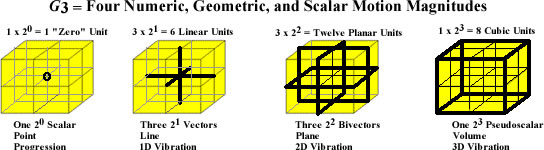
<p>Consequently, with these two functions, we can analyze the pseudoscalar oscillations, and their combinations as S|T units. The first thought was to plot the changing 1D, 2D and 3D pseudoscalars in terms of &pi;, which produced some interesting wave forms, but then the idea ocurred to us to take a point on the surface of the pseudoscalars as a zero reference. This means that the origin &#8220;moves&#8221; with respect to the reference point and gives us a way to compare the n-dimensional magnitudes as a function of time (space); that is, the&nbsp;2<span style="vertical-align: super;">0</span> point increases from 0 to 1 * 1<span style="vertical-align: super;">0</span> , and back to 0, while the 2<span style="vertical-align: super;">1</span> function&nbsp;changes from 0 to&nbsp;6 * 1<span style="vertical-align: super;">1</span>, during the same time, while the 2<span style="vertical-align: super;">2</span> function&nbsp;changes from 0 to 12 *&nbsp;1<span style="vertical-align: super;">2</span>, and the 2<span style="vertical-align: super;">3</span> function&nbsp;changes from&nbsp;0 to 8 *&nbsp;1<span style="vertical-align: super;">3</span> and back, during one cycle.</p>
<p>In this&nbsp;way, everything is positive, and never negative, just as the magnitude of the diameter is always positive and never negative.&nbsp;&nbsp;While this is interesting, the big challenge is to capture the inverse relationship. In what way is the TUDR oscillation the inverse of the SUDR? From the standpoint of the expanding/contracting diameter, there is no difference between the two oscillations of figure 1. The oscillation on the left is the +/- cosine projected on the horizontal diameter, while the oscillation on the right is the +/- sine projected on the vertical diameter, but the geometric inverse of the unit diameter is&nbsp;twice its size.</p>
<p>If this were not bad enough,&nbsp;how do&nbsp;we represent the temporal diameter&nbsp;with a spatial diameter? The answer, I believe, is to follow the math. As far as the math is concerned, the inverse of 1/2, is 2/1,&nbsp;and this is simply a doubling of the numerator, from 1 to 2, and a halving of the denominator, from 2 to 1, the mediato/duplacio math of the ancients.</p>
<p>Another way to express the same&nbsp;result is to keep the size of the diameter the same, but to quadruple the frequency of the TUDR, with respect to the SUDR. Figure 2 incorporates this idea.</p>
<p>&nbsp;&nbsp;<span class="full-image-float-left ssNonEditable"><span><img src="http://www.lrcphysics.com/storage/images/testclock2.gif?__SQUARESPACE_CACHEVERSION=1231610846896" alt="" /></span></span><span class="full-image-block ssNonEditable"><span><img src="../../storage/images/testclock2b.gif?__SQUARESPACE_CACHEVERSION=1231610747032" alt="" /></span></span>&nbsp;&nbsp;&nbsp;<span class="full-image-block ssNonEditable">&nbsp;</span> <strong>Figure 2.</strong> Normalized SUDR and TUDR Oscillations</p>
<p>Of course, this is tantamount to assuming that the relative frequencies of the oscillating pseudoscalars is a valid comparison, but I don&#8217;t see any other way of comparing them. If this works, we can leverage the knowledge of hetrodyning and harmonics. Something we&#8217;ve already explored to some extent.</p>
<p>&nbsp;</p>
]]></content:encoded></rss:item><rss:item rdf:about="http://www.lrcphysics.com/scalar-physics/2008/11/7/the-arrow-of-time.html"><rss:title>The Arrow of Time</rss:title><rss:link>http://www.lrcphysics.com/scalar-physics/2008/11/7/the-arrow-of-time.html</rss:link><dc:creator>Doug</dc:creator><dc:date>2008-11-07T15:50:07Z</dc:date><dc:subject></dc:subject><content:encoded><![CDATA[<p style="vertical-align: super;">Philip Gibbs, in his <a href="http://fqxi.org">FQXI</a> essay, <a href="http://fqxi.org/data/essay-contest-files/Gibbs_This_Time.pdf">&#8220;This Time &ndash; What a Strange Turn of Events!&#8221;</a> writes:&nbsp;</p>
<p>
<blockquote>
<p>Minkowski used the symmetry in the Lorentz transformation to bring together space and time making them merely different dimensions of spacetime. Yet time is somehow different in our mind. This difference is characterised by an <strong>arrow of time </strong>that defies the symmetry. In our conscious experience our past is clear and fixed but our future is uncertain. From the laws of thermodynamics we learn that this difference is due to <strong>entropy </strong>which always increases as time passes. Entropy is a measure of <strong>information </strong>and by the rules of quantum mechanics information of (sic) conserved. There is a paradox, but information can be as clear to us as the letters on this page, or as hidden and disordered as the states of the molecules in the air around it. As time passes, the disorder increases and entropy measures this change.</p>
<p>Time can distinguish itself from space in this way because the spacetime metric has a <strong>Lorentz </strong><strong>signature </strong>that assign a different sign in the time dimension versus the three space directions. Thus in locally flat Minkowski spacetime distances are measured by the invariant quantity</p>
<p>ds<span style="vertical-align: super;">2</span> = dx<span style="vertical-align: super;">2</span> + dy<span style="vertical-align: super;">2</span> + dz<span style="vertical-align: super;">2</span> &ndash; c<span style="vertical-align: super;">2</span>dt<span style="vertical-align: super;">2</span></p>
<p>Part of the mystery of time is to understand where this signature comes from. Why three plus signs for space and only one minus sign for time? Even with this separation of dimensions there should remain symmetry under time reversal t -&gt; -t, but the arrow of time breaks this symmetry. What is the origin of this arrow? From what bow did it take flight?</p>
</blockquote>
</p>
<p>When we understand that the progression of time is only&nbsp;one aspect of the space/time progression, and that the progression of space is its reciprocal, we can understand the broken symmetry. It&#8217;s broken when the uniform motion is quantized by the continuous reversals in the space, or the time, aspect of the progression, as shown in the graphic of the previous post below, which is shown again in figure 1.</p>
<p><span class="full-image-block ssNonEditable"><img src="http://www.lrcphysics.com/storage/images/RST%20World%20Line%20Chart.jpg?__SQUARESPACE_CACHEVERSION=1226078158436" alt="" /></span></p>
<p><strong>Figure 1.</strong>Two Fixed Reference Systems Created by Pseudoscalar Oscillations.</p>
<p>In figure 1, we see the arrow of time is created when the&nbsp;s/t pseudoscalar oscillations nullify the space progression, and the arrow of space is created when the&nbsp;t/s pseudoscalar oscillations nullify the time progression. Of course the two systems are separated by the unit space/time progression, which is c-speed from the 0 point of both systems.</p>
<p>From the perspective of either system, the zero speed (or frequency) of the inverse system is four times&nbsp;its own&nbsp;zero speed (or frequency); that is, 1/2&nbsp;* 4 = 2/1. Another way to say the same thing is that, if we take the frequency of&nbsp;one system as the fundamental, the frequency of the inverse system is two octaves above that frequency, regardless of which one we select as the fundamental (i.e. 1/2 + 1/2 = 1 and 1 + 1 = 2).</p>
<p>If fermions are triple combinations of&nbsp;s/t and&nbsp;t/s pseudoscalars, whose net frequency is at the fundamental, or whose net motion is at the spatial zero, then a natural question to ask is, &#8220;What effect does vectorial motion have on their time (space) flow?&#8221; Einstein&#8217;s theory shows that time slows down relative to inertial systems in motion. We can illustrate this effect as shown in figure 2.</p>
<p>&nbsp;&nbsp;&nbsp;<span class="full-image-block ssNonEditable"><img src="http://www.lrcphysics.com/storage/images/relativity%20world%20line%20chart.jpg?__SQUARESPACE_CACHEVERSION=1226080480222" alt="" /></span>&nbsp;&nbsp;&nbsp;</p>
<p><strong>Figure 2.</strong> Vector&nbsp;Motion Slows Down Time.</p>
<p>Of course, the difference between the space/time of figure 1 and the spacetime of figure 2 is&nbsp;that, in figure 1, both space and time are progressing, whereas, in figure 2, only time is progressing, and while the change in space of figure&nbsp;2 is a vectorial motion of an object, a one-dimensional change of x, y, z, locations, tied to events that are separated by spacetime, the events&nbsp;in one inertial frame happen slower&nbsp;(height of green arrow), relative to the events in another inertial frame, depending upon their relative speed (length of the purple and blue arrows).</p>
<p>In figure 1, we see that it&#8217;s the oscillation in the space progression, effectively nullifying it, that creates the inertial frames of figure 2. So, a more accurate representation would show the oscillation of an inertial frame, in both the&nbsp;s/t and&nbsp;t/s cases, as shown below in figure 3.</p>
<p>&nbsp;</p>
<p>&nbsp;<span class="full-image-block ssNonEditable"><img src="http://www.lrcphysics.com/storage/images/OscWorldLine%20Chart.jpg?__SQUARESPACE_CACHEVERSION=1226082721141" alt="" /></span><strong>Figure 3. </strong>The S/T and T/S Pseudoscalar Oscillations in a World Line Chart</p>
<p>The space/time progression of the oscillating&nbsp;s/t pseudoscalar is illustrated in the vertical bar of figure 3, where the space aspect of the continuous expansion&nbsp;is oscillating, while the time aspect continues&nbsp;its uniform increase. In the horizontal bar, the oscillation of the t/s pseudoscalar is&nbsp;illustrated, as, in this instance,&nbsp;the time aspect oscillates, while the space aspect continues its uniform increase.</p>
<p>In either case, the&nbsp;orthogonal paths of the oscillations show that the indicated system is at the zero point of&nbsp;their respective fixed reference system, created by the oscillations. Now, let&#8217;s give the same vector motion to the pseudoscalars as that shown it figure 2. Notice, depending on the vectorial speed, that the vertical bar will slant toward the horizontal, just as&nbsp;the green arrow does in figure 2, and the horizontal bar will slant toward the vertical.</p>
<p>However, there is a difference in how the x, y, z, spatial dimensions are&nbsp;to be understood in the two figures. In figure 2, the&nbsp;change in locations is defined by&nbsp;1D motion, whereas, in figure 1, every point in the graph is a 3D change in the size of the locations; that is, vectorial motion causes the bar to slant to the horizontal, but it&#8217;s a physical impossibility to represent vectorial motion in three directions at once.</p>
<p>Therefore, we have to understand&nbsp;the oscillations of figure 3, not as 3D psuedoscalar oscillations of figure 1, but as 1D&nbsp;pseudoscalar oscillations. On this basis, it would take a composite of three charts like that in figure 3 to&nbsp;illustrate all the vectorial motion possibilities (this has important implications later.) But,&nbsp;to illustrate the relation of vector and scalar motion, we can imagine&nbsp;a 1D pseudoscalar oscillation, affected by high-speed 1D vectorial motion, as shown in figure 4 below.</p>
<p>&nbsp;</p>
<p><span class="full-image-block ssNonEditable"><img src="http://www.lrcphysics.com/storage/images/PseudoscalarVectorMotion.jpg?__SQUARESPACE_CACHEVERSION=1226085071721" alt="" /></span></p>
<p><strong>Figure 4. </strong>1D Pseudoscalar Vector Motion</p>
<p>In figure 4, the red space/time arrow increases diagonally, to the upper right, as the s/t pseudoscalar expands, in space and time equally.&nbsp;Subsequently, it&nbsp;increases diagonally to the upper left, as the&nbsp;s/t pseudoscalar decreases in space, as time continues to increase.</p>
<p>Inversely, the blue time/space arrow increases diagonally, to the lower right, as the&nbsp;t/s pseudoscalar contracts, in time, but continues to&nbsp;increase in space, while it subsquently increases diagonally to the upper right, as the&nbsp;t/s pseudoscalar expands in time, while space continues to increase.</p>
<p>Hence, we can see the perfect symmetry of the&nbsp;space/time | time/space relationship. But now, when we add vectorial motion to these&nbsp;pseudoscalars, the&nbsp;vertical, s/t, pseudoscalar rotates right, to the unit speed diagonal, while the horizontal, t/s, pseudoscalar rotates left, to the unit speed diagonal, represented by the green boxes with green arrows.</p>
<p>The most&nbsp;interesting thing to note at the unit boundary&nbsp;is the directional changes of the&nbsp;red and blue&nbsp;arrows. As the&nbsp;s/t pseudoscalar&#8217;s speed increases to c-speed, the time component of its expansion arrow disappears. It&nbsp;increases in space only, while&nbsp;on the contraction part of the cycle, the space component of the contraction arrow disappears,&nbsp;indicating that&nbsp;only the time component&nbsp;is increasing in this half of the cycle.</p>
<p>The full implications of this development are not well understood as&nbsp;yet, but it seems clear at this point that&nbsp;any increase in&nbsp;vectorial speed of the&nbsp;s/t pseudoscalar, beyond the unit level, crossing the c-speed boundary so-to-speak,&nbsp;is tantamount to a decrease in&nbsp;the vectorial speed of a t/s pseudoscalar. Moreover, we can see that, what would appear to be an increase of s/t vectorial speed, is actually a decrease in t/s vectorial speed, which completely transforms the red diagonal arrows of the s/t pseudoscalar into blue diagonal arrows of the t/s pseudoscalar and vice-versa!</p>
<p>Thus, the arrow of time, the arrow that defines the entropy&nbsp;on the s/t pseudoscalar side of unit speed, reverses direction, as the arrow of space, on the t/s side of unity, defining a reverse entropy! (note to John:&nbsp;is this not tantamount to the direction of matter&#8217;s time arrow&nbsp;(s/t) being opposed to the direction of energy&#8217;s time arrow (t/s),&nbsp;described by you?)!</p>
<p>To&nbsp;underscore that the directions of the two&nbsp;scalar arrows (i.e. the two &#8220;time&#8221; arrows)&nbsp;progress in opposite &#8220;directions,&#8221; a final graphic&nbsp;serves&nbsp;to more clearly illustrate it geometrically, in figure 5 below.&nbsp;&nbsp;&nbsp;&nbsp;&nbsp;</p>
<p><span class="full-image-block ssNonEditable"><img src="http://www.lrcphysics.com/storage/images/TwoTimeArrows.jpg?__SQUARESPACE_CACHEVERSION=1226089586244" alt="" /></span></p>
<p><strong>Figure 5.</strong> The &#8220;Directions&#8221; of the Two Arrows of &#8220;Time&#8221; in&nbsp;Our RST-based Physical Theory are Opposed.</p>
<p>While our RST-based theory differs from Larson&#8217;s, in that <a href="http://www.lrcphysics.com/reciprocal-system-theory/">his theory</a> doesn&#8217;t incorporate the principles of the tetraktys in&nbsp;its development of the consequences of the <a href="http://www.lrcphysics.com/rst/">RST</a>, yet it continues to amaze me how&nbsp;the trail he blazed continues to be our guiding light.</p>
<p>Not only&nbsp;was he the first to solve the&nbsp;problem of the asymmetry of the &#8220;arrow of time,&#8221;&nbsp;and in the process uncover the t/s side of the universe, but he went on to show how high-speed vector motion, with the dimensions of scalar motion,&nbsp;and the unit c-speed datum, produces a cosmology of such beauty and grandeur that the contemplation of&nbsp;it is&nbsp;in itself almost a religious experience.</p>
<p>Of course, there is much, much more to learn about it. We have scarcely begun.</p>
]]></content:encoded></rss:item><rss:item rdf:about="http://www.lrcphysics.com/scalar-physics/2008/11/5/cosmology-the-universe-of-motion.html"><rss:title>Cosmology - The Universe of Motion</rss:title><rss:link>http://www.lrcphysics.com/scalar-physics/2008/11/5/cosmology-the-universe-of-motion.html</rss:link><dc:creator>Doug</dc:creator><dc:date>2008-11-05T13:48:20Z</dc:date><dc:subject></dc:subject><content:encoded><![CDATA[<p>In this forum, and in the <a href="http://fqxi.org/community/forum/topic/267">essay</a> submitted to <a href="http://www.fqxi.org/community/essay">FQXI Essay Contest</a>, we have concentrated on discussing the small scale phenomena of the universe of motion. While it&#8217;s certainly crucial to show the way space/time emerges from the fundamental motion of the universe, through vibration, to form the basic constituents of motion that make up the standard model (SM) and periodic elements, people are also interested, probably even more so, in the development of the new system&#8217;s&nbsp;concepts&nbsp;of large scale phenomena.</p>
<p>As a result, I&#8217;ve decided to&nbsp;enlarge the scope&nbsp;of the discussion&nbsp;of the essay in the FQXI forum, by changing the focus of the discussion on the nature of time, from the small scale&nbsp;to the large scale phenomena of the universe of motion.&nbsp;However, the editor in the FQXI forum is so limited that it makes it&nbsp;very difficult to carry on the discussion there. Therefore, I will post the entries here and provide a link to them there.</p>
<p>In the last&nbsp;FQXI forum entry, I explained&nbsp;the&nbsp;unit datum of the universe of motion, where the displacement of time, or space, in the unit motion, through pseudoscalar vibration, forms two, fixed,&nbsp;reference systems, relative to the unit motion&nbsp;datum. One of these is based on the 1:2 ratio, created by the oscillating spatial pseudoscalar, while the other is based on the 2:1 ratio, created by the oscillating temporal pseudoscalar. This concept is illustrated in figure 1 below:</p>
<p>&nbsp;&nbsp;</p>
<p><span class="full-image-block ssNonEditable"><span><img src="http://www.lrcphysics.com/storage/images/RST%20World%20Line%20Chart.jpg?__SQUARESPACE_CACHEVERSION=1225894788544" alt="" /></span></span></p>
<p>&nbsp;&nbsp;</p>
<p>Figure 1. Two Fixed Reference Systems Created by Pseudoscalar Oscillations.</p>
<p>In the spatial reference system, time progresses as a scalar. In the temporal reference system, space progresses as a scalar. SM bosons are formed&nbsp;as biform&nbsp;combinations of oscillating spatial and temporal&nbsp;pseudoscalars, while fermions are formed from triform combinations, as shown in figure 1 of the essay.</p>
<p>What is not mentioned in the essay, however, but is clearly implicit in this space/time&nbsp;structure of discrete units of scalar motion, is&nbsp;its supersymmetry, wherein every combination of the SM toy model has a counterpart in an inverse SM toy model that applies to the fixed <em>temporal</em> reference system.</p>
<p>Hence, there are two sets of combinations of bosons and fermions, and two sets of periodic elements, possible, where the difference&nbsp;is that one is the&nbsp;inverse of the other. Of course,&nbsp;since unit speed (c-speed) is the common boundary between the two sets of motion combinations, the two reference systems are separated by high speed motion, just as 1/2 = .5 is separated&nbsp;from 2/1 = 2, by a factor of four, i.e.&nbsp;4 * .5 = 2.</p>
<p>This change in the theoretical picture has a profound impact on the cosmology of the new system. Instead of thermodynamic entropy being the major process of the physical universe, it is actually relegated to a relatively minor role, while the space/time, time/space,&nbsp;progression&nbsp;takes&nbsp;over the major role, as the driving force of change in the theoretical universe of motion.&nbsp;</p>
<p>Of course, the first question in any theoretical cosmology always concerns&nbsp;its concept&nbsp;of initial conditions. In the&nbsp;theoretical cosmology of <a href="http://www.lrcphysics.com/legacy-physics/">legacy physics</a>,&nbsp;the question of initial conditions is problematic, since it&nbsp;requires an infinitely dense, infinitely small,&nbsp;mathematically impossible, singularity, to start things off.</p>
<p>In the&nbsp;cosmology of the new system of theory, the initial conditions are not quite so problematic, but still require&nbsp;a hypothetical assumption of&nbsp;unit vibration in the space/time | time/space progression. Given this oscillation, however, the system provides some remarkable results, showing why the invariance of special relativity holds, and why the covariance of general relativity works so well.&nbsp;</p>
<p>Moreover, without the need for an initial hot&nbsp;big bang, the cosmology of the new system is cyclic, where the gravitationally condensed matter of the low-speed sector is input for the energetic subatomic gas of the high-speed sector and vice-versa, through the transformation of the high-speed vector motion of one reference system into the low-speed vector motion of the other.</p>
<p>Understandably, the details of how this transformation works is the subject of much research, but in general terms, it is governed by the same fundamental properties of magnitude, dimension, and direction, that determine the characteristics of the small scale phenomena that we&#8217;ve been discussing.</p>
<p>One of its most dramatic impacts, however, is on our understanding of the arrow of time, which we will discuss next.</p>
]]></content:encoded></rss:item><rss:item rdf:about="http://www.lrcphysics.com/scalar-physics/2008/9/29/forming-atoms.html"><rss:title>Forming Atoms</rss:title><rss:link>http://www.lrcphysics.com/scalar-physics/2008/9/29/forming-atoms.html</rss:link><dc:creator>Doug</dc:creator><dc:date>2008-09-29T13:45:46Z</dc:date><dc:subject></dc:subject><content:encoded><![CDATA[<p>In the last entry, we announced the breakthrough, following Montgomery and Jeffrey (M&amp;J), that allows us to form atoms from nothing but motion. In our case, time and space speed-displacements (SUDRs &amp; TUDRs) join to form biforms called S|T units. These S|T units combine to form triforms, which act as preons to form two basic types of combinations called bosons and fermions. Bosons are photons, while fermions are quarks, electrons and neutrinos, each with their &#8220;antiparticles.&#8221;</p><p>The way M&amp;J&#8217;s model works, three quarks constitute a triform, depending on the mix of quarks. With two up and one down quark, a proton can be fitted to a neutron, with two down and one up quark, in such a way that the up and down quarks constitute bonded pairs at the three apexes of two triangles in two planes. Combining a proton &amp; electron, H, with a neutron, forms deuterium, <sup>2</sup>H, and adding two deuterium atoms together forms a hexagonal lattice of helium, <sup>4</sup>H, or the alpha particle, which then becomes the basic building block of their table of nuclides.</p><p>However, following nuclear reactions, tritium, <sup>3</sup>H and <sup>3</sup>He are formed first, as intermediate stages, by adding another neutron to <sup>2</sup>H, which decays in about 12 years to <sup>3</sup>He, but just how this works in the model is not so clear. Moreover, in the M&amp;J model, the bonds between the constituent quarks are formed from electrical and magnetic forces, which are not used per se in an RST model, since force is defined as a property of motion.</p><p>These considerations have forced us to take another path in the development of the periodic table of elements that modifies the way the constituent quarks of the protons and neutrons are paired to form higher combinations, compared to the M&amp;J model. Instead of forming a Dagwood sandwich from a deuterium atom, by adding a neutron on the other side of the proton, sandwiching it in between the two neutrons, in tritium, which decays into a proton|neutron|proton sandwich of helium three, we, again, form a triangle of triangles, following the quark pattern of triangles within a greater triangle. <br></p><p>Thus, in the LRC&#8217;s RSt model, quark triangles form proton and neutron triangles, and, now, these nuclei triangles form atomic triangles, as tritium and three helium. Of course, we have to remember that these triangles are only 2D diagrams, or schematics of the physical triangles of 3D merged spheres, but otherwise, it works out well.<br></p><p>Recall, that another difference in our model is that we include electrons with the quarks of protons, so we are dealing with atoms, not atomic nuclei, which don&#8217;t exist in our model. With only motion to work with, we have only two opposite, or dual, quantities to form the bonds between quarks, time motion and space motion ( time-displaced units = SUDRs and space-displaced units = TUDRs).</p><p>When deuterium forms, the total space and time units of motion balance out, which can be expressed as shown in figure 1 below:</p><p><span class="full-image-block"><span><img  src="http://www.lrcphysics.com/storage/images/Deuterium.jpg?__SQUARESPACE_CACHEVERSION=1222701365975"></span></span></p><p><strong>Figure 1.</strong> Quarks, Nuclei and Deuterium<br></p><p>As shown in figure 1 above, the quarks bond perfectly as the proton|neutron mirror one another, with the electron sandwiched in between them, and the number of positive units equals the number of negative units. However, where do we go from here? As depicted in the bottom right panel of the figure, deuterium has no way to bond to deuterium. The polarity of the motion combinations match, so we seem to be stuck. <br></p><p>In the M&amp;J model, the alpha particle, helium four, is formed from this latter combination of deuterium, by postulating that electrical and magnetic forces exist between the deuterium nuclei sufficient to bond them together (no mention is made of the electroweak force, only the electromagnetic force, as far as I can determine). Subsequently, once the deuterium atom is formed in this manner, another nucleon is added to the appropriate mirror nucleon to begin the formation of another alpha component (with tritium and helium three, as intermediaries, although tritium is not shown on the website)<br></p><p>Nevertheless, it&#8217;s clear from figure 1 that we cannot follow that procedure in our model, using motion combinations. Fortunately, though, if we re-arrange the nuclei triangles, so that, instead of mirroring them, as two layered planes, as shown in figure 1, we connect the nodes in a planar array of triangles, as shown in figure 2 below, we not only can form tritium and helium three, but helium four as well, and, indeed, every other isotope combination in the table of nuclides.</p><p><span class="full-image-block"><span><img  src="http://www.lrcphysics.com/storage/images/TritiumHelium3.jpg?__SQUARESPACE_CACHEVERSION=1222706505068"></span></span></p><p><strong>Figure 2.</strong> Planar Array of Nuclides Tritium and Helium Three</p><p>Since down quarks are composed of two green (balanced) S|T units and one red S|T unit (i.e. red = more SUDRs than TUDRs,) the unbalance is one red unit, or -1, while in the up quarks, there are two blue units with one green unit, for an unbalance of 2 blue units, or +2. With the three red units, -3, of the electron, the polarities balance out for each isotope, no matter how many protons and neutrons an atom is composed of. Therefore, we can simplify the diagrams by using colored triangles, blue for protons, and green for neutrons. Assuming that each node is an U-D quark bond, we can obviously diagram any atom in a planar array of triangles arranged on the sides of a polygon, with the requisite number of sides corresponding to the total number of protons and neutrons making up the isotope, as illustrated in Figure 3 below.</p><p><span class="full-image-block"><span><img  src="http://www.lrcphysics.com/storage/Table%20of%20Nuclides.jpg?__SQUARESPACE_CACHEVERSION=1222715129716"></span></span></p><p><strong>Figure 3.</strong> Schematic Diagram of LRC&#8217;s Model of Periodic Elements<br></p><p>Of course, there&#8217;s much more to the model than just a data schema, such as physical parameters that can account for physical properties, especially periodicity, mass and absoption/emission spectra, but then this is great progress.</p>
]]></content:encoded></rss:item><rss:item rdf:about="http://www.lrcphysics.com/scalar-physics/2008/9/20/from-preons-to-bosons-fermions-and-atoms.html"><rss:title>From Preons to Bosons, Fermions and Atoms</rss:title><rss:link>http://www.lrcphysics.com/scalar-physics/2008/9/20/from-preons-to-bosons-fermions-and-atoms.html</rss:link><dc:creator>Doug</dc:creator><dc:date>2008-09-20T18:02:41Z</dc:date><dc:subject></dc:subject><content:encoded><![CDATA[<P>As the regular readers of this blog know,&nbsp;the <A href="http://www.lrcphysics.com/lrc-charter/">LRC</A>&#8217;s&nbsp;<A href="http://www.lrcphysics.com/reciprocal-system-theory/">RSt</A>&nbsp;starts with nothing but motion,&nbsp;postulates &#8220;direction&#8221; reversals to obtain <A href="http://www.lrcphysics.com/sudr/">SUDRs</A> and <A href="http://www.lrcphysics.com/tudr/">TUDRS</A>, and combines these into&nbsp;<A href="http://www.lrcphysics.com/material-combinations/">SUDR|TUDR (S|T) units</A> that constitute <A href="http://www.lrcphysics.com/scalar-physics/2007/3/22/preon-models.html">preons</A>, forming the various entities&nbsp;of the standard model (SM). These&nbsp;entities take the form of two types of&nbsp;triforms, the&nbsp;bosons formed&nbsp;in a planar array of three S|T units,&nbsp;and the fermions, formed in a triangle of three S|T units, as&nbsp;illustrated with bar magnets,&nbsp;in figure 1 below:</P>
<P><span class=full-image-block><span><img src="http://www.lrcphysics.com/storage/images/BosonFermionTripletConfigs.png?__SQUARESPACE_CACHEVERSION=1221937789976"></span></span></P>
<P><strong>Figure 1.</strong> The Two Triforms of S|T Combinations</P>
<P>However, unlike magnetic poles, S|T units are formed from discrete units of time-displaced, s<SUP>3</SUP>/t<SUP>0</SUP> = 1/2,&nbsp;scalar motion and space-displaced, s<SUP>0</SUP>/t<SUP>3</SUP> = 2/1,&nbsp;inverse scalar motion. Hence, a given S|T unit can have either an equal number of SUDRs and TUDRs, or an unequal number. To&nbsp;indicate the different possibilities, schematically, we employ a bar with three colors, red, blue and green. The SUDR component of the S|T units&nbsp;is indicated with&nbsp;the color red on one end of the bar, while the TUDR component is indicated with the color blue on the other end. When a given S|T unit has more of one component than the other, the color of the greater component is placed midway between the ends of the bar.&nbsp;If the unit has an equal number of the two components, the color green is placed between them. The result for up and down&nbsp;quarks is shown in figure 2 below:</P>
<P>&nbsp;&nbsp;&nbsp;&nbsp;&nbsp;&nbsp;&nbsp;&nbsp;&nbsp;&nbsp;&nbsp;&nbsp;&nbsp;&nbsp;&nbsp;&nbsp;&nbsp;&nbsp;&nbsp;&nbsp;&nbsp;&nbsp;&nbsp;&nbsp;&nbsp;&nbsp;&nbsp;&nbsp;&nbsp;&nbsp;&nbsp;&nbsp;&nbsp;&nbsp;&nbsp;&nbsp;&nbsp;&nbsp;&nbsp;&nbsp;&nbsp;&nbsp;&nbsp;&nbsp;&nbsp;&nbsp;&nbsp;&nbsp;&nbsp;&nbsp;&nbsp;&nbsp;&nbsp;&nbsp;&nbsp;&nbsp;&nbsp;&nbsp;&nbsp;&nbsp;&nbsp;&nbsp;&nbsp;&nbsp; </P>
<P><span><span><img src="http://www.lrcphysics.com/storage/images/UpQuark.png?__SQUARESPACE_CACHEVERSION=1221940077757"></span>&nbsp;&nbsp;&nbsp;&nbsp;&nbsp; <span><img src="http://www.lrcphysics.com/storage/images/DownQuark.png?__SQUARESPACE_CACHEVERSION=1221940125293"></span></span></P>
<P><strong>Figure 2.</strong> The Up and Down Quarks Formed from S|T Preons</P>
<P>Of course, we were quite pleased with this much progress in our theory, but when we tried to take the next step, to form the atomic nuclei from the quarks, a proton with two up and one down quark, and a neutron with two down and one up quark, so we could move on to the periodic table, we&nbsp;always ended up with a complicated mess, which had little&nbsp;discernible order to it. Moreover, just how we were going to fit the electrons into the pattern was not apparent at all. As a result, our research focus shifted to other areas. Until this week, that is. </P>
<P>Last Wednesday, Jerry Montgomery and Rondo Jeffery, announced the dramatic results of their efforts to model atomic nuclei,&nbsp;based on arranging quarks as three particles, forming a triangle (see: their <A href="http://unclear2nuclear.com/index.php">website</A>). Immediately, it became clear that this was indeed the way to do it! Not only does this dramatically solve the problem they were working on, to successfully&nbsp;model the nucleus of legacy physics, solving the many difficulties with the historic approaches, but it also solves&nbsp;the problem in the LRC&#8217;s efforts to combine quarks and electrons&nbsp;in our RSt, taking us to the next level!</P>
<P>In pondering their nuclei model, they realized, as we did in pondering our preon model, that with three components, there is only one geometric possibility, three points must form a plane, a triangle. Of course, in our case&nbsp;the colored bars&nbsp;are only a schematic representation of the three psuedoscalar eigenstates&nbsp;merging together physically, as shown in figure 3 below:</P>
<P><span class=full-image-block><span><img src="http://www.lrcphysics.com/storage/images/basic%20zmerge1.jpg?__SQUARESPACE_CACHEVERSION=1221942150506"></span></span></P>
<P><strong>Figure 3.</strong> The Physical Triform of Fermions</P>
<P>Nevertheless, the result is the same. The only geometric possibility of combining three points&nbsp;is a plane. From there it was easy, following their lead, we just combine our triangular quarks into a larger triangular proton or neutron, instead of trying to make them into some complex 3D configuration, as we had been attempting to do. Figure 4 below shows the arrangement:</P>
<P><span class=full-image-block><span><img src="http://www.lrcphysics.com/storage/images/Atomic%20Nuclei.jpg?__SQUARESPACE_CACHEVERSION=1221942701640"></span></span></P>
<P><strong>Figure 4.</strong> The Proton and Neutron Arrangement of Quarks</P>
<P>As Jerry and Rondo point out, and as is clearly evident from figure 4 above, folding these two nuclei upon one another, like closing an open book, brings each quark into alignment with its inverse companion quark. But what may be news to them (hopefully welcome news!) is that, like a cutout in the middle of a book, a perfect slot for the electron is created!!!! Our preon model of the electron is shown in figure 5 below:</P><span><span class=full-image-block><span><img src="http://www.lrcphysics.com/storage/images/ElectronFermion.png?__SQUARESPACE_CACHEVERSION=1221943330750"></span></span> 
<P><br><strong>Figure 5.</strong> S|T Combinations Forming the Electron of the Standard Model</P>
<P>Clearly, there has not been enough time to examine all the ramifications of this yet, but the preliminaries sure look promising. Just a look at the colors shows why protons are positively charged (four blues and one red), but neutrons are not (two blues and two reds), but adding an electron to a&nbsp;proton neutralizes it (four reds, four blues), and the combination of one electron, one proton, and one neutron is neutral (six reds and six blues).</P>
<P>Following&nbsp;the Jerry and Rondo model,&nbsp;our model of&nbsp;a proton/electron/neutron &#8220;sandwich&#8221;&nbsp;would be&nbsp;joined at the base with another sandwich, just like it, but vertically inverted, to form the helium atom, which in their model forms a basis for building a lattice of atomic nuclei only. No mention of electrons is made, if I&#8217;m not mistaken. Presumably, though, the latticework of their nuclei&nbsp;is somehow surrounded by&nbsp;a cloud of&nbsp;electrons, required by the shell model of the legacy system&#8217;s atomic concept, based on quantum mechanics.</P>
<P>As has already been pointed out by Paul deLespinasse, however, in&nbsp;Larson&#8217;s RSt, the atomic model does not admit various, independent, entities to exist in the atom, such as rotating electrons, a la the Bohr model of electronic orbits, or the QM model of electron clouds. In Larson&#8217;s model, the atom consists of nothing but discrete units of scalar motion. Larson&#8217;s model consists of n-dimensional rotations of a linear vibration and combinations thereof. Meanwhile, our new RSt model consists of combinations of n-dimensional vibrations period. No rotation is involved, even thought the constituent entities, electrons, protons, and neutrons retain their identities, schematically. A roadmap of the requisite combinations is shown in figure 6 below:</P><br>
<P><span class=full-image-block><span><img src="http://www.lrcphysics.com/storage/images/ParticlesAtoms.jpg?__SQUARESPACE_CACHEVERSION=1221948519325"></span></span></P>
<P><strong>Figure 6.</strong> From Quarks and Leptons to Helium</P>
<P>Though different than Larson&#8217;s RSt model, the LRC&#8217;s RSt model treats&nbsp;the atom in the same way his model does, as nothing but discrete units of scalar motion. It&#8217;s important to remember, that the pattern of quarks and leptons in an atom, such as helium, indicate discrete units of scalar motion. There are no moving particles in the atom, and no nucleus.</span></P>
]]></content:encoded></rss:item><rss:item rdf:about="http://www.lrcphysics.com/scalar-physics/2008/7/2/the-periodic-table-of-cosmic-elements.html"><rss:title>The Periodic Table of Cosmic Elements</rss:title><rss:link>http://www.lrcphysics.com/scalar-physics/2008/7/2/the-periodic-table-of-cosmic-elements.html</rss:link><dc:creator>Doug</dc:creator><dc:date>2008-07-02T01:23:57Z</dc:date><dc:subject></dc:subject><content:encoded><![CDATA[<P>In <A href="http://www.lrcphysics.com/rst/">RST-based</A> physical theory, the universe is composed of two, reciprocal, sectors, the material sector, where we live, and the cosmic sector, where the time and space magnitudes are inverted in the equation of motion, forming an anti-particle, and an anti-element, for every type of particle and element in the material sector.</P>
<P>In the material sector, the particles and <span>elements</span> are formed from what Larson calls the &#8220;time-displaced&#8221; compounds of scalar motions. As these motions are compounded, the successive atoms of each element are formed, each having, theoretically, 1 unit of mass more than the preceding element. </P>
<P>The pattern, or periodicity, of the material elements&nbsp;is very interesting, from a mathematical point of view, as we have been pointing out, in the previous post.&nbsp;Not only do the number of the periods make sense as concentric areas derived&nbsp;algebraically and now even geometrically, but, unlike the periodic table of quantum mechanics, the pattern emerges as 4n<SUP>2</SUP>, not 2n<SUP>2</SUP>, and it is limited at n = 4.</P>
<P>When one looks at the table in the <A href="http://www.lrcphysics.com/wheel">wheel format</A>,&nbsp;it is tempting to wonder what the inverse of the wheel would be; that is, what comes after the last element in the&nbsp;material wheel? The logical answer&nbsp;would seem to be that the first element of the&nbsp;cosmic wheel would correspond to the last element of the material wheel, since the inverse of the heaviest material element should be the lightest cosmic element.&nbsp;But how can the top of the material wheel be tied to the center of the cosmic wheel? It really confuses the mind to try to visualize&nbsp;how to invert the wheel.</P>
<P>It turns out though that through something called &#8220;inversion geometry&#8221; a lot can be learned about the inverse of a circle. I don&#8217;t know a lot about it yet, but in studying it, I&#8217;ve come to appreciate how fundamental it is. It turns out that, if we want to be able to equate the legacy system of discrete oscillations (i.e. the four quantum numbers, the principle energy levels in terms of h, the angular momentum of probability amplitudes and magnetic moments (orbitals), and quantum spin) to the new system of discrete oscillations (pseudoscalar expansions/contractions), we need to find a <em>mathematical</em> correlation between rotation and expansion/contraction.</P>
<P>In our investigations to date we found a lot to be encouraged about. We found that the expansion/contraction is equivalent to a <A href="http://www.lrcphysics.com/scalar-physics/2007/10/30/waves-phases-and-spin.html">binary rotation</A>, just like the quaternions, rather than the usual quadrantal rotation of sine and cosine functions used in the legacy system. We also realized that we could compare the 3D oscillations with the <A href="http://www.lrcphysics.com/scalar-physics/2007/7/23/on-1d-vs-3d-expansioncontraction.html">counter rotations of two meshed gears</A>, which are reciprocally related; that is, one is always the counter rotation of the other. If one rotation is clockwise, the other must be a counter-clockwise rotation, which, in a sense at least, are two, reciprocal, binary motions.</P>
<P>Of course, since our spatially expanding/contracting SUDR is the reciprocal oscillation of the temporally expanding/contracting TUDR, in the new RST-based development, then the combination of the two, as a space|time, or S|T, unit is also a combination of two, discrete, reciprocal, motions. However, though rotational motions may be considered analogs of expansion/contraction motions, they are not the same thing. Physical rotation and the corresponding equations of rotation and frequency are part of the vector system of legacy physics, the principles of which are quite distinct from those of the RST.</P>
<P>Maybe for this reason, as unfortunate as it is for us, oscillation, as a pseudoscalar expansion/contraction, has not been studied much per se. As <A href="http://www.lrcphysics.com/dewey-b-larson/">Larson</A> put it, &#8220;After all, nobody is very much worried about the physics of expanding balloons. But that situation was changed very drastically by the development of the theory of the universe of motion, because scalar motion plays a very important part in that theoretical structure.&#8221; <A href="http://209.85.173.104/search?q=cache:4YmdvS7xsa0J:www.reciprocalsystem.com/lec/larlect1981.htm+site:http://reciprocalsystem.com+%22expanding+balloons%22&amp;hl=en&amp;ct=clnk&amp;cd=2&amp;gl=us">1</A></P>
<P>Nevertheless, because Larson&#8217;s investigation of the mathematics of the scalar oscillations focused on one-dimensional vibrations, rotated two-dimensionally, his work is not very applicable to our investigations of 3D oscillations, where rotation, as defined in the legacy community, is replaced by expansion/contraction.</P>
<P>As explained in previous posts below, and in posts on the <A href="http://www.lrcphysics.com/scalar-mathematics/">New Math</A> blog, we note the interesting correlation between the ancient &#8220;mediato/duplatio&#8221; method of reckoning and the combinations of the 3D pseudoscalar oscillations. This is especially important, since, using the operational interpretation of number in the new <A href="http://www.lrcphysics.com/reciprocal-system-mathematics/">Reciprocal System of Mathematics</A> (RSM), we find the same &#8220;half/double&#8221; principle emerging as the central concept of operation in the system&#8217;s arithmetic; that is, 1/2 is the discrete unit in the negative direction, while its inverse, 2/1, is the discrete unit in the positive direction.</P>
<P>As we apply the new mathematics concepts to the new physics concepts, we find that we must add dimensions to the operationally interpreted numbers, since a physical expansion in all directions of space over time, is a reciprocal relation of 3D units to 0D units, or the 3D pseudoscalar over the 0D scalar, giving us the system&#8217;s equation of motion,</P>
<P>v<SUB>s</SUB> = ds<SUP>3</SUP>/dt<SUP>0</SUP></P>
<P>where v<SUB>s</SUB> is the rate of volume change, rather than linear change, as in the legacy system equation. So, the natural algebraic unit of spatial volume, V, is simple to calculate:</P>
<P>V = v<SUB>s</SUB> * (t<SUB>0</SUB> - t<SUB>1</SUB>)<br>&nbsp;&nbsp;&nbsp; = 2<SUP>3</SUP><br>&nbsp;&nbsp;&nbsp; = 8 cubic units</P>
<P>This is because, in one unit of scalar time, the pseudoscalar expands one unit of space in <em>both</em> directions of <em>each</em> of the three available dimensions, simultaneously, which produces Larson&#8217;s cube. However, since the three dimensions of the expansion are only the basis needed for describing the expansion in any given direction, they cannot be used for calculating the geometry of actual physical expansion, in all directions.&nbsp; The physical expansion is spherical, not cubic, and therefore we have to confront the age-old challenge of squaring the circle, in order to find the actual spatial volume in cubic measure.</P>
<P>Of course, as discussed previously, we know that squaring the circle is not possible, given that π is a transcendental number, not a rational one. Yet, in terms of relative units of π, we find a rational proportion between the inner sphere, contained by Larson&#8217;s cube and the outer sphere that contains the cube. Fortunately, it turns out that these two spheres are related by inverse geometry. In fact, in terms of relative values of π, inverse geometry shows that the outer sphere turns out to be the unit sphere, the identity element, if you will, while the inner sphere is half of the unit value, with a ratio of 1/2, while the inverse of the inner sphere is double the unit sphere value!</P>
<P>Since it&#8217;s much easier to make 2D diagrams than 3D ones, we will show how this works in 2D for now. Referring to figure 1 below, we see the plan view of the familiar combination of the sphere of radius 1, the sphere of radius 2<SUP>1/2</SUP>, superimposed on one quadrant of Larson&#8217;s cube, containing its portion of the inner sphere, and at the same time just contained by the outer sphere. The largest sphere is the inverse of the inner sphere (making the outer sphere, the middle sphere in the diagram), according to the principles of inverse geometry (we will&nbsp;ignore the lines of the outer quad for now).<br><br></P>
<P><span class=full-image-block><span><img src="http://www.lrcphysics.com/storage/Inverse%20Circles.gif?__SQUARESPACE_CACHEVERSION=1217959741557"></span></span></P>
<P><strong>Figure 1.</strong> Three Concentric Circles of Unit Expansion</P>
<P>Proportionally, we know that the area of the inner sphere&#8217;s cross section, which is equal to π * r<SUP>2</SUP> = π * 1<SUP>2</SUP> = π, is twice the area of the outer sphere&#8217;s cross section, which is equal to π * r<SUP>2</SUP> = π * (2<SUP>1/2</SUP>)<SUP>2</SUP> = 2π, by the Pythagorean theorem. Now, the Greek, Apollonius, proved that the radius of the inner circle, OP, (O = origin) times the radius of the largest circle, OP&#8221;, is equal to the radius of the outer circle, OP&#8217; squared, or</P>
<P>OP * OP&#8221; = OP&#8217;<SUP> 2</SUP>,&nbsp; <br><br></P>
<P>which, numerically, is the inverse of OP. Using the usual notation of geometry, this is the same as that shown in figure 2 below:</P>
<P><span class=full-image-block><span><img src="http://www.lrcphysics.com/storage/images/Apollonious%20Circle.gif?__SQUARESPACE_CACHEVERSION=1217961581158"></span></span></P>
<P><strong>Figure 2.</strong> <em>B</em> is the inversion of <em>A </em>with respect to <em>C</em> (and vice versa), by r<SUP>2</SUP> = <em>CA</em> * <em>CB<br></em><br></P>
<P>With this much understood, we can see that if we normalize the areas of the circle, setting the area of the outer circle with radius OP&#8217; equal to 1 (i.e. 2π = 1), then the area of the inner circle is 1/2 of this value (i.e. 1π = .5*2π), and the area of its inverse circle is double this value (i.e. 4π = 2*2π). In terms of π then, we have three circles, the areas of which are numerically, or proportionately, equivalent to three ratios,<br><br></P>
<P>1/2, 1/1, 2/1,</P>
<P>which is the basis of the RSM and our theoretical, RST-based, development. But, what is more, is that these ratios also correspond to the 2π rotation of legacy physics! In other words, 1π of physical expansion, in the inner circle, is the inverse of 4π of physical expansion in the largest circle, so a total of 2π motion (one expansion/contraction cycle) is the inverse of a total of 8π motion (one, inverse, expansion/contraction cycle), so the ratio of one to the other is 2π/8π = 1/4, and 8π/2π = 4/1. Taking the latter case, the dimensions of the S|T combo motion would be 2D energy per unit of 2D velocity, or <br></P>
<P>(dt<SUP>2</SUP>/ds<SUP>0</SUP>)/(ds<SUP>2</SUP>/dt<SUP>0</SUP>) = dt<SUP>2</SUP>/ds<SUP>2</SUP>,</P>
<P>which is dimensionally correct for Planck&#8217;s constant, in the energy equation for radiation, E = h<em>v</em>, if it is understood that the dimensions of frequency, 1/t, should actually be the dimensions of velocity, s/t, in the equation, as Larson maintained. <br></P>
<P>The fact that the dimensions and the magnitude (8π/2π = 4π) of the S|T combo are correct, in this analysis, and that they accord with the findings of legacy physics, is very encouraging. Of course, we need to consider the volume of the spheres, not just their cross sections. We&#8217;ll discuss that more fully another time, but it should be noted that the 4π value of the S|T ratio can be understood in terms of uncertainty, because while a point is 100% localized, it&#8217;s 100% non-localized when expanded into a sphere, until it&#8217;s measured.</P>
<P>When measured after 1π, or 4π, expansion, the location of the original point is indeterminate, but can be described to within the parameters of the expansion. This reminds us of Heisenberg&#8217;s concern with the epistemology of quantum theory, as described in a <A href="http://xxx.lanl.gov/PS_cache/quant-ph/pdf/9611/9611009v3.pdf">paper</A> by <span>W. A. Hofer</span>:</P><br>
<blockquote>If quantization is only appropriate for interactions, i.e. measurement processes, then the results of quantum theory can only hold for actual measurement processes. But since the formalism of quantum theory is based on single eigenstates, meaning states of isolated particles, this logical structure is not accounted for by the mathematical foundations of quantum theory. While, therefore, the mathematical formalism suggests a validity beyond any actual measurement, it can only be applied to specific measurements. What it amounts to, in short, is a logical inconsistency in the fundamental statements of quantum theory.</blockquote>Even though the precise equations are yet to be determined, the new approach is giving us tantalizing hints that we are on the right track. If so, this inconsistency in the fundamentals of quantum theory promises to be completely resolved by the concept of 3D, or pseudoscalar, oscillations. Heisenberg&#8217;s discovery, so perplexing to scientists and philosophers alike, ever since, turns out to be simple child&#8217;s play: Expand a point and then measure its location at some point on the expanded surface, it will appear to have moved to the location on the surface at which the measurement was taken, and the next measurement will most likely define a new path. The probability amplitude is a function of time, the greater the expansion, the more possibilities there are on the greater surface area.<br><br>Thus, in the words of Heisenberg, &#8220;The path comes into existence only when we measure it.&#8221;
]]></content:encoded></rss:item><rss:item rdf:about="http://www.lrcphysics.com/scalar-physics/2008/6/19/discovering-larsons-factor-3.html"><rss:title>Discovering Larson's Factor 3</rss:title><rss:link>http://www.lrcphysics.com/scalar-physics/2008/6/19/discovering-larsons-factor-3.html</rss:link><dc:creator>Doug</dc:creator><dc:date>2008-06-19T23:05:54Z</dc:date><dc:subject></dc:subject><content:encoded><![CDATA[<p>One of the important topics of discussion in ISUS, since the days of Larson, was the &#8220;factor 3&#8221; he used, in the calculations of the gravitational and Planck&#8217;s constant. His calculation&nbsp;was challenged over and over again, because of this &#8220;factor,&#8221; which he seems to pull out of no where. He felt it was&nbsp;certainly connected with dimensions, but he wasn&#8217;t sure just how. He writes in Chapter 14 of <em>Basic Properties of Matter</em>:</p>
<blockquote>
<p>The ratio of the natural unit of mass in the cgs system to the arbitrary unit, the gram, was evaluated in Volume I as 2.236055 x 10<sup><span>-8</span></sup>. It was also noted in that earlier volume that the factor 3 (evidently representing the number of effective dimensions) enters into the relation between the gravitational constant and the natural unit of mass. The gravitational constant is then <br />3 x 2.236055 x 10<sup><span>-8</span></sup> = 6.708165 x 10<sup><span>-8</span></sup> (with a small adjustment that will be considered shortly).</p>
</blockquote>
<p>In calculating Planck&#8217;s constant, he refers to the same &#8220;factor 3.&#8221; He writes in Chapter 33 of <em>The Structure of the Physical Universe</em>:</p>
<blockquote>
<p style="text-align: justify;" align="justify">If we call the energy of the photon E and the ionizing energy k, the maximum kinetic energy of the ejected electron is E - k. Energy, E, is t/s, but in the time-space region where velocity is below the unit value, the effective value of s in primary processes is unity, hence E = t. The unit value of s has a similar effect on frequency (velocity) s/t, reducing it to 1/t. The conversion factor which relates frequency to energy is therefore t divided by 1/t or t&sup2;. Since the interchange in the photoelectric effect is across the boundary between the time-space region and the time region it is also necessary to introduce the dimensional factor 3 and the regional ratio, 156.44. We then have</p>
<p style="text-align: justify;" align="justify">E = 3 / 156.44 t&sup2;v (139)</p>
<p style="text-align: justify;" align="justify">In cgs units this becomes</p>
E = (3 / 156.44) &times; ((0.1521&times;10<sup>-15</sup>)&sup2;/6.670&times;10<sup>8</sup>) v = 6.648&times;10<sup>-27</sup> v ergs (140)
<p style="text-align: justify;" align="justify"><br />The coefficient of this equation is Planck&#8217;s Constant, commonly designated by the letter h.</p>
</blockquote>
<p>Later, Satz rederives Planck&#8217;s constant, without recourse to the factor of three. In &#8220;A New Derivation of Planck&#8217;s Constant,&#8221; he writes:</p>
<blockquote>
<p style="text-align: justify;" align="justify">Larson&sup1; was the first to attempt to derive Planck&rsquo;s constant from the Reciprocal System. Because of the change in the calculated natural values of mass and energy in the second edition of his work&sup2;, the original derivation has been invalidated. The factor of three that was used is dimensionally incorrect since the photon is a one-dimensional vibration. And the use of the cgs gravitational constant in such an equation is wrong since the result cannot be converted to a different system of units such as the Sl (mks) system. The remainder of Larson&rsquo;s original equation (including the use of the interregional ratio and the square of the natural unit of time) will be shown to be correct.</p>
</blockquote>
<p>This paper assumes that the factor of three is definitely connected to dimensions, even though Larson evidently wasn&#8217;t convinced. On this basis, Satz eliminates it, because, as he indicates above, in Larson&#8217;s development the photon of radiation is one-dimensional, but he probably got his clue from Sammer, as the following letter to Larson, dated 1986, shows:</p>
<blockquote>
<p>Jan Sammer&nbsp;&nbsp;&nbsp;&nbsp;&nbsp;560 Riverside Drive &nbsp;&nbsp;Apartment 3Q&nbsp;&nbsp;&nbsp;New York, NY 10027</p>
<p style="text-align: right;" align="right">&nbsp;&nbsp;&nbsp;&nbsp;<br />&nbsp;September 3, 1986&nbsp;&nbsp;&nbsp;&nbsp;&nbsp;&nbsp;&nbsp;&nbsp;&nbsp;&nbsp;</p>
<p><br />Dear Dewey:</p>
<p>Re: revisions to chapter 4 of <em>Basic Properties of Matter</em>, &ldquo;Compressibility.&rdquo;</p>
<p>As I understand from Ron, the change involves the natural unit of pressure, which has increased by a factor of three, because the mass unit was increased by this same factor. The change in the mass unit affects enrgy, momentum, pressure, and force. But this increase is compensated for by the fact that pressure is one-dimensional, rather then three-dimensional. Thus the final figures should be close to the ones you calculated on the basis of the old value of the mass unit.</p>
<p style="text-align: justify;" align="justify">Regards,</p>
<p style="text-align: justify;" align="justify">Jan</p>
</blockquote>
<p>However, the factor 3 that appears in the&nbsp;gravitational constant would not be affected by these one-dimensional considerations since mass is three-dimensional. Indeed, Larson&#8217;s&nbsp;uncertainty about the precise meaning of the dimensional character of the factor 3 can be seen in his discussion of one-dimensional electrical phenomena too, where the factor again shows up. He writes in Chapter 16 of <em>The Basic Properties of Matter</em>:</p>
<blockquote>
<p style="text-align: justify;" align="justify">The same considerations apply to the size of the unit of this quantity. Since the charge is not defined independently of the equation, the fact that there is only one force involved means that the expression QQ&rsquo; is actually Q&sup1;/<span style="font-size: xx-small;">2</span>Q&rsquo;&sup1;/<span style="font-size: xx-small;">2</span>. It follows that, unless some structural factor (as previously defined) enters into the Coulomb relation, the value of the natural unit of Q derived from that relation should be the second power of the natural unit of t/s<sup><span>2</span></sup>. In carrying out the calculation we find that a factor of 3 does enter into the equation. This probably has the same origin as the factors of the same size that apply to a number of the basic equations examined in Volume I. It no doubt has a dimensional significance, although a full explanation is not yet available.</p>
<p style="text-align: justify;" align="justify">The natural unit of t/s<sup><span>2</span></sup>, as determined in Volume I, is 7.316889 x 10<sup><span>-6</span></sup> sec/cm<sup><span>2</span></sup>. On the basis of the findings outlined in the foregoing paragraphs, the value of the natural unit of charge is</p>
<ul>
Q = (3 x 7.316889 x 10<sup><span>-6</span></sup>)<sup><span>2</span></sup> = 4.81832 x 10<sup><span>-10</span></sup> esu. 
</ul>
<p style="text-align: justify;" align="justify">There is a small difference (a factor of 1.0032) between this value and that previously calculated from the Faraday constant. Like the similar deviation between the values for the gravitational constant, this difference in the values of the unit of charge is within the range of the secondary mass effects, and will probably be accounted for when a systematic study of the secondary mass relations is undertaken.</p>
</blockquote>
<p style="text-align: justify;" align="justify">But as we discussed in the previous post, the difference between the algebraic calculations and the geometric ones, has to be taken into account. At the LRC, the photon (bosons) and the matter particles (fermions)&nbsp;are combinations of three-dimensional entities, not one-dimensional&nbsp;vibrations that can then be rotated two-dimensionally and one-dimensionally, as in Larson&#8217;s development.&nbsp;In the LRC development, the initial vibration is a 3D vibration, so the factor 3 can&#8217;t be eliminated on the grounds of reduced dimensions in the case of photons, pressure, and charge.</p>
<p style="text-align: justify;" align="justify">It turns out though that the dimensional meaning of the factor 3 may have more to do with the inherent characteristics of Larson&#8217;s cube than those of physical entities and forces. The reason for this conclusion is purely mathematical, however. Recall that, as we have been able to assign&nbsp;geometric dimensions&nbsp;to natural numbers, by modeling the the 3D progression with Larson&#8217;s cube, where each&nbsp;dimensional component of the&nbsp;scalar progression&nbsp;pertains to a natural series, the algebraic series cannot correspond to the geometric series; that is,&nbsp;the numbers which progress&nbsp;algebraically, are not the same as the numbers which progress geometrically, or scalarly, because a scalar progression must occupy none or all of the possible dimensions to be scalar, by definition.</p>
<p style="text-align: justify;" align="justify">Thus, the RST&#8217;s time&nbsp;progression is scalar, because time has no direction in space. In other words, it has zero dimensions, while&nbsp;its space progression is scalar, or what we call pseudoscalar, because it expands in every direction, defined by all three&nbsp;spatial dimensions of&nbsp;Euclidean space. Hence, the RST&#8217;s scalar&nbsp;space|time expansion, from any given moment of time or space, <em>algebraically</em> produces&nbsp;Larson&#8217;s cube in one unit of time. The three dimensional components of this expansion are shown in&nbsp;table 1 below.</p>
<p style="text-align: justify;" align="justify"><span class="full-image-float-none"><img style="width: 302px; height: 152px;" src="http://www.lrcphysics.com/storage/images/Table%20of%20Natural%20Numbers.jpg" alt="Table%20of%20Natural%20Numbers.jpg" /></span></p>
<p style="text-align: justify;" align="justify"><strong>Table 1.</strong>&nbsp;The Algebraic Number&nbsp;Series of the RST&nbsp;Expansion&nbsp;</p>
<p style="text-align: justify;" align="justify">Referring to Table 1, we can see that in one unit of time, 1<sup>0</sup>, the 1D expansion expands to 2 linear units in each of 3 directions (one unit left, right, up, down, forwards, backwards), while the 2D component expands to 4 square units in each of 3 directions (three orthogonal planes, each with 4 square units), and the 3D expansion increases to 8 cubic units, one in each of 8 diagonal directions. In the subsequent units of time, the numbers increase as shown in the table.</p>
<p style="text-align: justify;" align="justify">However, these algebraic numbers cannot be&nbsp;produced by a physical scalar expansion, because such an&nbsp;expansion expands in every direction <em>simultaneously</em>, producing an expanding ball, not an expanding cube. This brings us to consideration of the efforts to square the circle, as discussed in the previous post below. Recall that the inner circle of figure 1, with radius equal to 1/2 of the number of the 1D series,&nbsp;has a &pi;*r<sup>2</sup> area, which, at one unit of time, is&nbsp;equal to an area of &pi;, since 1<sup>2</sup> = 1.&nbsp;The area of this circle&nbsp;is 1/2 the area of the outer circle,&nbsp;after one unit of expansion, which has a larger radius equal to the square root of 2, making the area of the larger circle 2&pi;. Figure 1 is reposted below for convenience:</p>
<p style="text-align: justify;" align="justify">&nbsp;</p>
<p style="text-align: justify;" align="justify"><span class="full-image-block ssNonEditable"><span><img src="http://www.lrcphysics.com/storage/squaringcircleUD.jpg?__SQUARESPACE_CACHEVERSION=1251501911226" alt="" width="571" height="428" /></span></span></p>
<p style="text-align: justify;" align="justify"><strong>Figure 1.</strong> The&nbsp;Geometric Expansion vs. Algebraic Expansion</p>
<p style="text-align: justify;" align="justify">In other words, the geometric expansion is a fraction of the algebraic expansion. However, the two&nbsp;are related integer values, related by &pi;, but &pi; in terms of expansion area per unit of time, not in&nbsp;terms of rotation per unit of time. This is made clear by arranging the <em>geometric</em> calculations of four units of progression&nbsp;in table 2, below.</p>
<p style="text-align: justify;" align="justify">&nbsp;</p>
<p style="text-align: justify;" align="justify"><strong><span class="full-image-float-none"><img style="width: 362px; height: 121px;" src="http://www.lrcphysics.com/storage/images/Table%20of%20Geometric%20Numbers.gif" alt="Table%20of%20Geometric%20Numbers.gif" /></span></strong></p>
<p style="text-align: justify;" align="justify"><strong>Table 2.</strong> The Geometric Number Series of the RST Expansion</p>
<p style="text-align: justify;" align="justify">As can be seen by comparing the two tables, besides the &pi; factor, the coefficients of the two tables are remarkably different. What&#8217;s really remarkable, however,&nbsp;is that the geometric series reproduces the numbers of the periodic table of elements! In the progression of the area of the inner <em>circle</em>, A<sub>ic</sub>, we see the 0D expansion of the algebraic series squared, which corresponds to the four, 1/4,&nbsp;periods of the periodic table. In the&nbsp;progression of the area of the outer <em>circle</em>, A<sub>oc</sub>, we see the reproduction of the 1/2 periods of the periodic table, corresponding to the number of elements&nbsp;between the noble elements, where the geometric numbers are the product of the 0D algebraic numbers&nbsp;and the 1D algebraic numbers of table 1.</p>
<p style="text-align: justify;" align="justify">When the progression of the surface areas of the inner and outer <em>spheres</em> (A<sub>is</sub> &amp; A<sub>os</sub>) are calculated for the same four units of expansion, the progression of A<sub>is</sub>&nbsp;surface area&nbsp;corresponds to the number of elements in each successive period of the periodic table (recall that the first period actually ends with deuterium, having three precursor entities before it (including hydrogen). The strange series of numbers in the last row is the series corresponding to the surface area of the outer <em>sphere</em>, A<sub>os</sub>, but what do these numbers correspond to?</p>
<p style="text-align: justify;" align="justify">We&nbsp;don&#8217;t know yet, but notice the startling fact that they are a <em>factor of three</em> larger than the A<sub>is</sub> numbers! What we have here is a purely mathematical, multi-dimensional, scalar,&nbsp;progression matching nature&#8217;s pattern of elements arranged by relative mass.&nbsp;The fact that combining these with&nbsp;their&nbsp;inverses, in the manner that we are studying at the LRC, in the form of SUDR and TUDR combinations, provides a number of &#8220;slots,&#8221; corresponding to these numbers, is simply breathtaking.</p>
<p style="text-align: justify;" align="justify">For instance, the 4&pi; &#8220;slots&#8221; can be filled with four 1/4 magnitudes, the 16&pi; slots with sixteen 1/16 magnitudes and so on. As regular readers of this site know, our major goal is to calculate the atomic spectra,&nbsp;using the new system of theory. One major milestone that we anticipated in this effort was reproducing the marvelous work of Larson in explaining the periodic table of elements, as a 4n<sup>2</sup> pattern of physical magnitudes, rather than the 2n<sup>2</sup> pattern of quantum mechanics. As can be seen from the right&nbsp;most&nbsp;column of table 2, we are closing in on this milestone, but we hardly expected to find the mysterious factor of 3 in the process.</p>
]]></content:encoded></rss:item></rdf:RDF>